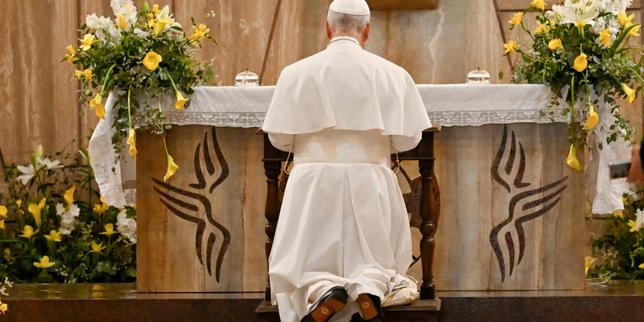
The upcoming state visit of Pope Francis to France, scheduled for September 25 to 28, represents a calculated convergence of diplomatic protocol and strategic signaling rather than a mere pastoral tour. While standard media narratives frame papal travel through the lens of religious sentiment or generalized international relations, a structural analysis reveals a complex matrix of institutional objectives. The Vatican and the French Republic are navigating a dual-track agenda defined by bilateral state-level diplomacy and internal European social policy. Understanding the true impact of this four-day visit requires breaking down the event into its component operational, political, and symbolic variables.
The Tri-Centric Framework of Papal Diplomacy
Papal international deployment operates under a distinct structural model that separates the Bishop of Rome's functions into three distinct vectors: sovereign state diplomacy, pastoral governance, and public-facing multi-lateral engagement. The September itinerary in France activates all three vectors simultaneously, creating a highly dense operational environment. For a different perspective, consider: this related article.
The Sovereign Track: State-to-State Mechanics
The core of the September 25–28 timeline is anchored in official state-level interactions. Unlike purely pastoral visits, a designated state visit triggers specific diplomatic protocols under international law, positioning the Pope strictly as the Head of State of the Holy See.
The primary mechanism here is the bilateral meeting between the Roman Pontiff and the French Head of State. This channel addresses specific geopolitical friction points, including: Further coverage regarding this has been shared by NPR.
- Mediterranean Migration Policy: The Holy See consistently advocates for coordinated European integration and humanitarian corridors, contrasting with the increasingly restrictive legislative frameworks debated within the French National Assembly.
- European Security Architecture: The dialogue serves as a strategic node for backchannel diplomacy regarding Eastern European stability and conflict resolution frameworks, where the Vatican maintains a stance of active neutrality.
- Institutional Secularism (Laïcité): The visit forces an operational calibration of France's strict legal definition of secularism, balancing state neutrality with the public hosting of a religious monarch.
The Pastoral and Civil Track
Simultaneously, the itinerary integrates public events designed to interface with French civil society and the domestic Catholic infrastructure. The logistical deployment across major urban centers serves to measure and catalyze institutional alignment within the French church, which has faced structural headwinds, including declining demographic participation and internal ideological polarization.
The Bilateral Friction Points: A Strategic Vector Analysis
The timing of the Vatican state visit intersects with critical legislative and social inflection points within France. Rather than a period of passive consensus, the four-day window acts as a crucible for several unresolved policy debates.
[Vatican Diplomatic Core Priorities] ──> Friction Point: Bioethics & End-of-Life Legislation <── [French Executive Agenda]
[Vatican Migrant Integration Model] ──> Friction Point: Border Controls & EU Quotas       <── [French Domestic Policy]
The first structural tension lies in bioethics. The French executive branch has systematically moved toward modifying legal frameworks surrounding end-of-life care, specifically debating the legalization of assisted dying. The Holy See operates under a rigid theological doctrine regarding the inviolability of human life. The state visit functions as a high-leverage lobbying window, where the Papacy utilizes its public platform to alter the political cost function for French legislators considering the bill.
The second friction point is the management of Mediterranean migration. The Vatican has positioned the Mediterranean basin not as a border to be policed, but as a shared cultural and humanitarian space. France's domestic political equilibrium, however, demands stringent border management and security protocols. The public addresses delivered during the visit will inevitably force a rhetorical confrontation between global humanitarian imperatives and localized nation-state security strategies.
Operational Logistics and Security Metrics
Executing a four-day state visit involving a global figure requires a massive mobilization of state resources, presenting a significant logistical optimization problem. The operational footprint spans multiple ministries, primarily the Ministry of the Interior and the Ministry of Foreign Affairs.
The security apparatus must manage two distinct risk profiles: asymmetric physical threats against a high-profile sovereign and large-scale public order management during mass gatherings.
- Zone Isolation: Implementing temporary exclusion zones (ZIT) and restricted airspace protocols across the host cities.
- Personnel Allocation: Mobilizing specialized units (including the GIGN and CRS) alongside municipal law enforcement, estimated to require thousands of active-duty personnel per day.
- Crowd Dynamics: Calibrating mass transport infrastructure to handle sudden, localized surges in commuter volume during public mass events without disrupting urban economic activity.
The economic cost of this deployment is borne directly by the host state's public treasury, justified under the principle of reciprocity governing international state visits. This expenditure represents a concrete investment by the French state to maintain its status as a premier diplomatic hub capable of hosting complex, multi-lateral events.
The Long-Term Geopolitical Forecast
The outcomes of the September 25–28 state visit will not be measured in immediate policy shifts, but in subtle alignments within European diplomatic circles. The Holy See is actively seeking to solidify a Western European coalition that supports its multi-polar view of global governance, particularly as international institutions face systemic gridlock.
France gains a distinct tactical advantage by positioning itself as the primary interlocutor between the Vatican and the broader European Union framework. By hosting the Pope in a formal state capacity, the French executive reinforces its historical role as a bridge between traditional European cultural identity and modern, secular governance models.
The success of the visit depends on the prevention of rhetorical miscalculations that could inflame domestic political factions. If the executive branch successfully navigates the protocol requirements without alienating secular voters, while the Vatican successfully projects its core moral imperatives without triggering a diplomatic rift, the event will validate the utility of traditional statecraft in an era dominated by digital and asymmetric international relations. The strategic move for observers is to look past the ceremonial optics and track the subsequent legislative adjustments in the French parliament regarding bioethics and immigration in the final quarter of the year.