When religious institutions project authority into secular geopolitical crises, the resulting mobilization follows predictable mechanics of signaling, institutional survival, and resource allocation. The convergence of Catholic clergy, religious orders, and lay advocates toward diplomatic centers represents a specialized form of influence operations. This phenomenon requires an analytical breakdown of how moral capital is converted into political leverage, the structural limitations of faith-based advocacy in active conflict zones, and the systemic feedback loops that govern institutional positioning during asymmetrical warfare.
The Mechanics of Moral Signaling
To understand why clergy and religious orders mobilize public demonstrations regarding high-intensity conflicts, one must examine the utility of moral capital. Institutional bodies operating under protracted conflict conditions face a severe information asymmetry. Military combatants control physical access, operational data, and tactical pacing. In contrast, moral institutions control narrative legitimacy.
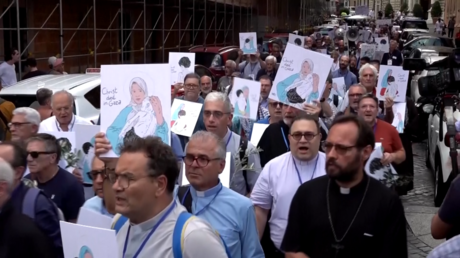
The mobilization of Catholic priests and nuns toward diplomatic hubs functions as an institutional signal designed to alter the transaction costs of political actors. When individuals bound by lifelong vows of obedience and celibacy occupy public spaces near sovereign administrative centers, they alter the calculus of state security forces and diplomatic gatekeepers.
- Visibility Arbitrage: Clerical garb and religious insignia lower the friction of media capture. They provide instant visual shorthand for non-partisan human suffering, bypassing the ideological filtering that typically accompanies secular activist movements.
- Asymmetric Deterrence: State actors incur higher reputational costs when dispersing or ignoring peaceful religious actors compared to secular political protestors. The intervention disrupts the state's preferred narrative framing by introducing an absolute ethical vocabulary into a relative strategic dispute.
- Internal Cohesion Maintenance: Beyond external influence, these demonstrations serve an internal regulatory function. Transnational religious hierarchies must manage ideological divergence among global constituencies. Public witness campaigns solidify institutional identity and align disparate regional factions around a unified operational stance.
The Structural Limits of Religious Mediation
Despite the high visibility of moral marches, the efficacy of faith-based diplomacy is bounded by strict structural constraints. Political science frameworks demonstrate that moral arguments rarely override hard security imperatives unless paired with material leverage.
The primary limitation lies in the absence of enforcement mechanisms. Religious institutions lack economic sanctions, military deterrence, and legislative authority. Consequently, their diplomatic interventions are restricted to agenda-setting and normative pressure.
- The Credibility Dilemma: When ecclesiastical bodies critique military strategies without commanding physical security solutions, target states categorize their input as non-actionable rhetoric. The strategic value of the intervention drops precipitously once the initial media cycle concludes.
- The Neutrality Paradox: To maintain credibility across fractured populations, moral actors must project absolute neutrality. However, taking a definitive stance on specific territorial conflicts or sovereignty disputes compromises that neutrality, reducing the institution's long-term utility as a backchannel mediator.
- Resource Misallocation: Mobilizing personnel for symbolic marches diverts administrative bandwidth from direct humanitarian relief operations. While public signaling generates immediate narrative attention, it consumes logistical capacity that could otherwise support field hospitals, refugee processing, or direct material aid distribution.
Strategic Allocation of Institutional Influence
Evaluating the long-term impact of clerical advocacy requires shifting focus from immediate media coverage to institutional positioning. Religious orders operate on multi-decadal time horizons, contrasting sharply with the short-term tactical cycles of state actors.
The strategic play for transnational religious bodies during regional conflicts involves hedging against regime transitions and preserving operational access across hostile borders. Public marches directed at supreme administrative bodies—such as Vatican-adjacent demonstrations—are rarely designed to alter immediate battlefield dynamics. Instead, they function as preemptive compliance measures to satisfy internal reform constituencies and maintain moral standing among global youth demographics.
When institutional leadership fails to sanction or visibly participate in such advocacy, it risks alienating progressive donor bases and younger clergy. Conversely, active participation carries the risk of diplomatic retaliation from state actors who view religious dissent as foreign interference. Navigating this tension requires precise calibration of public visibility against quiet, backchannel diplomatic engagement.
Strategic Forecast
Institutional moral advocacy will increasingly face diminishing returns in hyper-polarized media ecosystems. As state actors develop more sophisticated methods for narrative management and information control, traditional public demonstrations lose their comparative advantage. Future influence operations by religious bodies will transition away from physical street-level mobilization toward targeted institutional divestment, digital network coordination, and localized humanitarian infrastructure hardening. The efficacy of moral authority will no longer be measured by the scale of a march in a capital city, but by the resilience of the logistical networks maintained in the theater of conflict.