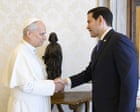
The meeting between US Secretary of State Marco Rubio and Pope Leo represents a calculated pivot in the bilateral architecture between Washington and the Holy See, moving beyond the reactionary damage control necessitated by previous rhetorical friction. This engagement functions as a strategic recalibration where ideological divergence is subordinated to functional alignment on three specific geopolitical theaters: the migration corridors of the Western Hemisphere, the preservation of religious liberty in authoritarian regimes, and the stabilization of the Middle Eastern security apparatus.
While media narratives often frame such encounters as "tension-easing" or "olive branches," a cold analysis reveals a more mechanical objective. The United States and the Vatican operate as the world’s two most expansive soft-power entities. When their messaging de-synchronizes, the friction cost manifests as diplomatic inefficiency in multilateral forums. Rubio’s objective was not merely to apologize for past political vitriol but to re-establish the Vatican as a strategic interlocutor for the current administration's foreign policy goals.
The Tripartite Framework of US Vatican Engagement
To understand the substance of this summit, one must analyze the interaction through three distinct logical layers: the Humanitarian Logistics Layer, the Moral Authority Layer, and the Internal Political Utility Layer.
1. The Humanitarian Logistics Layer
The Vatican maintains a ground-level infrastructure through Catholic Charities and diocesan networks that no secular government can replicate. In the context of Western Hemisphere migration, the Holy See functions as a non-state intelligence and logistics provider.
- Intelligence Gathering: Parishes across Central America provide real-time data on migration drivers—economic shifts, cartel violence, and crop failures—often before these trends register in official State Department cables.
- Logistical Buffer: Church-run shelters act as stabilizers. When the US seeks to "externalize" its borders by encouraging regional partners to manage flow, the Church’s cooperation is the friction-reducing agent.
Rubio’s dialogue with Pope Leo likely prioritized the synchronization of these networks. If the US administration intends to implement more rigorous enforcement, it requires the Vatican’s tacit cooperation to maintain the "human dignity" baseline that prevents international condemnation. Disagreement on the ethics of a border wall is secondary to the functional necessity of managing the people currently in transit.
2. The Moral Authority Layer
The Vatican’s unique status as a sovereign entity with a global, non-national constituency allows it to provide "moral cover" for complex diplomatic maneuvers. For a Republican administration often criticized for "America First" unilateralism, alignment with the Pope offers a veneer of multilateral legitimacy.
The specific mechanism at play here is Normative Arbitrage. By finding common ground on a single issue—such as the persecution of religious minorities in East Asia or the Middle East—the administration can project its foreign policy as a moral crusade rather than a quest for hegemony. Rubio, a practicing Catholic, serves as the ideal conduit for this arbitrage. His presence validates the administration to the global Catholic community, while his hawkish foreign policy credentials signal to the Vatican that the US remains the primary enforcer of the international order they both inhabit.
3. The Internal Political Utility Layer
Domestically, the Rubio-Pope Leo summit targets the "Median Catholic Voter" in the United States. This demographic is not monolithic; it contains a significant tension between traditionalist wings and social-justice-oriented wings.
- The Catholic Swing Factor: In key battleground states, the Catholic vote often mirrors the national outcome.
- The Rhetoric Gap: Trump’s previous criticisms of the Pope created a liability among moderate Catholics. Rubio’s visit serves as a corrective measure to close this gap before the next electoral cycle.
The Mechanics of Reconciling Incompatible Worldviews
A fundamental friction exists between the Vatican’s "Culture of Encounter"—which emphasizes dialogue even with adversarial regimes—and the US State Department’s "Integrated Deterrence" model. These two systems are theoretically at odds, yet they can be made to interlock through Compartmentalized Diplomacy.
The China Bottleneck
The most significant test of this realignment is the Holy See-China Provisional Agreement on the Appointment of Bishops. The US view, championed by Rubio in his legislative history, typically treats China as a systemic rival. The Vatican treats China as a mission territory requiring compromise for survival.
This creates a structural bottleneck. The US wants the Vatican to be a louder critic of human rights abuses in Xinjiang and Hong Kong. The Vatican wants the US to lower the temperature to avoid a crackdown on the underground church. The "Rubio Solution" involves a trade-off: the US tempers its public criticism of the Vatican’s China policy in exchange for the Vatican increasing its advocacy for religious freedom in other theaters, such as Nicaragua or Venezuela, where their interests more naturally align.
The Venezuelan Case Study
Venezuela provides a clear example of where the cause-and-effect relationship of this partnership bears fruit. The Vatican has a long history of attempted mediation in Caracas. While these efforts have frequently stalled, they provide the US with a "back channel" to the Maduro regime that avoids the political cost of direct negotiation. Rubio, given his intense focus on Latin American policy, recognizes that the Vatican can deliver messages that a US diplomat cannot.
Quantifying the Soft Power Dividend
The efficacy of this summit can be measured by the "Delta of Divergence" in subsequent public statements. If, over the next six months, the Holy See’s rhetoric on US border policy softens, or if the US State Department begins to adopt "Human Dignity" language in its Latin American policy briefings, the summit will have achieved its functional goal.
This is not about a change in heart; it is about a change in Operational Synchronicity. The cost of being at odds with the Pope is high for a US administration seeking to lead a coalition of "values-based" democracies. By neutralizing the Vatican as a critic, the US effectively removes a major obstacle to its moral leadership on the world stage.
Strategic Risks and Structural Limitations
No diplomatic realignment is without its failure points. Two primary risks threaten the stability of the Rubio-Leo accord:
- The Populist Volatility Factor: Should the executive branch revert to direct, personal attacks on the Pontiff via social media or campaign rallies, the work of the State Department is instantly liquidated. The Vatican operates on a timescale of centuries; US political cycles operate on four-year bursts. This temporal mismatch makes any agreement inherently fragile.
- The Doctrinal Hardline: If the Pope leans further into critiques of "unbridled capitalism"—a core tenet of the US economic model—the ideological gulf may become too wide for even a skilled diplomat like Rubio to bridge. The Vatican’s shift toward the Global South means its priorities are increasingly detached from the concerns of the North Atlantic security bloc.
The Recommended Path Forward: Tactical Multilateralism
The United States should not seek a total ideological merger with the Holy See, as such an attempt would be transparently political and ultimately self-defeating. Instead, the administration must pursue a strategy of Tactical Multilateralism.
The State Department should establish a permanent, sub-cabinet level working group focused specifically on "Joint Humanitarian Stabilization." This group would move beyond the high-level pageantry of Rubio-type summits and focus on the granular data-sharing required to manage migration and religious persecution.
By formalizing the relationship at the bureaucratic level, the US can insulate the partnership from the volatility of individual leaders. The goal is to transform the US-Vatican relationship from a series of "damage control" events into a reliable, functional utility for global influence. The Rubio-Leo meeting is the first movement toward this institutionalization, but its success depends entirely on the transition from optics to operational integration.