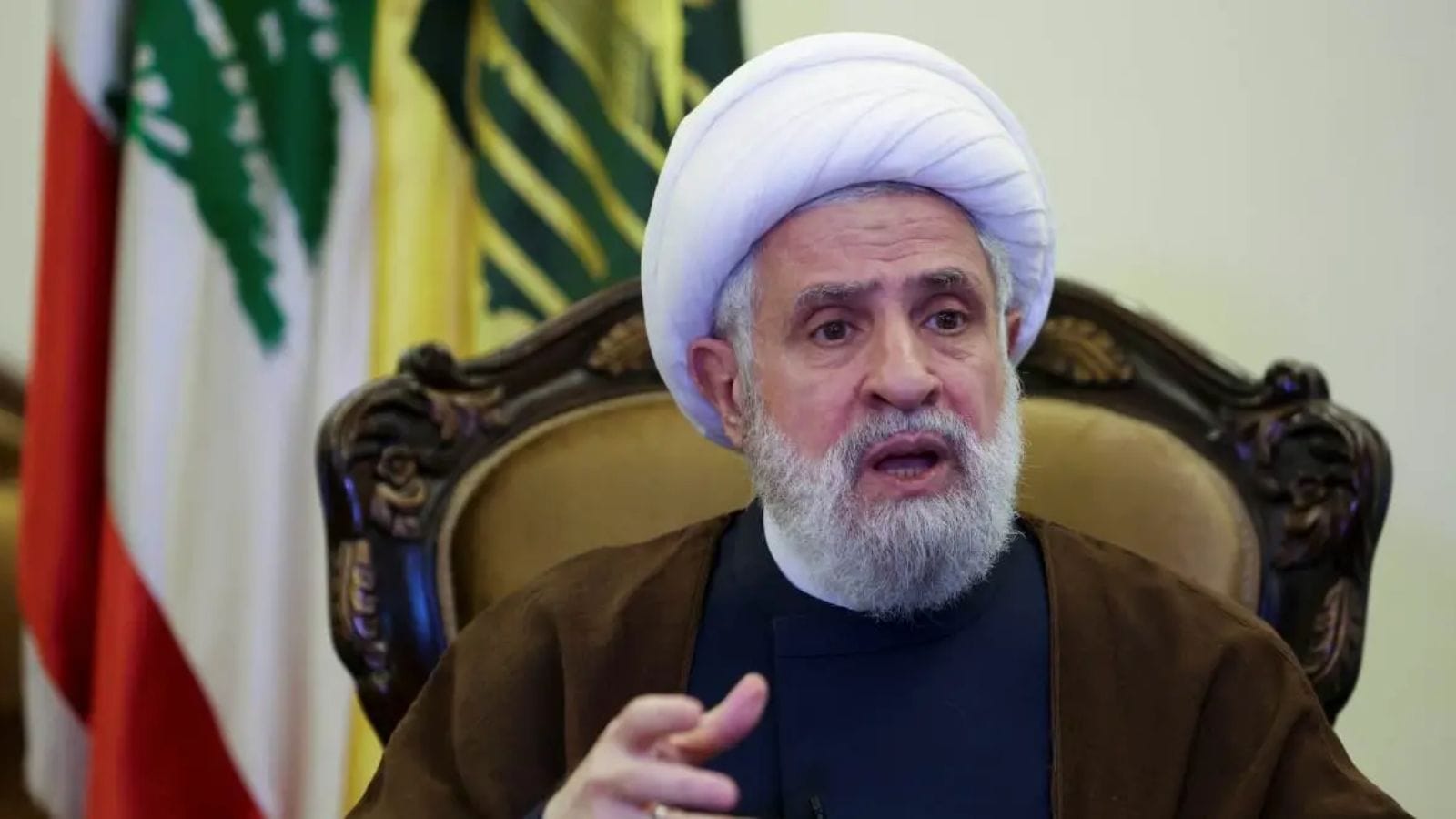
The call for Lebanon to terminate planned negotiations with Israel regarding maritime borders or security arrangements is not a mere rhetorical flourish; it is a calculated move to preserve a specific asymmetrical power dynamic. When Hezbollah’s leadership demands the cessation of talks, they are applying a strategic veto designed to ensure that the Lebanese state remains unable to formalize its own external relations. This obstruction serves a singular objective: maintaining the "Open Front" doctrine, which requires that Lebanon's borders remain undefined and contested to justify the existence of an autonomous paramilitary force.
The Tripartite Framework of Hezbollah’s Veto Power
To understand why a non-state actor can successfully demand the cancellation of sovereign state diplomacy, one must examine the three structural pillars that Hezbollah utilizes to paralyze the Lebanese decision-making apparatus.
1. The Sovereignty Gap
The Lebanese state operates under a fragmented executive authority. By threatening the legitimacy of any delegation sent to negotiate, Hezbollah exploits the lack of a unified national defense strategy. When the group labels negotiations as "capitulation" or "treason," it effectively raises the political cost for any secular or rival sectarian leader to a level that threatens their internal stability. The goal is to ensure that the state cannot claim the exclusive right to define its borders.
2. The Narrative of Constant Belligerence
Negotiations, by their nature, imply a transition from a state of conflict to a state of regulated dispute resolution. For Hezbollah, a finalized border—whether maritime or terrestrial—is a strategic liability. A defined border creates a legal "red line" that, if crossed, carries specific international law implications for the state. By keeping the borders in a state of flux, Hezbollah maintains a "gray zone" where kinetic operations can be conducted without triggering a formal state-to-state war declaration, yet providing enough friction to keep the central government weak.
3. Regional Alignment and Proxy Utility
The timing of these calls for cancellation rarely correlates with Lebanese domestic needs. Instead, they align with the broader strategic requirements of the "Axis of Resistance." If a regional patron requires increased pressure on Israel or a distraction from other theaters (such as Syria or Yemen), Hezbollah uses the potential for Lebanese-Israeli diplomacy as a bargaining chip. Canceling talks is a signal to international mediators that no deal in the Levant can bypass the paramilitary structure.
The Economic Cost Function of Diplomatic Paralysis
The refusal to negotiate has quantifiable impacts on Lebanon’s devastated economy, specifically concerning the Levantine Basin’s hydrocarbon reserves. The "Cost of Non-Agreement" can be broken down into three primary variables:
- The Risk Premium on Foreign Direct Investment (FDI): International energy firms (e.g., TotalEnergies, Eni, QatarEnergy) operate on long-term capital expenditure cycles. A contested maritime zone is an uninsurable asset. By forcing the cancellation of talks, Hezbollah ensures that the "Geopolitical Risk Premium" remains high enough to deter the full-scale infrastructure investment required for extraction.
- Opportunity Cost of Delayed Revenue: Lebanon’s debt-to-GDP ratio requires immediate, high-volume revenue streams. Every year negotiations are stalled is a year of compounded interest on national debt without the offset of energy exports.
- Infrastructure Decay: Without a formal agreement, the "joint development" of straddling reservoirs is impossible. This leads to a "race to the bottom" where one side may drain shared resources more efficiently, leaving the paralyzed side with stranded assets.
The Mechanism of Internal Coercion
Hezbollah does not rely solely on its arsenal to prevent negotiations; it utilizes a sophisticated "Bureaucratic Chokepoint" strategy. This involves:
- Constitutional Ambiguity: Leveraging the requirement for "consensus" among sectarian leaders to block any cabinet-level decision that favors a diplomatic track.
- Information Warfare: Portraying technical maritime coordinates as a zero-sum ideological struggle. If a technical team suggests a compromise on "Line 23" vs "Line 29," the movement characterizes the shift as a surrender of "sacred soil/water," regardless of the geological or legal merit.
- Security Overhang: The implicit threat that any official who signs a deal could face the same fate as previous anti-Hezbollah figures. This creates a psychological barrier for the Lebanese negotiating team.
The Logic of the Unresolved Border
A resolved border is a prerequisite for a normalized state. Hezbollah’s foundational identity is rooted in "Resistance," a term that requires an active, unresolved grievance. If the maritime and land borders were finalized and recognized by the UN, the justification for a private army existing alongside a national army would evaporate in the eyes of the Lebanese public and the international community.
The second limitation of the Lebanese state is its inability to decouple its economic survival from Hezbollah’s security preferences. The group has successfully linked the two, arguing that "only the Resistance’s missiles" provide Lebanon with leverage at the negotiating table. This creates a circular logic: the state cannot negotiate without the threat of Hezbollah, but the presence of Hezbollah makes the negotiations unacceptable to the other side.
Strategic Forecast and the Deadlock Scenario
The call to cancel talks is a preemptive strike against the possibility of a "Stabilization Agreement." Such an agreement would likely include clauses regarding the cessation of hostilities, which would directly strip Hezbollah of its operational freedom.
The most probable outcome of this obstructionism is a "Controlled Escalation" cycle. In this scenario:
- Lebanon remains unable to tap into its offshore wealth.
- The Lebanese Armed Forces (LAF) remain underfunded and sidelined.
- The international community shifts its focus to more stable energy markets in the Eastern Mediterranean (Cyprus, Egypt, Israel), leaving Lebanon as a "skipped" node in the regional energy grid.
The structural reality is that as long as the veto power remains in the hands of a non-state actor with divergent interests from the national treasury, Lebanon will remain in a state of "Pre-Diplomatic Stasis." The cancellation of talks is not a defense of Lebanese rights; it is the protection of a specific organizational utility that thrives on the absence of a defined state.
For any future negotiations to succeed, the "Security vs. Economy" trade-off must be reframed. The Lebanese state must establish a "Technical Insulation Layer"—a negotiating body that is shielded from sectarian vetoes by international mandate or by a cross-sectarian consensus that prioritizes debt solvency over ideological purity. Failing this, the maritime assets will remain "Ghost Assets," existing on maps but never appearing on the national balance sheet.
The final strategic play involves the international community moving away from a "Whole of Government" approach to Lebanon and instead focusing on "Specific Asset Protection," where individual energy projects are ring-fenced by international security guarantees, effectively bypassing the paralyzed central administration. This, however, risks further eroding Lebanese sovereignty, playing directly into the cycle of state failure that the obstructionist strategy intends to perpetuate.