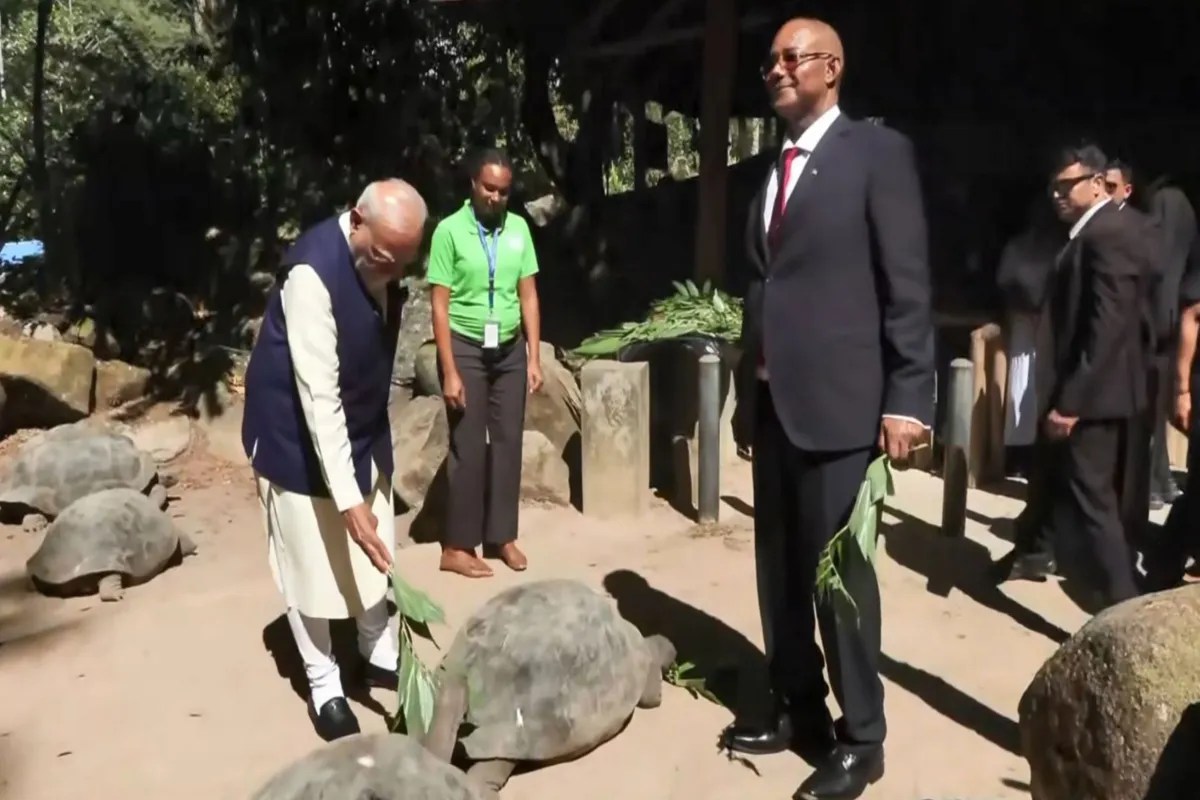
The intersection of state-level diplomacy and ecological anomalies often yields highly potent soft-power assets. When Indian Prime Minister Narendra Modi interacted with Jonathan—a Seychelles giant tortoise (Aldabrachelys gigantea) widely recognized as the world's oldest living terrestrial animal at an estimated 194 years of age—the event was frequently framed by popular media as a simple, heartwarming human-interest story. This superficial reading misses the underlying strategic architecture. In reality, the encounter operates at the nexus of two distinct vectors: the biomechanical realities of extreme chelonian longevity and the calculated deployment of ecological diplomacy within the contested maritime geography of the Western Indian Ocean.
Understanding this event requires breaking down the biological mechanisms that allow an organism to survive across three centuries, alongside the strategic imperatives that drive a nuclear-armed state to integrate a 190-kilogram reptile into its diplomatic itinerary.
The Biomechanical Architecture of Extreme Longevity
To evaluate the significance of an animal born circa 1832, one must first dismantle the cellular and metabolic frameworks that prevent the standard senescence seen in most vertebrates. Jonathan’s survival is not a biological miracle; it is the result of specific evolutionary adaptations optimized for resource-scarce, isolated island ecosystems.
Metabolic Efficiency and Thermal Regulation
The primary driver of chelonian longevity is a suppressed metabolic rate. The metabolic cost function of a giant tortoise operates on an inverse scale relative to smaller mammals. Because tortoises are ectothermic, they do not expend metabolic energy maintaining a constant internal body temperature.
- Energy Conservation: Jonathan's daily caloric requirement is a fraction of a mammal of equivalent mass. This low metabolic throughput directly correlates with reduced production of reactive oxygen species (ROS), which are primary agents of cellular damage and aging.
- Cellular Senescence Resistance: Research into giant tortoise genomes indicates an overrepresentation of genes linked to DNA repair, tumor suppression, and immune response. While mammalian cells hit the Hayflick limit and undergo apoptosis or become senescent (contributing to systemic inflammation), chelonian tissues exhibit a high tolerance for DNA damage, actively repairing double-strand breaks with greater fidelity over time.
The Island Gigantism Paradigm
Jonathan’s physical scale is a classic manifestation of island gigantism, an evolutionary trajectory occurring when a species is freed from predatory pressure and intense resource competition. In the Aldabra Atoll and surrounding southwestern Indian Ocean islands, the lack of large mammalian predators eliminated the need for agility or speed. Instead, evolution favored structural mass, a thick carapace for thermal inertia, and the capacity to survive months without food or water. This structural durability creates a highly resilient biological chassis that is naturally insulated against localized environmental shocks.
The Strategic Geography of Indian Ocean Diplomacy
The biological reality of Jonathan provides the backdrop for his role as a diplomatic instrument. While the competitor narrative places this encounter vaguely "in Seychelles," rigorous geographic and historical accuracy dictates a critical correction: Jonathan does not reside in Seychelles. He resides on the island of Saint Helena, a British Overseas Territory in the South Atlantic Ocean.
The analytical value of mapping this encounter lies not in accepting a flawed geographical premise, but in deconstructing how India leverages soft-power assets across small island developing states (SIDS) spanning both the Indian and Atlantic Oceans to secure critical maritime choke points.
The Indian Ocean Architecture
India's maritime strategy relies on the SAGAR doctrine (Security and Growth for All in the Region). Within this framework, island nations like Seychelles, Mauritius, and Comoros are not peripheral actors; they are foundational nodes for maritime domain awareness.
[India's Maritime Core]
       │
       ├─► Strategic Infrastructure (Assumption Island, Seychelles)
       ├─► Maritime Domain Awareness (Coastal Radar Networks)
       └─► Soft-Power Assets (Ecological & Historical Diplomacy)
The execution of ecological diplomacy—such as interacting with iconic fauna or gifting strategic assets—serves a distinct tri-focal purpose.
The Three Pillars of Ecological Statecraft
- Asymmetric Value Alignment: Traditional diplomacy relies on economic aid or military hardware. While effective, these transactions can create friction regarding sovereignty. Ecological statecraft, by contrast, focuses on shared heritage and conservation, building a neutral layer of goodwill that smooths the way for harder security negotiations.
- The Continuity Metric: By aligning a diplomatic visit with an organism that has survived since the colonial era, a state projects an image of long-term stability and permanence. It shifts the perception of bilateral relations from short-term transactional agreements to multi-generational alliances.
- Public Diplomacy Optimization: High-density visual imagery of a head of state feeding a historic animal commands immediate international media real estate. This displaces or softens harder narratives concerning military installations, radar networks, or exclusive economic zone (EEZ) patrol rights.
The Operational Reality of State Visits to Isolated Ecosystems
When a head of state engages with a critically managed biological asset, the operational parameters are governed by strict biosecurity and veterinary protocols. The logistical execution of these interactions reveals a calculated balance between public relations and ecological risk management.
Biosecurity Protocol Barriers
Introducing external pathogens to an ancient, isolated organism poses a severe existential threat. Jonathan, currently blind from cataracts and lacking a sense of smell, relies entirely on acoustic cues and tactile feedback.
- Dietary Standardization: The act of hand-feeding must be strictly curated by resident veterinary officers. Jonathan’s diet is highly calibrated—consisting of apples, carrots, cucumbers, bananas, and guava—to compensate for his inability to forage effectively due to a worn beak. External handlers must conform to strict sanitation standards to prevent the introduction of invasive microflora.
- Stress Mitigation: Large-scale diplomatic delegations generate significant acoustic pollution. Managing the proximity of security detail, media pools, and official personnel is essential to prevent triggering a cortisol spike in the animal, which could destabilize his fragile metabolic equilibrium.
The Friction of Misattributed Geography
The misattribution of Jonathan’s location to Seychelles highlights a deeper systemic vulnerability in modern digital media ecosystems: the rapid propagation of unverified geographic data. Jonathan was transported from Seychelles to Saint Helena in 1882 as a gift to the governor.
The analytical breakdown of this error reveals how regional soft-power narratives can become conflated. Because India maintains deep strategic interests in the Seychelles—specifically the development of military facilities on Assumption Island to counter regional rivals—public memory frequently blends Indian Ocean diplomatic initiatives with prominent symbols of island conservation, even if those symbols reside thousands of miles away in the Atlantic.
Operational Risk Matrix of Ecological Diplomatic Engagements
| Risk Vector | Potential Impact | Mitigation Strategy |
|---|---|---|
| Pathogen Transmission | Zoonotic infection leading to rapid decline of a unique biological asset. | Strict quarantine of touch zones; mandatory use of medical-grade hand sanitization by the primary principal. |
| Physical Trauma | Accidental injury to the handler or the animal during close-quarters feeding. | Use of long-stemmed nutritional vectors; positioning of professional veterinary staff within a sub-two-second intervention radius. |
| Geopolitical Misalignment | Association with colonial-era symbols or disputed territories generating regional friction. | Precise narrative framing emphasizing global conservation and shared ecological stewardship over historical ownership. |
Implementing High-Yield Soft Power Initiatives
For states seeking to replicate the high-impact, low-risk returns of ecological diplomacy, the strategy cannot rely on random encounters with local fauna. It requires a systematic framework.
Phase 1: Asset Identification and Mapping
Identify unique ecological or historical assets within the target state that possess high global recognition or deep intrinsic cultural value. These assets must be vetted for political neutrality to ensure that engagement does not inadvertently trigger localized ethnic or partisan sensitivities.
Phase 2: Protocol Integration
Coordinate directly with local conservation authorities rather than standard diplomatic channels. This moves the interaction out of the realm of political theater and elevates it to an act of international scientific solidarity. The principal's briefing materials must prioritize the biomechanical and conservation realities of the asset over mere optics.
Phase 3: Narrative Scaling
Deploy the imagery across asymmetric media channels. The primary focus should not be the political figure, but rather the preservation of the asset, thereby positioning the visiting nation as a responsible custodian of global natural heritage. This subtle alignment yields sustainable diplomatic capital that outlasts election cycles and shifts in regional military balances.
The strategic leverage gained from these encounters is directly proportional to the seriousness with which the host nation's ecological assets are treated. By treating an ancient organism not as a prop, but as a living monument of evolutionary resilience, a state signals its capacity for long-term thinking, a vital trait when negotiating decades-long maritime security pacts or infrastructural access rights in critical global waterways.