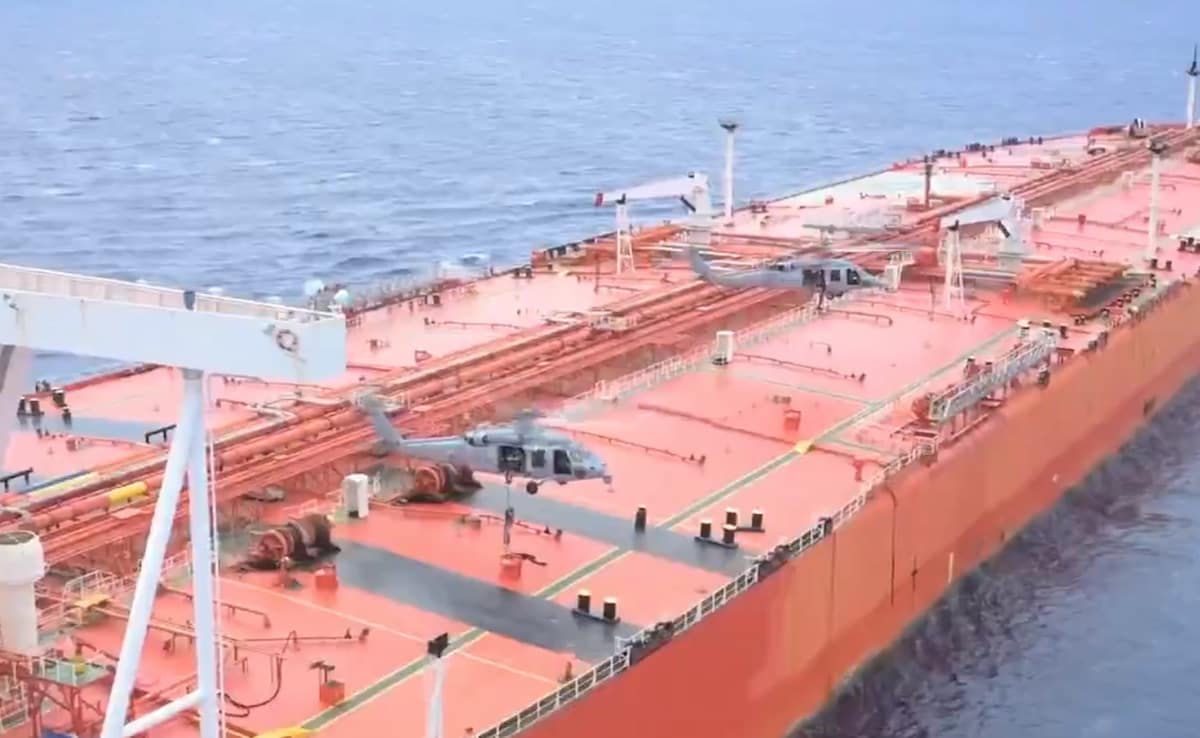
The seizure of oil tankers in the Persian Gulf and the Gulf of Oman is not a series of isolated criminal acts but a sophisticated form of state-sponsored geopolitical arbitrage. When Iran characterizes U.S. actions as "piracy" and "plunder," it is employing a deliberate rhetorical inversion designed to mask a mechanical tit-for-tat strategy. This cycle operates on a logic of calibrated escalation where maritime assets are treated as liquid collateral for frozen financial accounts and seized physical inventories.
The current friction centers on the enforcement of the International Emergency Economic Powers Act (IEEPA). Under this framework, the U.S. Department of Justice (DOJ) targets vessels carrying Iranian petroleum products destined for sanctioned entities. When a vessel like the Suez Rajan (later renamed St. Nikolas) is diverted by U.S. authorities, it triggers a predictable Iranian kinetic response. This is the Feedback Loop of Asset Reciprocation: for every barrel of crude seized by Western legal mandates, a corresponding barrel is detained via IRGC (Islamic Revolutionary Guard Corps) maritime operations.
The Mechanics of Maritime Tit-for-Tat
The operational cycle follows a distinct three-phase progression that dictates how both state actors interact within the contested waters of the Strait of Hormuz.
- Legal Justification and Asset Interception: The U.S. utilizes civil forfeiture laws to seize Iranian oil, often citing the funding of designated terrorist organizations. This process relies on satellite telemetry and financial tracking to identify "ghost" tankers—vessels that have disabled their Automatic Identification Systems (AIS).
- Rhetorical Reprogramming: Iran responds by labeling the seizure "piracy." This is a calculated attempt to challenge the legitimacy of extraterritorial jurisdiction. By using terms like "plunder," Tehran seeks to shift the narrative from sanctions enforcement to a violation of international maritime law (UNCLOS).
- Kinetic Reciprocation: Within weeks of a U.S. seizure, the IRGC typically intercepts a vessel of equivalent value or strategic importance to Western interests. This is not random; it is a forced balancing of the ledger.
Strategic Asymmetry in Sanctions Enforcement
The disparity between U.S. and Iranian methodologies reveals a fundamental asymmetry in how power is projected. The U.S. leverages a global financial and legal infrastructure, effectively turning the international banking system into a blockade. Iran, lacking that systemic reach, relies on geographic proximity to one of the world's most vital energy arteries.
This creates a Cost Function of Transit. Shipping companies operating in the region must now calculate a "geopolitical premium" that exceeds standard insurance and fuel costs. This premium includes:
- Insurance Hardening: War risk premiums for the Persian Gulf fluctuate based on the frequency of IRGC boardings. When a tanker is seized, the cost to insure a fleet for a single transit can spike by double-digit percentages.
- Operational Latency: Vessels are increasingly forced to take circuitous routes or wait for naval escorts, increasing the "days at sea" metric and reducing the overall efficiency of global supply chains.
- Asset Depreciation: Prolonged detention of a tanker leads to mechanical degradation and cargo spoilage, particularly if the heated crude oil cools and solidifies in the tanks.
The Logic of the Pirate Label
Iran’s use of the term "pirate" against the U.S. serves a specific functional purpose in its foreign policy. Under the United Nations Convention on the Law of the Sea (UNCLOS), piracy is defined as an act for private ends. By accusing the U.S. of piracy, Iran is making the legal argument that U.S. sanctions enforcement is not a legitimate state action but an extra-legal theft of sovereign resources.
This creates a Sovereignty Paradox. The U.S. views the seizure of Iranian oil as the enforcement of domestic law on a global scale to prevent regional destabilization. Iran views the same act as a violation of the high seas' freedom. Both sides use the language of "international law" to justify diametrically opposed kinetic actions.
Quantifying the Impact on Global Energy Flows
Approximately 20% of the world’s petroleum—nearly 21 million barrels per day—passes through the Strait of Hormuz. The disruption of even a single Ultra Large Crude Carrier (ULCC) has ripple effects through the spot markets in London and Singapore.
The Iranian strategy is to demonstrate that the cost of U.S. sanctions is not borne by Tehran alone, but by the global energy market. When the Advantage Sweet or the Niovi were seized, the immediate intent was to create a "risk-off" environment for any company considering the transport of Iranian crude under U.S. warrants.
This is Deterrence by Cost-Imposition. If the risk of losing an entire vessel outweighs the profit of cooperating with U.S. forfeiture orders, shipping firms will eventually refuse to comply with Western legal directives, effectively neutralizing the sanctions.
The Failure of Traditional Maritime Security Models
Standard naval presence—such as the International Maritime Security Construct (IMSC)—often fails to prevent these seizures because of the "gray zone" nature of the conflict. The IRGC does not typically engage in high-intensity naval warfare; instead, they utilize fast-attack craft to board vessels in Iranian territorial waters or under the guise of "safety inspections."
A traditional destroyer or frigate is an oversized tool for these interactions. The bottleneck in maritime security here is not firepower, but Reaction Window. By the time a Western naval asset identifies a boarding attempt, the targeted tanker is often already under the control of IRGC personnel and moving toward Iranian waters.
Structural Bottlenecks in Diplomacy
The escalation of tanker seizures is a direct byproduct of the collapse of the Joint Comprehensive Plan of Action (JCPOA). Without a functional diplomatic framework to manage financial disputes, both nations have defaulted to Commodity-Based Diplomacy.
In this environment, oil is no longer just an energy source; it is a medium of exchange for political leverage. This shift has three primary consequences:
- De-linking of Commercial and Political Risk: Companies can no longer rely on standard risk assessments because the variables are controlled by state actors whose goals are non-commercial.
- Weaponization of Maritime Choke Points: The Strait of Hormuz is being transformed from a commercial highway into a tactical theater where every transit is a potential hostage situation.
- Normalization of State-Led Seizures: As these events become more frequent, the "shock value" diminishes, leading to a permanent increase in the baseline cost of global shipping.
The Shift Toward "Shadow Fleets"
To bypass the U.S. legal net, Iran has perfected the use of a "shadow fleet." These are vessels with opaque ownership structures, often registered in jurisdictions with lax oversight and utilizing fraudulent flags of convenience.
This creates a Visibility Gap. The U.S. must spend significant intelligence resources to link these vessels back to the National Iranian Oil Company (NIOC). Conversely, the IRGC has no such difficulty identifying Western-linked vessels, as the global shipping registry is largely transparent and public.
The growth of the shadow fleet introduces a secondary risk: environmental catastrophe. These vessels are often older, poorly maintained, and uninsured. A collision or spill in the Strait of Hormuz during a contested boarding would result in an ecological disaster that could shut down the strait for months, regardless of the political outcome.
Tactical Recommendations for Maritime Stakeholders
Shipowners and energy firms must move beyond passive monitoring. The current environment requires a shift in operational doctrine to mitigate the risks of state-led asset seizure.
- Telemetric Anonymization: While not a complete shield, reducing the digital footprint of a vessel during high-risk transits—by managing AIS broadcast intervals and utilizing encrypted communications—is now a baseline requirement.
- Legal Ring-Fencing: Cargo owners should utilize "Sanctions Clause" protections in charter parties that clearly define liability and insurance coverage in the event of state-ordered seizure versus criminal piracy.
- Naval Integration: Commercial operators must integrate their bridge operations more closely with the United Kingdom Maritime Trade Operations (UKMTO) and the U.S. 5th Fleet. This includes conducting drills specifically for "non-consensual boarding" scenarios.
The conflict in the Persian Gulf is not a misunderstanding; it is a disciplined exchange of economic and kinetic blows. As long as U.S. policy relies on the seizure of physical assets to enforce financial sanctions, Iran will continue to use its geographical position to exact a physical toll on global commerce. The strategic objective for observers is to recognize that the rhetoric of "piracy" is merely the soundtrack to a much more calculated game of asset management and sovereign defiance.