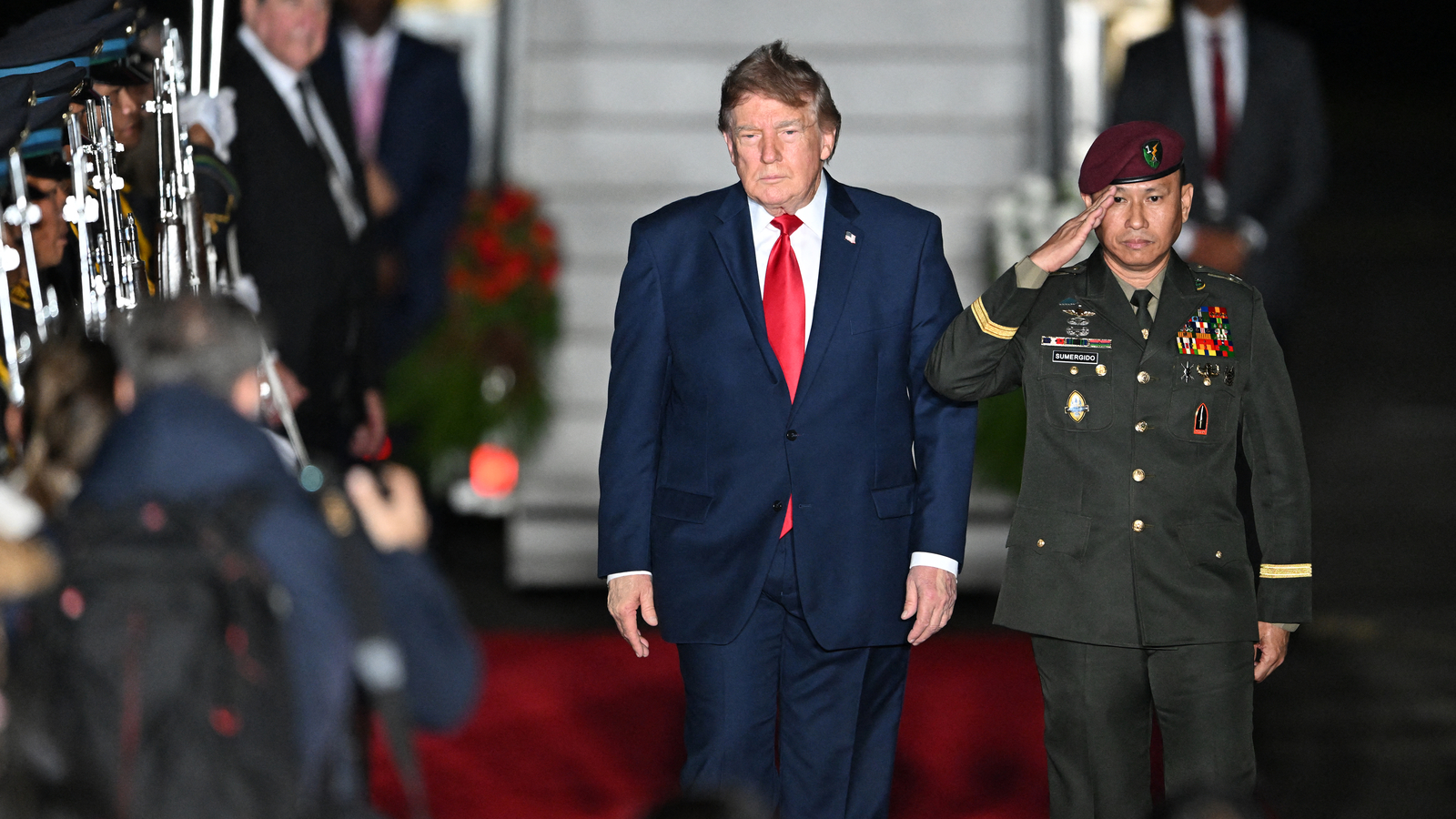
Sideline diplomacy at multilateral summits functions as a high-efficiency clearinghouse for strategic alignment, bypassing the consensus-driven bottlenecks of formal plenary sessions. When President Donald Trump convenes with Indian Prime Minister Narendra Modi, Japanese Prime Minister Sanae Takaichi, and Australian Prime Minister Anthony Albanese on the margins of the Association of Southeast Asian Nations (ASEAN) summit, the event represents far more than a photo opportunity or a routine diplomatic courtesy. This gathering is an operational stress test of the Quadrilateral Security Dialogue (the Quad) under shifting domestic political mandates and intensifying regional friction in the Indo-Pacific. To understand the true output of this meeting, analysts must look past standard diplomatic communiqués and examine the underlying power symmetries, transaction costs, and security architectures binding Washington, New Delhi, Tokyo, and Canberra.
Standard coverage of sideline meetings treats them as passive extensions of the host summit. In reality, a Quad leaders' meeting held on the periphery of ASEAN operates through a deliberate mechanism of institutional layering. ASEAN operates on the principle of non-interference and strict consensus, which structurally limits its capacity to issue forceful security directives regarding maritime coercion or supply chain weaponization. By convening inside the physical footprint of the ASEAN summit without subjugating their agenda to ASEAN’s veto players, the four Quad nations achieve two distinct objectives: You might also find this related article useful: Inside the Balochistan Media Blackout Nobody Is Talking About.
- Signaling Solidarity Without Formal Treaty Obligations: The Quad is not a mutual defense pact like NATO; it is a flexible strategic network. Meeting on the sidelines signals to Beijing and regional capitals that the coalition remains active and synchronized, even as leadership transitions occur in Washington and Tokyo.
- Reassuring Southeast Asian States: Holding the meeting alongside ASEAN demonstrates that the Quad does not seek to replace regional architecture, thereby lowering the diplomatic cost for Southeast Asian nations that rely on Chinese trade while quietly welcoming an American-led security counterbalance.
The Four-Actor Matrix and Competing Utility Functions
A rigorous assessment of this summit requires mapping the distinct domestic constraints and strategic incentives of each leader at the table. Diplomacy is never conducted in a vacuum; each executive brings a specific utility function dictated by domestic electoral pressures, economic vulnerabilities, and geographic proximity to regional flashpoints.
The United States and Transactional Bilateralism
The return of Donald Trump to the White House introduces a distinctly transactional calculus to American alliance management. Under previous administrations, the Quad was framed heavily around institutional public goods—vaccine distribution, climate resilience, and infrastructure financing. Trump’s foreign policy doctrine prioritizes burden-sharing, bilateral trade deficit reduction, and direct deterrence. As reported in recent coverage by The Guardian, the implications are notable.
For Washington, the primary utility of this meeting is recalibrating expectations. Trump’s team views the Indo-Pacific through the lens of great-power competition with China, specifically targeting trade imbalances and industrial overcapacity. The presence of Trump alongside Modi, Takaichi, and Albanese tests whether the Quad can survive a shift from multilateral institutionalism to hard-nosed transactional coordination. Washington’s objective is to secure tangible commitments on defense spending, critical mineral supply chains, and tariff alignment, using the Quad forum to extract bilateral concessions under a multilateral umbrella.
Japan and the Takaichi Doctrine
Sanae Takaichi’s tenure as Prime Minister of Japan marks a decisive consolidation of conservative, security-first policymaking in Tokyo. As a protégé of the late Shinzo Abe—the original architect of the "Free and Open Indo-Pacific" concept and the revived Quad—Takaichi views the coalition as the indispensable anchor of Japan’s national survival.
Japan faces the most acute immediate security threats among the four members, navigating daily maritime pressure around the Senkaku Islands, ballistic missile testing from North Korea, and the existential risk of a contingency in the Taiwan Strait. Takaichi’s primary strategic imperative at the ASEAN sidelines is containment of American isolationism. By locking Trump into a visible, high-level Quad engagement early in the diplomatic calendar, Tokyo seeks to institutionalize American presence in the Western Pacific and ensure that Washington’s focus on bilateral trade disputes does not fracture the broader security deterrent.
India and Strategic Autonomy Under Friction
Prime Minister Narendra Modi enters the meeting balancing deep structural alignment with the Quad against India’s foundational doctrine of strategic autonomy. New Delhi shares a contested Himalayan border with China and views Beijing’s expanding naval footprint in the Indian Ocean as a direct encroachment on its sphere of influence. Consequently, India relies on Quad partners for intelligence sharing, maritime domain awareness, and advanced defense technology transfers.
However, Modi’s utility function diverges sharply from Washington and Tokyo on economic and geopolitical alignment. India maintains robust energy and defense ties with Russia, resists binding multilateral trade agreements that threaten its domestic manufacturing protections, and avoids formal military alliances that could provoke a two-front crisis with China and Pakistan. At this sideline meeting, Modi’s objective is asymmetric optimization: maximizing access to Western capital, semiconductor supply chains, and maritime surveillance while insulating India from Trump’s aggressive tariff policies and avoiding entanglement in a potential conflict over Taiwan.
Australia and the Middle-Power Balancing Act
Prime Minister Anthony Albanese represents a middle power whose economic prosperity is structurally tied to Chinese commodity demand, while its national security is guaranteed by the United States through the ANZUS treaty and the AUKUS submarine partnership. Albanese’s government has spent significant diplomatic capital stabilizing trade relations with Beijing, lifting punitive tariffs on Australian wine, barley, and coal without conceding core security interests.
For Canberra, the Quad meeting is an exercise in calibrated deterrence. Australia requires the Quad to remain focused on non-military regional public goods—such as undersea cable security, Pacific Island infrastructure, and clean energy transitions—so that the grouping does not appear purely as an anti-China military bloc. Albanese’s goal is to keep the Quad palatable to ASEAN neighbors and Beijing, ensuring that regional tension remains below the threshold of economic coercion that previously cost Australian exporters billions of dollars.
The Structural Friction Points
When four nations with divergent economic profiles and threat perceptions coordinate, friction is inevitable. Observers who treat the Quad as a monolithic bloc miss the internal operational bottlenecks that limit its speed and scope.
- Trade Protectionism vs. Supply Chain Resilience: The core economic thesis of the Quad is "de-risking" critical supply chains—specifically semiconductors, rare earth elements, and pharmaceuticals—away from Chinese monopolies. Yet, Trump’s reliance on universal baseline tariffs and aggressive bilateral trade enforcement directly penalizes allies. If Washington imposes tariffs on Indian pharmaceuticals or Japanese steel while simultaneously demanding those nations decouple from cheap Chinese inputs, the economic math breaks down. A viable supply chain alternative requires preferential market access, not punitive border taxes.
- The Definition of Maritime Security: While all four nations endorse freedom of navigation in the South China Sea, their operational tolerances differ. Japan and the United States routinely conduct freedom of navigation operations (FONOPs) and joint military exercises that directly challenge Chinese maritime claims. Australia participates selectively, while India prefers to keep its naval deployments focused on the Malacca Strait and the Indian Ocean. Reaching consensus on joint maritime enforcement requires constant calibration to avoid exceeding New Delhi’s risk threshold.
- Institutional Bandwidth and Execution Lag: Sideline meetings generate high-level directives, but execution relies on bureaucratic working groups. Past Quad initiatives—such as the Quad Vaccine Partnership and the Indo-Pacific Partnership for Maritime Domain Awareness (IPMDA)—have suffered from implementation delays due to mismatched regulatory frameworks, procurement rules, and funding cycles across the four capitals. Without dedicated, streamlined funding mechanisms, sideline announcements risk remaining declarative rather than operational.
Operationalizing the Quad Agenda
To move beyond symbolic diplomacy, the leaders on the ASEAN sidelines must convert shared threat perceptions into concrete, self-reinforcing mechanisms. The success of this specific engagement hinges on three measurable operational domains where the interests of Trump, Modi, Takaichi, and Albanese intersect without triggering domestic political backlash.
1. Critical Minerals and Processing Cartels
China currently dominates the midstream processing and refining of rare earth elements, lithium, and cobalt—materials essential for defense systems, aerospace, and advanced electronics. Australia possesses vast upstream reserves of these raw materials; Japan and the United States possess the capital and refining technology; India offers a massive, scalable industrial base and domestic demand.
The actionable mechanism here is a Quad Critical Minerals Offtake Framework. Rather than relying on free-market pricing, which Beijing routinely manipulates by flooding the market to bankrupt Western competitors, the four governments can establish price floors, joint strategic stockpiles, and coordinated export credit financing. This aligns directly with Trump’s focus on resource security, Albanese’s desire to move Australia up the value chain from raw extraction to processing, and Takaichi’s mandate to insulate Japanese manufacturing from supply shocks.
2. Maritime Domain Awareness and Data Fusion
Direct naval confrontation carries high escalation risks, whereas persistent surveillance imposes asymmetric costs on grey-zone coercion. Beijing relies on its maritime militia and coast guard vessels to harass Philippine, Vietnamese, and Malaysian ships in the South China Sea, operating just below the threshold of conventional warfare.
Through the existing Indo-Pacific Partnership for Maritime Domain Awareness, the Quad can integrate commercial satellite imagery, radio-frequency data, and synthetic aperture radar into a unified, real-time tracking architecture. By distributing this fused intelligence directly to ASEAN coast guards and fisheries agencies, the Quad neutralizes China’s information advantage. This requires zero kinetic force, respects India’s preference for non-escalatory capacity building, and provides immediate utility to the Southeast Asian states hosting the summit.
3. Defense Industrial Co-Production
Historically, defense trade within the Quad flowed in one direction: from the United States to its allies. That model is no longer viable due to severe bottlenecks in the American defense industrial base, which is strained by munitions production for Europe and the Middle East.
The strategic solution is distributed co-production. Japan’s advanced manufacturing sector can co-produce interceptor missiles and naval components; India’s shipyards are already servicing US Navy vessels and can scale up maintenance, repair, and overhaul (MRO) operations for the entire region; Australia is integrating into the US-UK submarine industrial base. By standardizing technical specifications and relaxing export control barriers—such as the US International Traffic in Arms Regulations (ITAR)—the Quad turns its collective industrial capacity into a force multiplier. This directly satisfies Trump’s demand for allied burden-sharing by shifting manufacturing costs and labor onto capable partners.
Limitations of the Sideline Format
No diplomatic mechanism is without structural constraints. Analysts must account for the inherent limitations of conducting high-stakes strategy on the margins of a broader multilateral summit.
First, time compression restricts granular negotiation. Leaders meeting for sixty to ninety minutes between ASEAN plenary sessions cannot resolve complex technical disputes over intellectual property rights, tariff schedules, or rules of engagement. The sideline format is strictly an executive forcing function; it compels lower-level bureaucrats to clear administrative logjams ahead of the leaders' arrival, but it cannot substitute for sustained bilateral negotiation.
Second, the ASEAN host environment imposes diplomatic friction. ASEAN member states are deeply divided on how to manage the US-China rivalry. Countries like the Philippines welcome overt American and Quad deterrence, while states like Cambodia, Laos, and increasingly Malaysia and Indonesia remain cautious of any grouping perceived as an containment coalition. If the Quad leaders issue overly aggressive rhetoric while standing on ASEAN soil, they risk alienating the very regional partners they seek to court, pushing fence-sitting nations closer to Beijing’s diplomatic orbit.
Third, domestic political volatility creates commitment problems. Democratic systems undergo regular electoral cycles, and policy continuity is never guaranteed. A framework agreed upon at an ASEAN sideline meeting can be stalled by parliamentary gridlock in Tokyo, coalition friction in New Delhi, or abrupt executive shifts in Washington. Institutionalizing agreements through binding commercial contracts and joint military exercises is the only hedge against political turnover.
The Strategic Trajectory
The convergence of Donald Trump, Narendra Modi, Sanae Takaichi, and Anthony Albanese at the ASEAN sidelines signals that the Quad has successfully transitioned from a fragile diplomatic experiment into a permanent feature of Indo-Pacific statecraft. The grouping has survived leadership changes across all four capitals because its underlying driver is structural rather than ideological: no single nation in the region can independently balance the economic and military scale of a revisionist China.
Over the next twenty-four months, the Quad will shed its remaining multilateral softness and harden into a focused, functional mechanism centered on supply chain insulation, defense industrial integration, and maritime surveillance. Washington will continue to apply bilateral tariff pressure on Tokyo, New Delhi, and Canberra to extract trade concessions, creating persistent friction in the economic sphere. However, that economic friction will not fracture the strategic coalition. Instead, the four capitals will compartmentalize their disputes—fighting fiercely over bilateral trade balances in commercial channels while steadily integrating their intelligence, naval logistics, and critical mineral supply chains through the Quad architecture. Regional actors and corporate planners must operate on the assumption that technological and industrial bifurcation in the Indo-Pacific will accelerate, driven not by sweeping multilateral treaties, but by targeted, operational alignments forged in rooms exactly like this one.