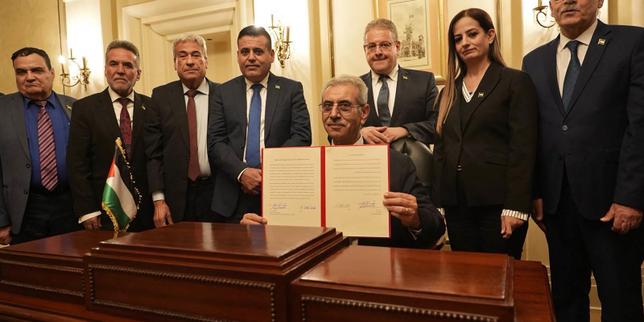
The National Committee for the Administration of Gaza (NCAG) is currently an executive body without an executive reality. Launched with significant diplomatic fanfare as part of an international peace framework authorized by UN Security Council Resolution 2803, the committee was designed to solve a seemingly intractable dilemma: how to govern and reconstruct a devastated Gaza Strip without handing authority to Hamas or relying on an un-reformed Palestinian Authority. Led by Chief Commissioner Ali Shaath and composed of independent technocrats, the panel remains largely marooned in Egypt, unable to establish a footprint inside the territory it is mandated to manage.
The primary cause of this paralysis is an unyielding operational impasse between the core security assumptions of the transitional framework and the realities controlled by the local actors on both sides of the border.
While initial consensus from regional backers in Cairo, Doha, and Ankara suggested a smooth handoff of civil service operations, the mechanism has stalled. The committee functions strictly under a civilian mandate focused on municipal governance, health care, education, and infrastructure recovery. It holds no independent security apparatus. Consequently, its entry and eventual efficacy depend entirely on a two-pronged compliance structure that currently does not exist.
On one side, the international blueprint calls for a complete disarmament of armed groups before major reconstruction funding can safely flow. On the other side, local security within the remaining enclave continues to be maintained by existing factions who refuse to disarm prior to a guaranteed, total external withdrawal.
This deadlock manifests directly at the border crossings. The technical and political approvals required to transition personnel, computers, and administrative assets into the Gaza Strip have been repeatedly delayed.
Israeli authorities have consistently linked physical access for the technocratic panel to verifiable progress on demilitarization and the establishment of an international stabilization force. Because the proposed international force has yet to deploy, the physical perimeter remains entirely militarized. The operational reality is that an administrative body cannot run schools, manage water networks, or direct electricity grids when it does not control the streets, the gates, or the funding mechanisms.
The Problem of Divided Authority
The internal structural design of the NCAG further complicates its mission. Conceived as an apolitical bridge, the committee operates completely outside the diplomatic framework of the Palestinian Authority (PA) based in Ramallah. This structural separation was intended to bypass the political stagnation within the broader Palestinian leadership, yet it strips the committee of established institutional legalities. The PA still holds the official administrative keys to civil registries, passport issuances, and public sector salary distributions that historical networks in Gaza rely upon.
By functioning as an isolated technocratic island under the distant supervision of an international oversight board, the committee lacks both the top-down sovereign legitimacy of a recognized state and the bottom-up enforcement capability of a local power broker.
Local analysts emphasize that governance cannot exist in a vacuum. A technocratic committee can design sophisticated recovery blueprints and manage logistical data from a distance, but the actual execution of civil policy requires explicit cooperation from those who hold physical territory. Currently, the territory is divided.
Approximately half of the land mass is under direct external military enforcement, while the remaining urban pockets are governed by the remnants of the pre-war administrative structure. This structure has made it clear that while it welcomes the civil relief and reconstruction funds the committee promises to attract, it will not cede local policing or internal security functions to an entity it views as an instrument of international guardianship.
The Reconstruction Funding Freeze
The gridlock carries severe financial consequences. Billions of dollars in pledged reconstruction aid from Gulf states and international donors are legally tied to the successful deployment of the NCAG and the enforcement of the UN-backed peace framework. Donors are unwilling to release substantial capital into an environment where infrastructure projects could be damaged by renewed fighting or where funds could be diverted by unaccountable actors.
Because the committee cannot physically enter the territory to set up transparent banking, auditing, and procurement systems, the financial pipeline remains frozen.
This creates a destructive cycle for the population. Without the committee on the ground, large-scale reconstruction cannot begin. Without reconstruction, the humanitarian crisis deepens, leaving the population dependent on sporadic, ad-hoc aid deliveries rather than a systemic, state-led recovery program. The longer the administrative vacuum persists, the more the local population is forced to rely on informal networks and black-market economies to survive, further eroding the potential authority of any future technocratic administration.
The illusion of the current strategy lies in the belief that civil governance can pave the way for security stabilization. History dictates the exact opposite. Administrative committees do not create security conditions; they inherit them. Until the international backers of the current peace framework address the fundamental mismatch between a purely civilian administrative mandate and a highly militarized environment, the National Committee for the Administration of Gaza will remain an administrative body on paper only, operating out of hotel conference rooms rather than the municipal offices of Gaza.