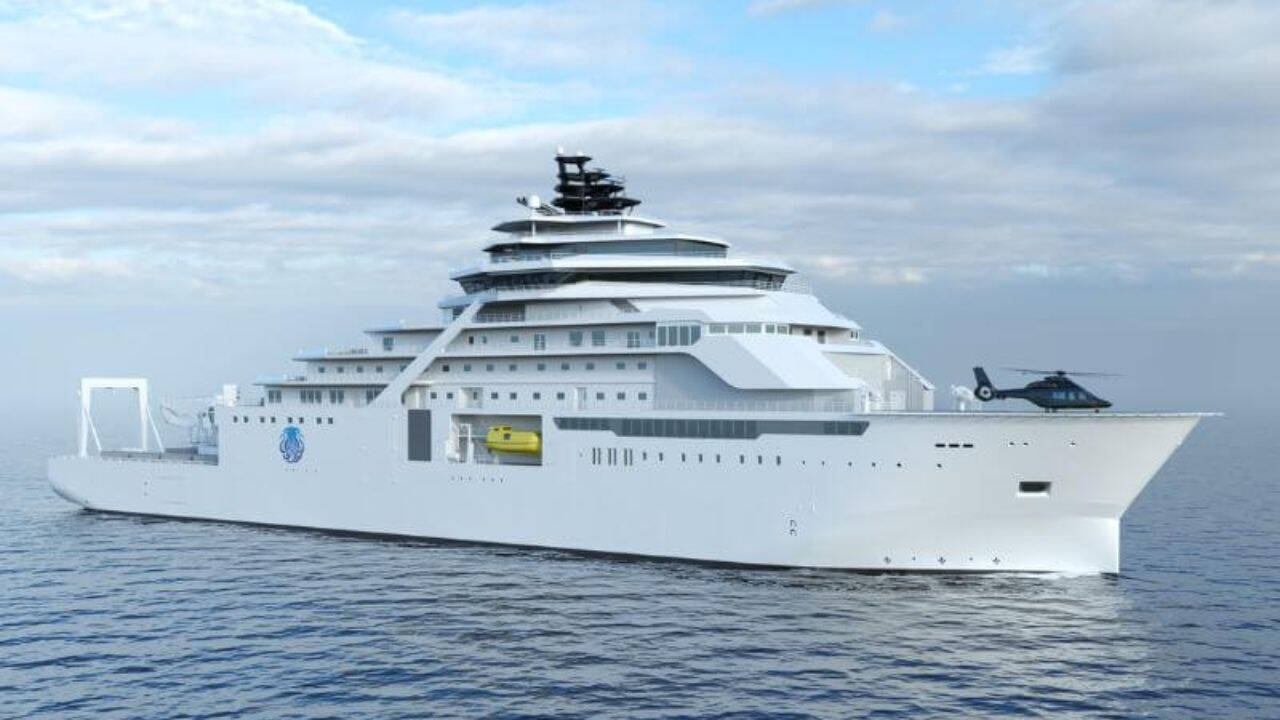
Every tech blogger with an internet connection is currently losing their collective mind over Gabe Newell and his latest oceanic pet project. Inkfish, his marine research venture, commissioned a monstrous 162-metre deep-sea vessel with a price tag hovering around $816 million. The tech press is treating this like some philanthropic crusade for the benthic zone, a heroic billionaire throwing his Steam-generated cash at the mysteries of the abyssal plain.
It is a vanity project masquerading as marine biology, and the narrative surrounding it exposes everything wrong with how we view ultra-high-net-worth expenditure. Don't forget to check out our recent coverage on this related article.
Let us clear
Gabe Newell is Building a Billion Dollar Tax Writeoff Not a Science Vessel
technology, business To read more about the history of this, TechCrunch offers an in-depth breakdown.
Every tech blog on the internet is currently drooling over Gabe Newell’s latest pet project. Inkfish, his marine research outfit, is dropping an estimated 816 million dollars to build a 162-metre deep-sea exploration leviathan. The tech press treats this like the second coming of Jacques Cousteau. Headlines gush about philanthropy, oceanic preservation, and a billionaire's noble crusade to map the crushing dark of the abyss.
It is a fairy tale for people who do not understand how ultra-high-net-worth liquidity works.
I have spent the last fifteen years watching private equity titans and tech moguls dump eight-figure sums into vanity projects disguised as altruism. I have seen companies blow millions on hardware that looks great in a press release and rots in a dry dock two years later. Let us strip away the romantic gloss. This massive ship is not a charitable donation to marine biology. It is a brilliant, highly calculated asset allocation play wrapped in steel and titanium, designed to solve a very specific problem for a man who won capitalism: what do you do when your cash pile grows too heavy to sit quietly in a bank?
The Deep Sea Economy is a Solution in Search of a Problem
Let us look at the lazy consensus. The narrative says we know less about the ocean floor than the surface of the moon, therefore sending a massive boat down there is inherently valuable.
That logic belongs in a middle-school science textbook, not a board room.
Knowing what is at the bottom of the Mariana Trench does not generate a return on invested capital. Marine science is notoriously starved of funding because the commercial feedback loop is broken. You drop a probe, you find a new species of tubeworm, you take a water sample, and your balance sheet remains completely untouched. Unless Newell plans to mine polymetallic nodules—a regulatory nightmare that would trigger enough international lawsuits to choke a whale—this vessel will not produce a single dime of operating revenue.
So why build it? Because physical assets of this magnitude operate under entirely different rules of accounting, depreciation, and estate preservation. When your primary cash cow prints money faster than you can spend it on video games, traditional investments start looking pedestrian. Real estate caps out. Superyachts depreciate the moment they hit salt water. But a classed, commercially registered research vessel? That enters a completely different tax and corporate structuring category.
The Superyacht Loophole is Dead Long Live the Research Vessel
For decades, billionaires bought white-hulled floating condos and called them pleasure craft. Governments caught on. Luxury taxes, stiff crew regulations, and public relations nightmares turned traditional megayachts into targets for wealth taxes and regulatory scrutiny.
Enter the research vessel classification.
If you register a ship as a scientific research vessel, the operational reality shifts beneath your feet. Crew standards change. Port access rules loosen. Tax treatment on fuel, maintenance, and refitting takes on an entirely different hue under maritime law. You transition from a consumer of luxury to an operator of commercial maritime infrastructure.
Gabe Newell is not the first person to figure this out, but he is executing it at a scale that exposes how obsolete our maritime definitions are. Inkfish is structured to hold heavy iron. By building a 162-metre behemoth, the enterprise locks up capital in a tangible, sovereign-scale asset that floats outside the traditional domestic tax grid. It is an offshore fortress in the most literal sense possible.
To understand why this matters, you have to look at how modern fortunes are shielded from velocity loss. Cash sitting still loses to inflation. Liquid equities trigger realization events. Mega-scale physical assets act as a sponge for capital expenditure, creating a permanent structural buffer.
The Engineering Reality Check
Now, let us address the hardware itself. Building a 162-metre ship capable of sustained deep-sea operations is a brutal industrial challenge. Most people assume that because a billionaire writes a check, the physics sort themselves out.
They do not.
I have watched maritime engineering budgets implode because project managers underestimated the integration complexity of dynamic positioning systems, acoustic thrusters, and heavy-lift subsea handling gear. A vessel of this size needs to hold position within inches over a trench four miles deep while the surface weather tries to tear the superstructure apart. The engineering overhead is staggering.
Most marine research is bottlenecked not by a lack of big ships, but by a lack of nimble, autonomous robotics. Spending nearly a billion dollars on a single floating monolith is a nineteenth-century solution to a twenty-first-century data collection problem. Swarms of low-cost autonomous underwater vehicles can map the benthic zone faster, cheaper, and safer than any titanium-hulled palace with a helipad and a wet lab.
Newell built his empire on the scalable efficiency of digital distribution. Steam does not require physical warehouses for every game sold. Yet, in his personal life, he is reverting to the most monolithic, capital-heavy, physical-world artifact imaginable. The irony is thick enough to cut with a salvage torch.
The Real Motive
Stop buying the PR department's talking points about saving the oceans. The ocean does not need a billionaire's floating estate to stay wet.
What we are witnessing is the ultimate expression of ultra-scale asset defense. When you have more money than entire sovereign nations, you stop buying things for utility. You buy things to anchor your wealth against the chaos of currency devaluation, public scrutiny, and political shifts. A ship that size cannot be easily seized, easily taxed, or easily ignored.
He is building a floating island that moves at eighteen knots, shielded by the noble banner of science. It is brilliant. It is cynical. And it has nothing to do with squids.