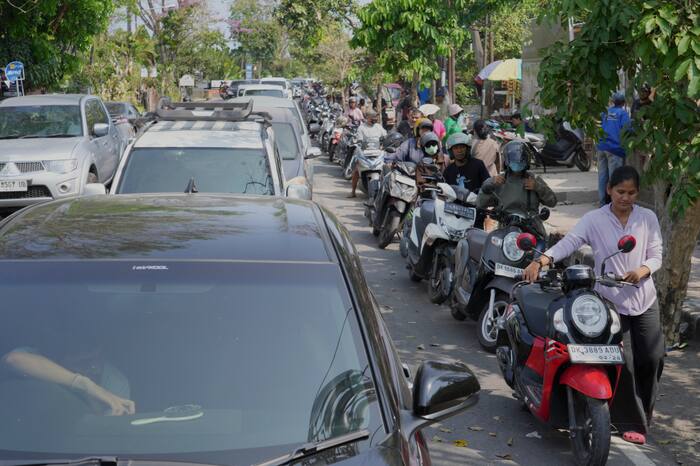
Standard reporting on Bali's multi-day fuel queues treats the crisis as a simple story of empty pumps, delayed tankers, and impatient drivers. That framing misses the real mechanism. The disruption stems from an island energy system operating with thin buffer capacity, fixed subsidized pricing, and high-frequency road congestion that turns a localized maritime delay into a multi-day retail bottleneck.
Conventional coverage typically maps onto a shallow chain of events: a tanker runs into trouble or weather slows shipping, fuel runs low at stations, people panic-buy, and authorities step in. While those observations capture surface symptoms, they blur distinct layers of causality. A maritime unloading snag is not the same thing as an exhausted national reserve. Rising baseline consumption for subsidized fuel is not the same thing as speculative or precautionary hoarding. Treating every queue as a macro scarcity event obscures where the system actually broke down and which interventions work.
Separating Known Facts From Educated Hypotheses
A rigorous diagnosis starts by sorting verified operational facts from plausible interpretations of how actors responded.
Known facts center on physical geography, supply structure, and policy responses:
- Bali lacks a domestic oil refinery and relies on seaborne fuel shipments into marine terminals such as Sanggaran in Denpasar and Manggis in Karangasem before inland transport by road tanker.
- Subsidized Pertalite (RON 90) serves as the primary fuel for scooters and everyday vehicles, keeping pump prices shielded from full market pass-through.
- Anchor or unloading complications on an incoming tanker, adverse sea and weather conditions, and heavy road traffic around major tourism and commuter corridors—including Denpasar, Badung, Kuta, South Kuta, and routes near Ngurah Rai Airport—slowed the replenishment cycle.
- Operators and authorities responded with targeted measures including extended or 24-hour station hours, prioritized delivery routing to heavily queued sites, odd-even license plate rules or per-vehicle purchase caps on subsidized fuel, nighttime truck loading windows, and enforcement against informal resale.
Educated hypotheses explain the behavioral feedback loops that amplified the physical delay:
- When drivers observe empty dispensers or see queue footage circulating online, rational individual precaution—topping off early rather than waiting until the tank is low—accelerates withdrawal velocity at open stations.
- Wide price gaps between regulated subsidized fuel and unsubsidized grades or informal roadside markups create incentives for arbitrage and hoarding whenever retail availability looks uncertain.
- As queues spill onto arterial roads, slower truck turnarounds reduce daily delivery trips per tanker, turning a temporary replenishment lag into a multi-day inventory deficit at retail sites.
The Four-Pillar Architecture of an Island Fuel Crunch
To understand why lines persist even when regional reserves have not vanished, analyze the disruption across four structural pillars: Maritime Import Dependency, Last-Mile Distribution Throughput, Price-Subsidy Distortion, and Queue Dynamics.
Pillar 1: Maritime Import Dependency
Because Bali does not refine fuel locally, every liter sold at a retail station must clear a multi-stage marine-to-land handoff. When an island depends on coastal tankers docking at a small number of terminals, schedule slack is narrow. A single berth delay, weather window, or anchor issue shifts the arrival curve of incoming stock. Even if terminal tankage holds reserves, lower working stock and uneven parcel timing compress the margin for error across the entire island.
Pillar 2: Last-Mile Distribution Throughput
Fuel does not move from a ship to a scooter tank automatically; it moves through terminal racks, road tankers, underground station tanks, and forecourt nozzles. Throughput on the final leg depends on turnaround time, not just total tanker count. Consider a delivery truck that normally completes multiple runs per shift between a terminal and stations in South Bali or Ubud. If queues block forecourt access or dense traffic slows outbound and return legs, each truck delivers less volume per day. Shifting loading or delivery schedules toward off-peak hours helps recover road speed, provided stations have staff and safe access to receive fuel at night.
Pillar 3: Price-Subsidy Distortion
Fixed retail prices on subsidized fuels like Pertalite remove price rationing at the pump. In an unsubsidized market, a sudden tightness relative to immediate supply pushes prices up, which curbs marginal trips and discourages holding excess fuel. Under regulated subsidy pricing, demand remains high even as supply tightens. The result is excess demand at the posted price, which clears through waiting time rather than price. Meanwhile, informal resellers can capture temporary premiums by buying at regulated prices and selling in small containers when stations run dry, prompting regulatory crackdowns and volume limits.
Pillar 4: Queue Dynamics and Information Cascades
Queues are self-reinforcing systems. When a driver sees a 30-minute line today, the perceived risk of finding an empty pump tomorrow rises. Buying earlier than usual pulls future demand forward into the present. Social media amplifies this effect by broadcasting worst-case scenes from the busiest stations, making a localized stockout look universal. In reality, station-level inventory is uneven: one site may be dry on Pertalite while another nearby still has supply or higher-grade fuel, yet drivers often herd toward familiar or visible locations.
Cause-and-Effect Chains That Standard Coverage Misses
Standard summaries list causes side by side as if they add up linearly. In practice, they interact through feedback loops:
- The Traffic-Turnaround Loop: Delivery delays create station stockouts. Drivers queue along roads to catch remaining supply. Spillover queues worsen road congestion, slowing the exact fuel trucks needed to refill neighboring stations.
- The Grade-Switching Asymmetry: When lower-cost subsidized fuel runs out first, motorists who can afford higher-octane alternatives shift over, while lower-income riders and gig couriers—who depend directly on daily fuel margins—face longer waits or higher unit costs. That shift alters product mix depletion across underground storage tanks.
- The Rationing Trade-Off: Quota caps (such as liter limits per motorcycle or car) and odd-even plate rules stretch remaining inventory across more days and curb bulk hoarding. The second-order effect is more frequent visits per vehicle once normal travel resumes, which can create a secondary wave of demand if lifted abruptly without sufficient buffer stock.
Tactical Playbook for Operators, Businesses, and Commuters
Different actors face different constraints during a distribution crunch, so effective actions depend on role rather than generic advice.
For Fuel Distributors and Station Operators
- Allocate by depletion velocity, not static quotas. Route tankers first to high-turnover stations serving commuter arteries and transport hubs before they hit zero-tank dead stock.
- Decouple truck movement from peak daytime congestion. Use off-peak dispatch and nighttime replenishment windows where local rules and safety protocols allow, reducing road friction.
- Extend operating hours selectively. Operating 24 hours at key stations spreads demand across quieter hours, provided night staffing and security are matched to real off-peak traffic.
- Enforce anti-hoarding controls cleanly. Pair volume caps or plate rules with clear station-level signage so customers know whether a queue is for subsidized stock or general refueling.
For Fleet Managers, Tour Operators, and Local Businesses
- Audit daily fuel burn per route. Separate essential revenue-generating trips (deliveries, airport transfers, guest logistics) from discretionary idling or deadhead miles.
- Stagger refueling ahead of shift changes. Send drivers to refuel during off-peak windows rather than at the start or end of peak commuter rushes.
- Establish backup refueling corridors. Map alternative stations outside immediate congestion choke points so a single dry site does not strand a vehicle.
For Residents and Travelers
- Refuel on a rolling threshold, not on empty. Top up when tanks drop to roughly a quarter or half rather than waiting for the warning light, avoiding emergency queues.
- Avoid roadside jerrycan or bottle markups. Informal resale carries steep price premiums, uncertain fuel quality or measurement accuracy, and legal risk during enforcement drives.
- Plan buffer time for ground transit. Factor potential road bottlenecks near queued stations into airport transfers, appointments, and inter-district travel.
Where These Measures Fall Short
No operational fix eliminates every vulnerability on a high-growth island market. Extended station hours cannot manufacture fuel if marine arrivals or terminal loading stall. Rationing rules reduce peak rush pressure, yet they also add friction for daily commuters and small couriers who cannot easily shift their work hours. Real-time crowd-sourced maps help drivers locate open pumps, but they can also trigger stampedes toward newly restocked stations if dozens of motorists act on the same report at once. Subsidies protect household budgets, but keeping retail prices below replacement cost guarantees periodic tension between fiscal limits, supply logistics, and consumer demand whenever external shocks hit.
Strategic Recommendation
Treat recurring queue episodes in high-traffic island markets as throughput and buffer stress tests rather than isolated weather or shipping accidents. The highest-leverage move for energy planners and logistics operators is to pair stricter terminal-to-pump dispatch telemetry—tracking station tank levels and truck turnaround times in near real time—with pre-agreed contingency triggers for off-peak delivery and targeted rationing before queues spill onto major roads. Without faster last-mile replenishment and clearer demand management during shocks, any future maritime delay or holiday traffic surge will convert a manageable supply dip into gridlock at the pump.