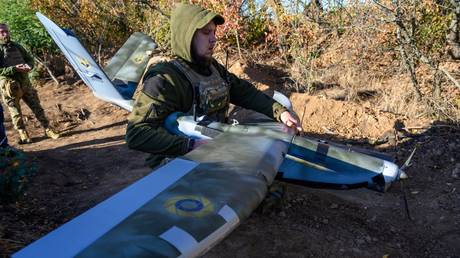
The physical interception of a suspected Ukrainian long-range strike drone by a Romanian F-16 over southern Estonia exposes a critical systemic vulnerability in contemporary air defense architecture. It marks the first kinetic engagement of an allied asset by NATO's Baltic Air Policing mission within NATO airspace since the escalation of regional hostilities. Beyond the immediate tactical execution, this event demonstrates that the operational envelope of high-altitude, long-range uncrewed aerial vehicles (UAVs) has structurally overwhelmed local deterrence mechanisms, generating severe geopolitical friction and forcing Western air defense paradigms to absorb the collateral cost of Ukraine's strategic deep-strike campaign.
The operational reality of this kinetic engagement reveals a stark mismatch between twentieth-century air combat doctrines and modern asymmetric threats. By mapping the vector of the drone's flight path, its mechanical breakdown, and the downstream institutional consequences, a precise operational framework emerges. This blueprint clarifies how electronic warfare, kinetic cost curves, and defensive alignment dictate security along NATO's eastern flank.
The Tri-Border Airspace Attrition Framework
To understand why a stray UAV over Estonia destabilized the regional political architecture—including the total collapse of the Latvian government days prior—one must analyze the interaction of three distinct structural pillars. Stray drone incursions are not isolated navigation errors; they are predictable outputs of high-density air defense environments.
                  [ Ukrainian Long-Range Strike Launch ]
                                    │
                                    ▼
                     [ Russian Electronic Warfare ]
                     (GPS Spoofing / GNSS Jamming)
                                    │
                                    ▼
                     [ Guidance System Disruption ]
                (Drift / Loss of Attitude & Heading Control)
                                    │
            ┌───────────────────────┴───────────────────────┐
            ▼                                               ▼
[ System Failure / Crash ]                       [ Flight Path Deviation ]
                                                            │
                                                            ▼
                                               [ NATO Airspace Incursion ]
1. Vector Deviation via Electronic Warfare Jamming
Long-range strike drones targeting industrial infrastructure in northwestern Russia operate predominantly via Global Navigation Satellite Systems (GNSS) coupled with secondary Inertial Navigation Systems (INS). When these platforms encounter intense localized electronic warfare (EW) deployments, particularly Russian high-power jamming complexes in western regions, the GNSS signal is completely denied or spoofed.
Deprived of primary satellite updates, the platform falls back on INS tracking. Over extended ranges, INS tracking experiences cumulative positioning drift. If the drone loses attitude or heading control, its vector is inadvertently redirected into the Baltic corridor. The flight path over southern Estonia, terminating near Lake Võrtsjärv, was a direct consequence of this electronic disruption rather than a deliberate targeting choice by Ukrainian planners.
2. Kinetic Asymmetry and Interception Cost Functions
Deploying an F-16 fighting falcon to track, intercept, and destroy a low-radar-cross-section, slow-moving uncrewed platform introduces an unsustainable economic and operational asymmetry. The cost function of this defense mechanism is heavily skewed.
$$C_{\text{intercept}} = C_{\text{flight_hour}} + C_{\text{munitions}} + C_{\text{airframe_depreciation}}$$
A standard short-range air-to-air missile represents a significant financial expenditure, while the operating cost per flight hour for a fourth-generation fighter jet remains high. Conversely, the cost of the invading long-range asymmetric UAV is orders of magnitude lower. This equation reveals a severe structural bottleneck: NATO forces are burning high-value airframe hours and premium munitions to neutralize low-cost targets, a dynamic that depletes conventional readiness over extended timelines.
3. Institutional Stability and Threshold Definition
The primary risk of these airspace violations is not immediate kinetic destruction, but the rapid degradation of political stability within frontline states. The resignation of Latvia’s prime minister and defense minister following an unmitigated strike on an oil refinery highlights this dynamic. When national authorities fail to cleanly define the threshold between a stray weapon and an intentional act of aggression, public trust breaks down and government stability degrades.
Frontline nations must balance the risk of escalatory overreaction against the risk of domestic political collapse caused by appearing defenseless. This tension creates a vulnerability that opposing intelligence agencies can exploit through targeted disinformation campaigns.
The Interception Profile: Tactical Variables and Execution Mechanics
The shootdown over Estonia provides a clear case study in non-cooperative target engagement within sovereign airspace. Analyzing the tactical steps of the engagement highlights the extreme friction inherent in air policing under current rules of engagement (ROE).
- Detection and Track Correlation: Estonian ground-based early warning radars detected the target prior to boundary penetration. The primary challenge at this stage is distinguishing a low-radar-cross-section composite drone from commercial traffic or migratory avian tracks. Radar cross-section fluctuation requires prolonged cross-cueing with passive electronic support measures to confirm an unauthorized signature.
- Scramble and Vectoring: The Combined Air Operations Centre ordered the launch of Romanian F-16s from Šiauliai Air Base in Lithuania. The time-to-intercept equation is strictly limited by the low airspeed of the target, meaning the fighter jet must drastically reduce its speed envelope, approaching its stall margin, to achieve positive visual identification under night or low-visibility conditions.
- The Engagement Decision: The decision by the Estonian Ministry of Defense to authorize a kinetic shootdown reflects a calculated assessment of the drone's trajectory. If a drifting platform is projected to intersect with critical infrastructure or high-density population zones, the operational risk of a kinetic interception—including falling debris—drops below the risk of allowing the drone to fly on autonomously.
Technical Constraints and Operational Boundaries
This operational paradigm contains several core limitations. Air defense systems do not offer absolute protection; they are bounded by geography, sensor physics, and command-and-error latency.
The first limitation is sensor degradation at low altitudes. Frontline radars face radar clutter and terrain masking when trying to track low-flying UAVs tracking below 500 feet. This creates a blind spot where tracking data can be lost, preventing a clean fire-control solution.
The second limitation is the debris footprint. Neutralizing a drone carrying an explosive payload over land transfers the risk from an uncontrolled impact to a dispersed debris field. The swampy terrain between Lake Võrtsjärv and Põltsamaa minimized civilian risk in this instance, but an identical interception over urban terrain like Tallinn or Riga would pose significant hazards to local populations.
Finally, political attribution remains highly complex. While government officials state with high probability that the platform was Ukrainian in origin, confirming that assessment requires analyzing the physical wreckage, serial numbers, and guidance system logs. Until that forensic audit is complete, the threat must be categorized as an unconfirmed classification, which limits the speed of official diplomatic responses.
Strategic Re-Alignment Protocols
Frontline states cannot rely on reactive, air-frame-heavy air policing to manage a sustained cross-border drone problem. To mitigate the structural risks exposed by the Estonian interception, regional defense architectures must deploy a three-part defensive play.
First, defense forces must deploy permanent ground-based, short-range air defense systems (SHORAD) along sensitive border corridors. Moving away from expensive jet fighter scrambles toward low-cost, surface-launched options or directed-energy weapons corrects the unsustainable cost imbalance of drone defense.
Second, NATO and Ukrainian military commands must establish a real-time, automated data link for flight-path tracking. De-conflicting operations requires sharing telemetry data for deep-strike routes before launch, allowing allied air defense networks to immediately identify stray systems and predict drift vectors long before they breach sovereign air space.
Finally, border security agencies must deploy local electronic warfare corridors along eastern borders. Creating targeted, localized jamming and spoofing zones allows allied forces to capture or safely divert drifting systems without resorting to kinetic missile strikes, neutralizing threats quietly before they can trigger domestic political crises.
The airspace violation over Estonia demonstrates that the line between active conflict zones and neutral territory has blurred. Frontline states must rapidly update their air defense systems to counter these quiet, persistent threats, or risk seeing their political stability eroded by a steady stream of stray regional weapons.
Frontline air defense requires deep synchronization between ground sensors and air assets to successfully identify low-altitude threats. View this analysis of Baltic air defense integration and tracking capabilities to understand the technical challenges of managing low-radar-cross-section targets along NATO's eastern flank.