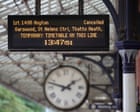
When trains are cancelled, giving rail passengers an automatic right to switch operators for free promises immediate relief at the worst possible moment. In practice, that right only works if a competing train has spare seats, ticket systems can validate the change on the spot, and staff on the concourse know who is authorized to say yes. A rule on paper creates an entitlement. Turning that entitlement into a boarding pass before a rival train pulls out of the platform requires deep operational coordination that many rail networks still lack.
For decades, stranded travelers have lived with a frustrating mismatch. A morning service disappears from the departure board, leaving hundreds of people staring at a platform screen while another train bound for the same city sits a few tracks over. Under older, fragmented arrangements, holding a ticket with one carrier often meant buying a brand-new fare with another or hunting down an agent to stamp or endorse a voucher. Automatic free switching aims to cut out that friction so passengers can reach their destination instead of waiting hours for the next departure from the original operator.
Why Paper Rights Fail on Rainy Platforms
Policy announcements love clean promises. Station platforms deal in messy physics.
When a line goes down due to signaling trouble, overhead wire damage, or severe weather, disruptions rarely stay polite or contained. Cascades build quickly. A single cancelled intercity train pushes passengers onto the next two departures, which then run late because boarding takes longer and dwell times stretch out. Adding an automatic right to switch operators for free is an intuitive consumer protection, yet legal text cannot conjure extra carriages out of thin air.
Consider what happens at a busy junction when a major operator cancels a service and points riders toward an open-access rival or a competing franchise. If station signage is vague, mobile apps do not update in real time, or ticket gates reject barcodes issued by the original carrier, the "automatic" part of the right evaporates. Passengers end up crowding customer service desks anyway, burning precious minutes while the alternative train departs without them.
There is also a quieter operational trap around duty of care and responsibility. When a traveler moves from Carrier A to Carrier B during a disruption, who owns the journey from that point forward? If the second train is also delayed, or if the passenger needs onward rebooking or assistance with luggage or accessibility, ambiguity slows everyone down. Smooth travel depends on clear accountability, not shared blame.
Veteran transport planners know that consumer rights succeed or fail at the boundary between policy and front-line execution. A passenger standing in the cold does not care about regulatory intent. They care whether their QR code scans green and whether there is space to stand or sit before the doors lock.
The Hidden Math Behind Empty Seats
Free switching assumes slack in the system. Modern high-demand rail corridors rarely have much of it.
Many busy routes run near capacity during peak commuting windows and popular weekend blocks. Operators schedule rolling stock and train crews tightly to keep fares competitive and unit costs down. When a rival operator is asked—or required—to absorb displaced riders at zero extra charge to the passenger, the underlying capacity has to come from somewhere. If the competing train is already packed with its own full-fare or advance-booked travelers, a free switch can quickly turn into overcrowding, safety concerns, or passengers left behind on the platform anyway.
Revenue mechanics complicate the picture further. Rail operators rely on yield management and advance-fare tiers to balance peak demand against off-peak travel. A carrier that invests heavily in punctuality, fleet maintenance, and spare train sets may view mandatory free acceptance as a subsidy to a less reliable competitor. If Operator X routinely suffers cancellations and leans on Operator Y's better-run trains to bail out its passengers, the financial incentives tilt in strange ways.
To see how this plays out operationally, consider a hypothetical example along a busy intercity corridor served by two separate rail companies running hourly trains. Suppose Company A cancels a peak departure due to a crew shortage, and a new rule lets affected travelers board Company B's train free of charge. If Company B's train already carries heavy commuter load from earlier stops, dozens of Company A's passengers may board anyway, slowing station stops, straining onboard facilities, and testing the patience of Company B's paying customers. A hypothetical example like that highlights why capacity rules and financial settlement matter just as much as the passenger right itself.
How Clearinghouses and Fare Rules Collide
Behind every rail ticket sits a web of fare databases, split-ticketing rules, and inter-operator accounting. Most passengers never see that machinery until something breaks.
When multiple operators share tracks or corridors, a single journey can involve distinct fare structures, seat reservation policies, and validation systems. Some tickets are tied to specific trains or time windows; others are flexible season passes or regional multi-modal products. Making an operator switch seamless at the moment trains are cancelled requires real-time data exchange between operators and ticketing platforms so inspection staff and automated gates recognize valid alternative travel immediately.
Without shared technical standards, friction creeps in at every checkpoint. One carrier might require a seat reservation where another operates open seating. One operator's app might issue a dynamic pass only after a cancellation is officially logged in a central system, whereas local dispatchers often know a train will not run long before the formal cancellation feed updates. That lag between operational reality and digital status is where travelers get stuck arguing with gate staff.
Inter-operator settlement adds another layer of complexity. Someone has to pay for the carriage provided when rail passengers switch carriers after cancellations. Whether reimbursement uses pre-agreed flat rates, per-passenger-kilometer formulas, or reciprocal clearinghouse balances, disputes over attribution can drag on long after the disruption ends. If settlement terms are punitive or unclear, operators may resist broader acceptance or carve out narrow exceptions that confuse travelers.
Technology alone cannot fix misaligned commercial agreements. Software only enforces the rules that operators and regulators agree to encode into it.
Where Competition Helps and Where It Hurts
Competition in rail is neither a cure-all nor a villain. Its effects depend heavily on network design and market structure.
Where true route overlap exists and multiple operators run frequent services between the same origin and destination, switch operators for free gives stranded travelers genuine choice. Instead of waiting for a single monopoly carrier to recover from a rolling-stock fault or staffing gap, passengers can board an alternative service and keep their day moving. Competition can also sharpen operational discipline if carriers know poor reliability pushes riders toward rivals or triggers costly inter-operator transfers.
Yet forced or uncalibrated switching carries real trade-offs. Smaller operators, regional lines, or carriers running tighter margins may struggle to absorb sudden surges of displaced passengers without hurting their own punctuality. In markets where one operator runs frequent services and another runs infrequent long-distance trains, a one-size-fits-all switching rule can create lopsided burdens. Good policy accounts for fleet size, frequency, and network topology rather than treating every route as identical.
What Actually Needs to Happen Before the Next Disruption
An automatic right to switch is only as strong as the weakest link between a cancelled train and the next available departure. Regulators can mandate acceptance, and consumer groups can celebrate the principle, but reliability is built in daily operations long before a timetable unravels.
Operators and infrastructure managers need shared real-time disruption feeds, clear platform communication when trains are cancelled, and straightforward validation rules that work across apps, smartcards, and paper tickets without putting the burden of proof on a stranded traveler. Transparent inter-operator settlement rules also need to be settled upfront so carriers treat disruption relief as a standard network function rather than a zero-sum fight.
Before the next major timetable breakdown hits, transport authorities and rail operators should publish plain-language route maps showing exact operator-switching rights, supported ticket types, and platform rules for every corridor—and test those workflows under simulated disruptions rather than waiting for real passengers to find the flaws.