Mainstream entertainment outlets treat a trip to the infield care center like a career-ending tragedy.
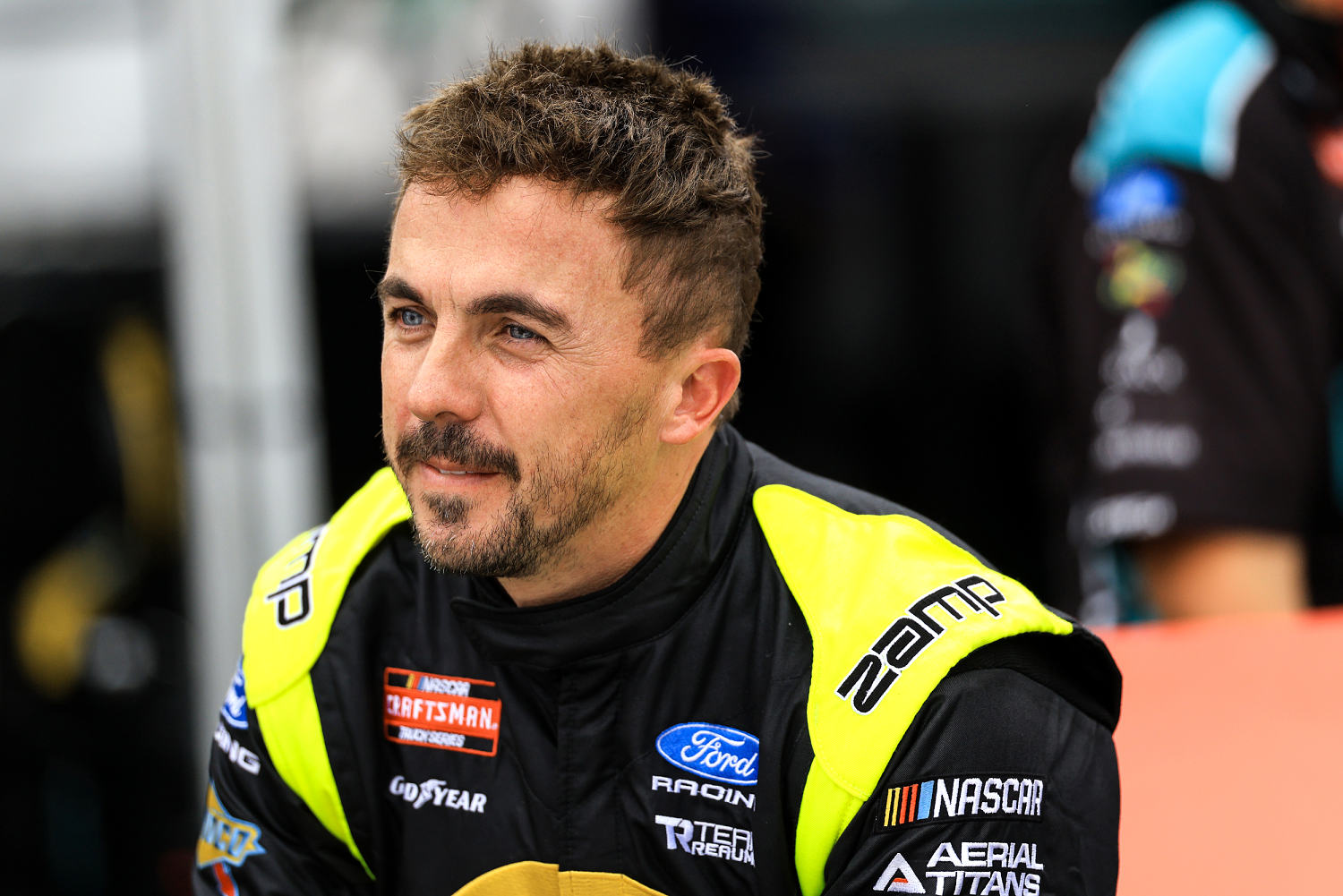
They see a former child star get airlifted or transported to a local Florida hospital after a multi-car pileup at Daytona International Speedway, and they immediately reach for the panic button. They frame Frankie Muniz as a fragile Hollywood tourist playing in traffic, lucky to escape with his life, and overdue for a return to safe, air-conditioned soundstages.
That narrative is lazy, patronizing, and fundamentally ignorant of how stock car racing works.
If you actually understand motorsport, a hospital evaluation after a superspeedway wreck is not an indictment of Frankie Muniz’s driving ability. It is his graduation certificate. Until you have been caught in the unavoidable physics of a Daytona pack crash, absorbed the G-forces of a SAFER barrier impact, and walked out of the medical center ready to climb back into the seat, you are just a hobbyist. Muniz did not fail at Daytona; he paid the mandatory entry fee required of every legitimate driver in the NASCAR ecosystem.
The Hollywood Tourist Myth Is Dead
Entertainment journalists love a neat, condescending box. To them, an actor transitioning into professional motorsport is always a vanity project—an extension of the "celebrity pro-am" circuit where wealthy amateurs buy shiny equipment to play out midlife fantasies.
I have spent years watching celebrity drivers wash out of the lower tiers of motorsport. Most of them show up with massive entourages, demand top-tier equipment, and quietly disappear the exact second they experience their first violent impact at 180 miles per hour. Racing looks glamorous from the hospitality suite, right up until the moment a 3,400-pound steel chassis snaps sideways at triple-digit speeds and slams into a concrete wall.
Muniz did the exact opposite of what tourists do. He did not buy a one-off vanity ride in the Cup Series just to wave at the cameras. He grinded through the ARCA Menards Series, logged the unglamorous test laps, took the coaching, and worked his way up into the NASCAR Craftsman Truck Series and Xfinity ranks.
When a crash happens at Daytona, the casual observer asks, What mistake did he make?
Anyone who has ever sat on a pit box asks a completely different question: Where was he supposed to go?
The Brutal Physics of Superspeedway Pack Racing
To understand why the "Muniz crashed because he's an actor" narrative is garbage, you have to understand the aerodynamic prison of Daytona International Speedway.
Daytona is a 2.5-mile tri-oval with 31-degree banking in the turns. Because the track is so wide and fast, NASCAR mandates horsepower-reducing tapered spacers to keep the vehicles from literally lifting off the asphalt. The unintended consequence of choking the engines is that no single driver can pull away from the field. Instead, thirty to forty trucks or cars run nose-to-tail, three and four wide, separated by inches, trapped in a massive aerodynamic bubble at nearly 190 miles per hour.
In this environment, individual driving skill accounts for about twenty percent of your survival. The other eighty percent is pure probability and proximity.
When a driver three rows ahead of you misses a shift, gets bumped awkwardly in the left-rear quarter panel, or cuts a tire, a chain reaction ignites instantly. At 185 mph, a vehicle covers roughly 271 feet every single second. By the time smoke appears on the horizon, the exit routes are already blocked by spinning sheet metal. You can have the reflexes of a fighter pilot and the resume of a seven-time champion, and you are still going to get collected in "The Big One."
Look at the history of Daytona. Dale Earnhardt Sr., Jeff Gordon, Jimmie Johnson, Kyle Busch, and Denny Hamlin have all been wadded up in multi-car Daytona wrecks. Nobody wrote think-pieces questioning whether Kyle Busch belonged in a racecar when he broke his leg and foot hitting an interior concrete wall at Daytona in 2015. They recognized it as an occupational hazard of superspeedway racing.
Holding Muniz to a different standard because he starred in Malcolm in the Middle twenty years ago is pure intellectual dishonesty.
Why "Hospitalized" Does Not Mean What You Think It Means
Clickbait editors love the word hospitalized. It conjures images of emergency surgeries, life support, and weeping family members in sterile waiting rooms.
In modern motorsport, a hospital transport is overwhelmingly a triumph of safety protocol, not an indicator of catastrophic injury.
NASCAR operates under some of the strictest medical clearance protocols in professional sports. Every track has an advanced infield care center staffed by trauma physicians, nurses, and paramedics. When a crash exceeds a certain threshold on the vehicle’s incident data recorder—commonly referred to as the "black box"—medical evaluation is mandatory, regardless of whether the driver feels fine.
Here is what happens behind the scenes after a heavy hit at Daytona:
- G-Force Telemetry Triggers: Sensors mounted inside the chassis measure lateral, longitudinal, and vertical acceleration. If a hit spikes past a predetermined G-load threshold, NASCAR officials automatically flag the driver for mandatory concussion screening and neurological checks.
- The Limits of Infield Imaging: While the infield care center can stabilize trauma, stitch lacerations, and run basic diagnostics, it does not house multi-ton MRI machines or advanced CT scanners. If a driver reports back soreness, neck stiffness, or a lingering headache, the track physician will order a precautionary transport to Halifax Health Medical Center just across the street from the speedway.
- Insurance and Sanctioning Liability: No driver can legally strap back into a NASCAR-sanctioned vehicle for the next race without formal clearance from a neurologist and the sanctioning body’s medical liaison. Transporting a driver to a trauma center creates an indisputable diagnostic baseline.
When headlines scream that Frankie Muniz was hospitalized after a crash, they are describing standard operating procedure for an athlete who just absorbed a high-energy impact. Treating a routine diagnostic scan as a sensational medical emergency sells ads, sure, but it completely misrepresents the reality of modern crash safety.
What the Safety Critics Completely Miss
Whenever a recognizable name takes a hard hit at a superspeedway, a secondary chorus of armchair critics emerges to demand that racing be made "safer" or that inexperienced drivers be barred from high-speed ovals.
This argument misses the entire evolution of motorsport engineering over the last twenty-five years.
The reason Muniz was able to undergo evaluation and move forward with his career—rather than suffering the fatal basilar skull fractures that plagued drivers in the 1990s—is the relentless progression of passive safety systems developed by engineers like Dr. John Melvin and researchers at the University of Nebraska-Lincoln.
Consider the four layers of protection that absorbed the energy of Muniz’s crash before his body ever felt a fraction of the force:
- The SAFER Barrier: The Steel and Foam Energy Reduction barrier lines the perimeter walls of Daytona. Instead of hitting solid concrete, the car strikes structural steel tubes backed by bundles of closed-cell polystyrene foam, extending the duration of the impact by milliseconds and drastically reducing peak deceleration forces.
- Crush Zones: Modern stock car chassis are engineered with front and rear clips designed to fold like accordions. Every twisted piece of tubing and shattered carbon-fiber panel represents kinetic energy being dissipated away from the driver’s compartment.
- Full-Containment Carbon Seats: Drivers no longer sit in flimsy aluminum buckets. They are bolted into custom-molded carbon-fiber shells with built-in shoulder, rib, and head bolsters that prevent lateral spinal whiplash.
- The HANS Device: The Head and Neck Support device tethers the driver’s helmet to their shoulders via carbon-fiber collars and woven polyester straps. In a frontal impact, it prevents the head from whipping forward and snapping the base of the skull.
To argue that a crash proves the system is broken is backwards. Walking away from a multi-car pileup at 180 miles per hour is proof that the engineering works.
The Psychological Crucible Every Driver Must Face
There is an unspoken truth in every garage from Daytona to Charlotte: you do not know who a racecar driver is until after their first massive wreck.
Before your first violent crash, bravery is theoretical. You drive deep into the corners because you trust the grip of the tires, the downforce of the splitter, and the competence of the spotter on your roof. You have not yet felt the sickening weightlessness of a car snapping loose at high speed, nor have you heard the deafening crunch of steel tearing apart inches from your ribs.
Once you have been to the hospital after a wreck, the illusion of invincibility is gone forever.
When you climb back into the cockpit the following weekend, you are no longer driving on youthful ignorance. You are making a conscious, sober calculation that the reward of competing outweighs the very real physical penalty of failure.
This is where celebrity vanity projects die. A guy doing it for Instagram likes or a reality TV documentary takes one big hit, feels his ribs ache for three weeks, looks at his bank account, and quietly retires to golf.
Muniz has spent years publicly discussing his history of concussions and health scares from his youth. Nobody understands the physical cost of neurological trauma better than he does. Choosing to strap into a stock car at Daytona—knowing full well the statistical probability of getting caught in a pack wreck—is not reckless stupidity. It is the ultimate validation of his commitment.
Stop Asking If He Should Quit
If you look at search trends whenever a driver gets injured, the top queries are always variations of the same timid question: Should Frankie Muniz retire from racing? or Is NASCAR too dangerous for actors?
Both questions are built on a flawed premise. They assume that physical safety is the highest human virtue, and that anyone with enough money to stay comfortable should avoid high-consequence environments.
By that logic, nobody should ever climb K2, surf Nazaré, fight in the UFC, or launch into low-Earth orbit.
Life is not a bubble-wrapped exercise in risk elimination. The entire appeal of motorsport—and the reason fans still pack the grandstands at Daytona—is that the stakes are real. Unlike stick-and-ball sports, where a mistake results in a turnover or a missed free throw, a mistake at 190 miles per hour carries immediate, violent physical consequences.
Asking whether Muniz should quit after a crash is like asking a boxer if he should retire the first time he gets knocked down. Getting knocked down is part of the job description. How you get up is the only metric that matters.
The Reality Check for Aspiring Racers and Critics Alike
Of course, defending Muniz’s legitimacy does not mean pretending he is immune to the steep learning curve of professional stock car racing.
There is a legitimate downside to the modern NASCAR ladder system, and Muniz sits right at the center of it. Because track testing is heavily restricted to control costs, rookies and part-time drivers get a fraction of the seat time that drivers received twenty years ago. You cannot learn the subtle aerodynamic feel of side-drafting at Daytona on an iRacing simulator in your living room. You only learn it in live traffic, with real sheet metal on the line.
That lack of real-world testing means drivers transitioning from other disciplines—whether they come from open-wheel cars, dirt tracks, or Hollywood sets—are forced to learn their craft in public, under the microscope of national television broadcasts. Every misjudgment is amplified. Every bad break becomes a headline.
If you want to evaluate Frankie Muniz accurately, stop reading celebrity gossip blogs that treat a Daytona wreck like a red-carpet wardrobe malfunction. Watch his telemetry. Listen to his radio communications with his spotter. Look at his lap times in clean air compared to funded veterans in comparable equipment.
You will see a driver who hits his marks, respects the veterans around him, manages his equipment, and refuses to flinch when the inevitable chaos of superspeedway racing erupts directly in front of his windshield.
Daytona did not expose Frankie Muniz as an imposter. It stripped away the last shred of his Hollywood novelty and left behind what he actually set out to become: a racecar driver who earned his seat the hard way.