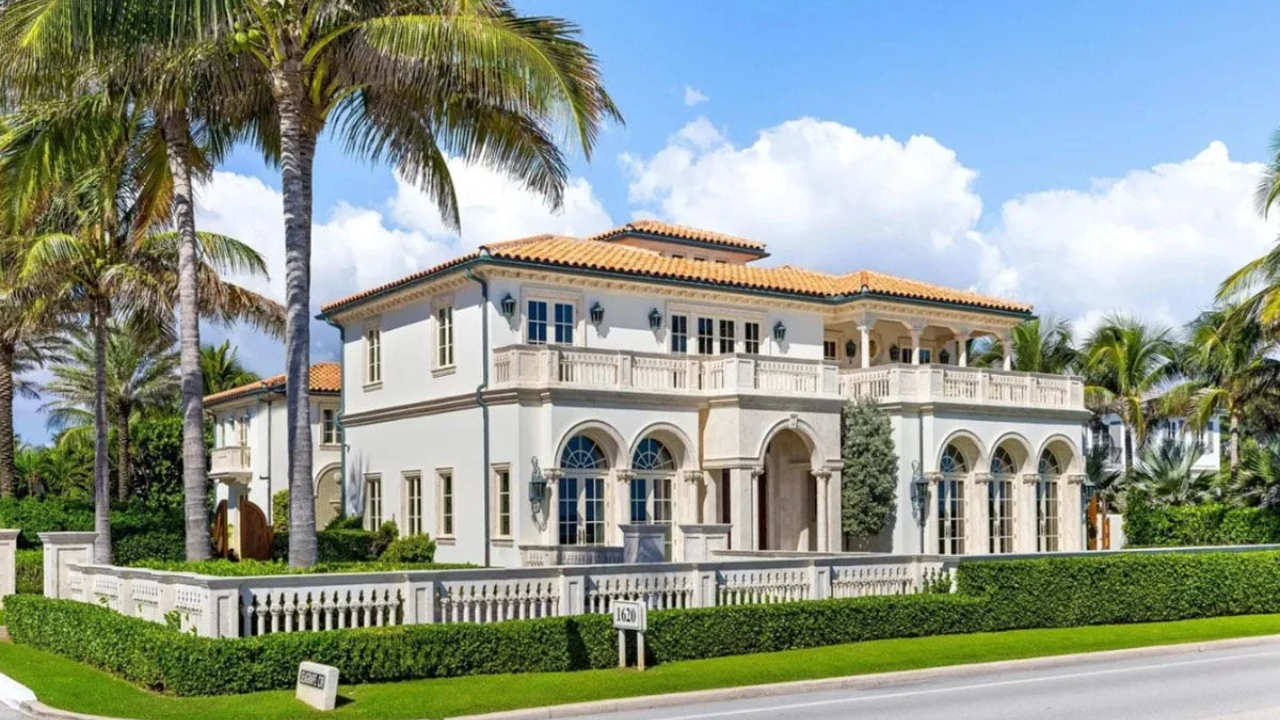
Most retired athletes blow their money on depreciating toys. Not Fran Tarkenton.
The Pro Football Hall of Fame quarterback just dropped $51.89 million on a massive Palm Beach estate, and honestly, the numbers behind this deal tell a much bigger story than a simple celebrity home purchase. The sellers originally bought that exact same property for just $12.65 million back in 2019. That's a staggering 310% jump in roughly seven years.
You might look at that price tag and think he overpaid at the absolute peak of the Florida luxury real estate bubble. I disagree. When you look at how Tarkenton built his post-NFL fortune—and what is actually happening on the ground in Palm Beach County right now—this purchase looks less like a splurge and more like a calculated wealth-preservation play.
The Math Behind Fran Tarkenton's $51.89 Million Palm Beach Mansion
Let's break down the raw numbers first because the jump from $12.65 million to $51.89 million sounds absurd on paper.
In 2019, pre-pandemic Palm Beach was already expensive, sure, but it hadn't yet experienced the massive migration of Wall Street hedge funds, tech founders, and ultra-high-net-worth retirees fleeing high-tax states like New York, Illinois, and California. Back then, $12.65 million got you a serious piece of coastal real estate.
Fast forward to today, and the inventory on the barrier island has practically vanished. Palm Beach is only about 16 miles long and barely half a mile wide at its broadest point. You can't manufacture new land there. When billionaire buyers want an oceanfront or Intracoastal estate with modern renovations, they aren't shopping against local doctors anymore. They're bidding against private equity titans who treat $50 million like pocket change.
Here is why that 4x price jump happens so regularly on the island right now:
- Land scarcity dictates everything. Even tear-down lots in prime Palm Beach zones routinely trade for tens of millions of dollars simply because the dirt itself is finite.
- Construction timelines are brutal. Getting architectural review board approval and finishing a ground-up luxury build on the island takes three to five years. Buyers at Tarkenton's level will happily pay a massive premium for a turnkey estate rather than wait half a decade dealing with contractors.
- Tax shelter advantages. Florida's lack of state income tax and generous homestead protections turn primary residences into massive wealth-shielding vehicles for high earners.
How a 1970s Quarterback Afforded a $50 Million Estate
If you only know Fran Tarkenton from grainy NFL Films highlights of him scrambling away from defensive linemen for the Minnesota Vikings and New York Giants, a $51.89 million real estate purchase probably seems impossible. Players in the 1960s and 1970s didn't make Patrick Mahomes money. Not even close.
Tarkenton didn't buy this house with football checks. He bought it because he spent the last four decades quietly becoming one of the most successful entrepreneurs in sports history.
While he was still playing in the NFL, Tarkenton started building businesses during the offseason. After retiring in 1978, he founded Tarkenton Software, which eventually merged with KnowledgeWare—a company that went public and made him tens of millions of dollars long before tech startups were trendy. Since then, he has launched and led over 20 different companies, focusing heavily on small business consulting, financial services, and annuity marketing through Tarkenton Financial.
He actually understands balance sheets. That's the difference between a guy going broke five years after his last snap and an 86-year-old Hall of Famer casually absorbing a $52 million cash-heavy transaction without blinking.
What People Get Wrong About Ultra-Luxury Florida Real Estate
Whenever a celebrity or athlete buys a home north of $30 million, the internet immediately floods with comments about property taxes, insurance nightmares, and impending market crashes. People love predicting the demise of South Florida real estate. They've been doing it since 2021, and they keep getting burned.
Let's address the biggest misconceptions surrounding deals at this price tier.
Misconception 1 Property Taxes and Insurance Will Crush the Buyer
For a regular homeowner in Broward or Miami-Dade County, soaring homeowners insurance and property tax reassessments are a genuine financial crisis. At the $50 million tier in Palm Beach, the math works completely differently.
First, property taxes in Florida are assessed based on the purchase price the year after a sale. On a $51.89 million transaction, Tarkenton is looking at an annual property tax bill hovering right around $800,000 to $900,000 depending on the exact millage rate and exemptions. That sounds terrifying to normal humans, until you realize what he saves by establishing or maintaining primary residency in a state with zero income tax. If you earn $15 million or $20 million a year from business distributions and investments, saving 10% to 13% in state income taxes easily covers the property tax bill twice over.
Second, buyers in this bracket rarely carry traditional retail insurance policies. Many self-insure the structure itself—meaning they keep enough liquid capital on hand to rebuild out of pocket if a Category 5 hurricane hits—and only carry excess liability and basic windstorm coverage through private syndicates like Lloyd's of London.
Misconception 2 The Market Is About to Crash
The entry-level and mid-tier housing markets across Florida have definitely cooled off. Inventory is sitting longer in places like Tampa, Orlando, and Austin, and sellers are cutting prices because 6% to 7% mortgage rates squeeze normal buyers.
Palm Beach doesn't care about mortgage rates. Roughly 70% to 80% of transactions above $25 million on the island are all-cash deals. Interest rates could hit 12% tomorrow and it wouldn't stop a billionaire from buying a compound near Worth Avenue. The ultra-luxury market operates on a completely separate economic track driven by stock market performance, corporate exits, and global wealth migration.
The Bigger Trend of Athletes Turning Into Real Estate Moguls
Tarkenton isn't operating in a vacuum here. Over the last decade, we've watched a massive shift in how elite athletes treat high-end real estate. Instead of buying gaudy mansions in random suburbs that lose half their value the second they try to sell them—remember Michael Jordan's Highland Park estate that sat on the market for over a decade?—modern wealthy athletes are targeting trophy assets in supply-constrained markets.
Look at the pattern across South Florida alone:
- Tom Brady dropped $17 million on an Indian Creek Island lot in Miami, tore down the existing house, and built a custom waterfront compound worth well over $100 million today.
- Derek Jeter built a massive waterfront mansion in Tampa's Davis Islands, sold it for $22.5 million, and subsequently poured money into Coral Gables real estate.
- Serena Williams and Venus Williams have both invested heavily in Jupiter and Palm Beach Gardens estates, capitalizing on the exact same demographic shift pushing wealth north from Miami into Palm Beach County.
They all figured out the same rule. Never build the most expensive house in a normal neighborhood. Always buy the best dirt in a neighborhood where your neighbors are worth ten figures.
What This Deal Means for Anyone Watching the Luxury Market
You probably aren't shopping for a $52 million mansion this weekend, so why does Fran Tarkenton's latest real estate move actually matter to you? Because ultra-high-net-worth buyers are the ultimate leading indicator for regional economic health and tax policy winners.
Follow the smart money. When self-made business veterans like Tarkenton—men who spent their entire careers analyzing risk, cash flow, and tax efficiency—decide to park over $50 million into a single residential asset in Palm Beach, they are making a massive bet on long-term stability. They're betting that Florida's tax-friendly environment will remain intact, that corporate wealth will keep flowing south, and that trophy coastal real estate will outperform traditional cash holdings over the next decade.
If you're looking at real estate investments on a smaller scale, apply the exact same filter Tarkenton used here. Stop chasing cheap properties in areas with endless flat land where developers can throw up 5,000 new houses next year. Look for hard geographic boundaries—water, mountains, strict zoning caps—where supply is permanently locked. Buy in states where capital is welcomed rather than taxed into oblivion, focus on turnkey quality over risky multi-year renovations, and let scarcity do the heavy lifting for your net worth.