The steam rises in a predictable, rhythmic swirl. It is the first sign of order in a world that often feels like it is coming apart at the seams. For the regulars at the small park kiosk, the sound of the milk frother isn't just a kitchen noise; it is a heartbeat. And behind the machine stands a man whose hands move with the practiced grace of a watchmaker.
His name is Sahand. He is an immigrant, a barista, and for many, the unofficial guardian of their morning sanity.
We like to think of our local coffee spots as transactional hubs. You give five dollars; you receive a caffeinated jolt. But that is a lie we tell ourselves to maintain a sense of professional distance. In reality, these spaces are the "third places" of our lives—the thin tissue connecting the isolation of home to the performance of the workplace. When you walk up to a window and someone remembers that you take an extra shot on Mondays because your boss is a tyrant, a contract is signed. It is a contract of mutual recognition.
Then, the geometry broke.
It happened on a Tuesday that looked like every other Tuesday. The sun was filtering through the trees of the park, dapping the pavement in gold. Sahand was doing what he always does—serving the community. But hate doesn't need a reason to show up; it only needs a target. A man approached the window, but he wasn't looking for a latte. He was looking for a ghost to punch.
The attack was sudden. It was violent. It was loud.
In the aftermath, the physical space of the park felt different. The air was thinner. When a person who provides nothing but kindness is met with nothing but cruelty, the community experiences a collective shudder. It is a realization that the safety we take for granted is actually quite brittle. It is a glass ornament hanging by a single thread of social decency.
The news reports called it an assault. They listed the injuries. They mentioned the perpetrator’s arrest. But the "facts" of a police report are like a skeleton; they tell you the structure of the event without describing the soul of the tragedy. They don’t tell you about the silence that fell over the park the next morning. They don’t tell you about the way Sahand’s hands might have shaken the first time he reached for a portafilter after the bruises began to yellow.
But then, something shifted.
The neighborhood didn't just move on. They didn't offer a polite "thoughts and prayers" and find a different cafe. Instead, a silent signal went out. It wasn't a corporate marketing campaign or a scripted PR move. It was the frantic, beautiful reaction of human beings who realized they were about to lose something precious.
They began to arrive. Not in ones or twos, but in a steady, unrelenting stream of solidarity.
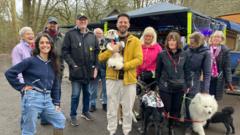
Consider the anatomy of a rally. Usually, we think of placards, megaphones, and shouted slogans. This was different. This was a rally of Presence. People stood in line for forty minutes, not because they were particularly thirsty, but because their physical presence served as a human shield against the memory of the violence. They were re-drawing the borders of the park. They were saying, with every cup of coffee purchased, that the geography of this place belongs to the "angel" behind the counter, not the darkness that tried to dim his light.
The tips started to pile up. The notes of encouragement began to wallpaper the kiosk.
Money is often a cold substitute for empathy, but in this context, it was a scorecard. Every dollar dropped into the jar was a vote for the world we want to live in versus the world we are afraid we are becoming. It provided Sahand with more than just a financial safety net; it provided him with a mirror. It allowed him to see himself not as a victim of a random act of hate, but as the centerpiece of a massive, sprawling family.
We often underestimate the stakes of these small interactions. We live in an era of deep fragmentation, where the "other" is often a caricature we see on a screen. But you cannot caricature the man who knows your name and makes your drink exactly the way you like it. In that moment of service, the labels of "immigrant" or "Iranian" or "stranger" dissolve. All that remains is the barista and the customer, two people navigating the complexities of a Tuesday morning together.
The attacker tried to isolate Sahand. That is the ultimate goal of hate—to make the victim feel like they are standing on an island, surrounded by a cold and indifferent sea. By rallying around him, the community built a bridge. They didn't just support a business; they protected a neighbor.
There is a specific kind of bravery required to return to the scene of a trauma. For Sahand, walking back into that kiosk wasn't just about earning a paycheck. It was an act of defiance. Every time he pulls a shot of espresso now, he is reclaiming the ground. He is proving that a single act of malice is no match for a thousand acts of grace.
The park is noisy again. The frother is hissing. The rhythmic clink of spoons against ceramic has returned.
But if you look closely at the people in line, you’ll notice they aren’t looking at their phones as much as they used to. They are looking at the man behind the window. They are making eye contact. They are saying "thank you" with a weight that wasn't there before. The geometry of the morning has been repaired, but the scars remain—not as marks of shame, but as reminders of the strength of the weave.
We are only as safe as the person standing next to us. When that person falls, we have two choices: we can look away and hope the shadows don't find us, or we can step into the light and hold the line. The people in the park chose to hold the line. They turned a crime scene back into a community, one cup at a time.
The steam continues to rise. The world is still complicated. But in one small corner of a park, the light is winning.