The map on the wall of a windowless briefing room doesn’t show people. It shows vectors, heat signatures, and supply lines. But if you look closely at the jagged border between Iraq and Iran, or the shadowed coastlines of the Persian Gulf, you aren't looking at geography. You are looking at a tripwire.
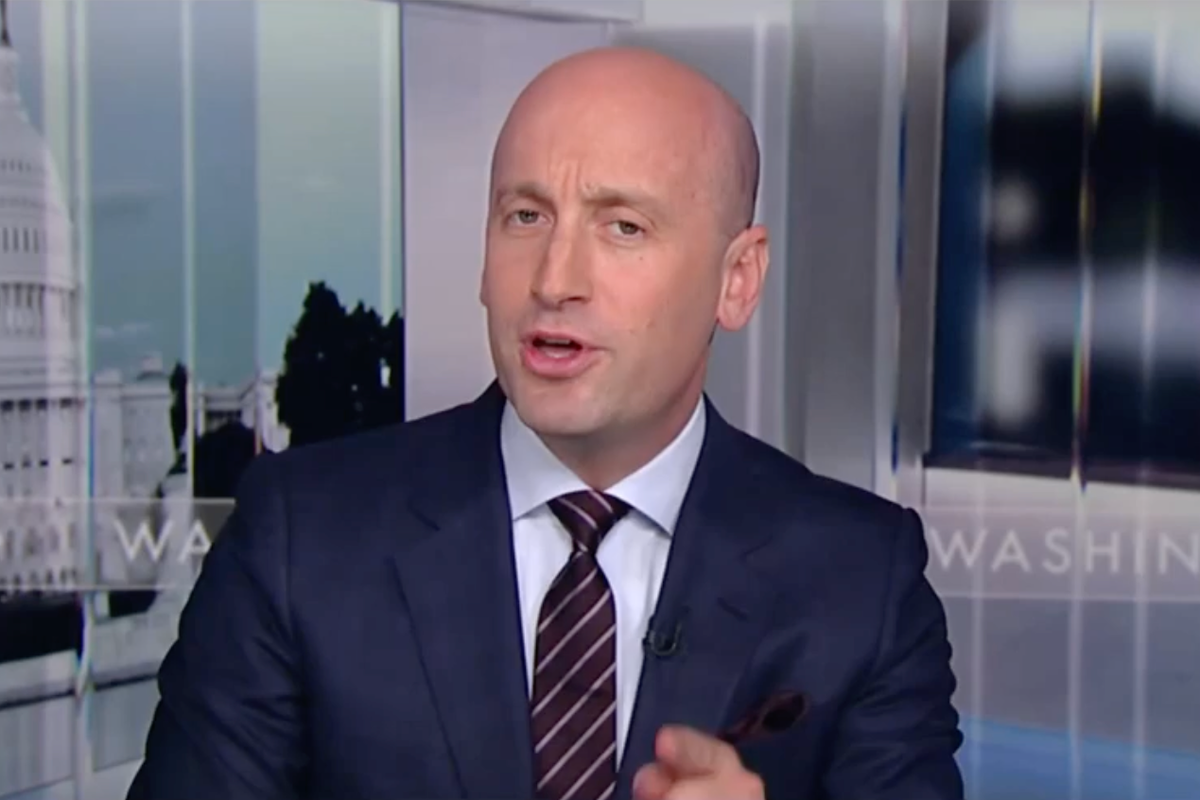
When Stephen Miller stands before a microphone to warn that a conflict with Iran could stretch out "indefinitely," he isn't just talking about a calendar. He is talking about a fundamental shift in how the American machine breathes. War is no longer a discrete event with a ribbon-cutting ceremony at the end. It has become a state of being. We have spent decades learning that you can start a fire in the desert in an afternoon, but you might spend the rest of your life trying to keep the smoke out of your lungs.
Consider a hypothetical young woman named Sarah. She wasn't born when the first ripples of modern Middle Eastern intervention began. Today, she sits in a cubicle in Virginia or stands on a flight deck in the Arabian Sea. For Sarah, "indefinite" isn't a political buzzword. It is the reason her father has a phantom limp and the reason her own children might grow up watching the same grainy footage of missile strikes on the evening news that she did as a toddler.
History is a heavy ghost.
Miller’s warning rests on a jagged truth: Iran is not a desert enclave that can be isolated. It is a regional nervous system. Its influence reaches into the Mediterranean through Hezbollah, into the Red Sea via the Houthis, and deep into the political bedrock of Baghdad. To strike at the center is to send a shockwave through every one of those nerves.
The math of modern warfare has changed. We used to measure victory in territory seized. Now, we measure "success" in the absence of total collapse. This is the trap of the indefinite. When the goal is "stability," the mission never actually ends because the world is, by its very nature, unstable.
The cost of this perpetual posture isn't just found in the trillion-dollar ledgers of the Pentagon. It’s found in the erosion of the American psyche. We have become a nation that expects the horizon to be on fire. We have conditioned ourselves to believe that "over there" will always be a problem that requires "over here" to stay on a permanent war footing.
If Miller is right—and the sheer gravity of regional alliances suggests he might be—then an Iranian conflict wouldn't be a sequel to Iraq or Afghanistan. It would be a different beast entirely. Iran’s geography is a fortress of mountains and vast plateaus. Its population is nearly 90 million. This isn't a regime that folds when the statues fall. It is a culture that views time through the lens of centuries, not four-year election cycles.
Think about the way a forest fire behaves when it hits an underground peat bog. You can douse the flames on the surface. You can declare the area safe. But weeks later, miles away, the ground begins to smoke. The fire was traveling through the roots.
That is the "indefinite" Miller fears.
The economic ripples alone would be enough to reshape a generation. We like to think we are insulated by our own energy production, but the global oil market is a single bathtub. If someone drops a lead weight in the Strait of Hormuz, the water level rises for everyone. The single mother in Ohio trying to afford the drive to work and the factory owner in Munich trying to keep the lights on are both tethered to a coastline they will never visit.
Money isn't the only currency being spent.
There is a specific kind of exhaustion that settles into a society when it is told that the "great struggle" has no expiration date. It breeds a cynicism that eats away at the pillars of civic trust. If the war is forever, then the emergency powers are forever. If the threat is permanent, then the transparency is optional. We trade our clarity for a sense of guardedness that never quite lets us sleep.
Miller’s rhetoric often strikes a chord because it taps into a very real, very raw American realization: we are tired of being told the exit is just around the corner. We have seen too many corners. We have walked too many miles.
The logic of intervention usually starts with a clean, sharp premise. We are told that a surgical strike or a "maximum pressure" campaign will yield a specific result. But the reality of the Middle East is more like a game of 3D chess where the board is made of liquid. You move a piece, and the entire surface ripples. You remove a threat in one valley, and three more grow in the shadow of the next ridge.
We must ask ourselves what happens to a democracy when it accepts the "indefinite" as a baseline.
The soldiers who would be sent to the Iranian front are the children of the soldiers who went to Kandahar. We are beginning to see families where military service isn't just a tradition, but a cycle of returning to the same geography to solve the same riddles. This creates a disconnect between the people who fight the "indefinite" wars and the people who watch them on a smartphone screen between TikTok videos.
That gap is dangerous.
It allows the stakes to feel abstract until the doorbell rings or the gas prices double. It allows us to treat geopolitical warnings like Stephen Miller’s as mere white noise in a crowded news cycle. But "indefinite" is a terrifying word when applied to human life. It means there is no plan for the day after. It means we are betting our future on the hope that we can outlast a fire that has been burning since the dawn of the modern age.
Imagine the silence of a town that has sent its youth to the same desert for three generations. That silence is the real cost of the indefinite. It is a quiet, hollowed-out space where the dreams of a nation used to be.
The warnings are not just about missiles or enrichment levels. They are about the soul of a country that might be one "indefinite" conflict away from forgetting what peace actually looks like. We are staring at a horizon that never moves closer, no matter how fast we run toward it.
The sun sets over the Potomac, reflecting off the stone monuments of men who fought wars with clear beginnings and definitive ends. Somewhere else, the sun is rising over a dusty outpost where a twenty-year-old checks his gear, wondering if his own son will one day stand in that exact same spot, looking at that exact same horizon, waiting for a fire that never goes out.