The fluorescent lights in the corridor do not buzz. They hum a flat, low note that gets inside your teeth. If you sit still enough in the holding cell, you can hear the precise second the second hand on the wall clock clicks forward. It sounds like a dry twig snapping.
For the people who spend their days inside the United Nations headquarters in New York, the concept of justice is often measured in resolutions, treaties, and the polite clinking of water glasses. But for those on the other side of the legal apparatus—the ones sitting in concrete boxes across the globe—justice is measured by that snapping twig. It is measured in time running out.
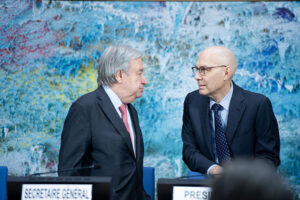
Recently, senior officials at the UN bypassed the usual diplomatic phrasing. They did not issue a standard, easily ignored memo. Instead, they made a direct, collective push for something that has eluded global consensus for decades: the universal abolition of the death penalty. They argued that the state-sanctioned taking of a life is not a tool of justice. It is an irreversible gamble played with a flawed deck.
To understand why this shift is happening now, we have to look past the leather-bound law books. We have to look at the machinery of the state through the eyes of the people caught in its gears.
The Margin for Error
Every human institution makes mistakes. We misplace keys. We miscalculate budgets. Doctors misdiagnose illnesses, and mechanics overlook faulty brakes. Usually, we can fix it. We can issue a refund, print a correction, or offer an apology.
The legal system is no different. It is built by humans, run by humans, and subject to every bias, blind spot, and bout of fatigue that plagues the human condition. Eyewitnesses misremember details under pressure. Forensic science, once thought infallible, evolves; bite-mark analysis and hair microscopy have been thoroughly debunked in recent decades.
But when the punishment is execution, the margin for error must be zero.
It never is.
Consider a hypothetical case, though one mirrored in hundreds of real-world transcripts. Let us call him Marcus. Marcus is twenty-two. He is quiet, easily confused, and cannot afford a private lawyer. He is convicted of a violent crime based on circumstantial evidence and a confession extracted after fourteen hours of continuous interrogation without sleep. Ten years later, DNA testing—a technology that did not exist during his trial—proves his absolute innocence.
If Marcus is serving a life sentence, the state can open the door. He can walk out into the sunlight. The state cannot give him his youth back, but it can give him his freedom.
But if the state executed Marcus in year nine, there is no remedy. There is no undoing. A posthumous pardon is just a piece of paper handed to a grieving mother. It is a confession of error wrapped in a shroud.
This is the core of the UN’s argument. The absolute permanence of the death penalty demands absolute perfection from a system that is inherently imperfect. When we retain capital punishment, we accept a terrifying mathematical certainty: eventually, we will execute an innocent person.
The Illusion of the Deterrent
The most common defense of the gallows or the gurney is simple intuition. If the penalty for a crime is death, a rational person will think twice before committing it. It sounds logical on paper. It makes intuitive sense when discussed over dinner.
The data, however, tells a completely different story.
Criminologists have studied this for generations. They look at states that abolished the death penalty and compared them to neighboring states that kept it. They look at murder rates before and after abolition. The pattern is stark. There is no measurable evidence that the threat of execution deters violent crime any more than the threat of life imprisonment.
Why? Because violent crime is rarely the product of a cold, rational cost-benefit analysis.
People do not stand in a dark alley, holding a weapon, weighing the sentencing guidelines of the local penal code. Violent crimes are almost always committed in moments of blinding rage, severe intoxication, acute mental illness, or desperation. In those moments, the future does not exist. The consequence does not exist. The brain is firing on pure adrenaline and panic.
By the time the individual sits in a courtroom, staring at a judge, the deterrent has already failed.
The UN leaders pointed to this reality not to minimize the horror of violent crime, but to expose the emptiness of the policy. If capital punishment does not keep communities safer, if it does not stop the next hand from lifting a weapon, then it ceases to be a measure of public safety. It becomes something else entirely. It becomes a ritual of vengeance.
The Weight on the Executioner
We often talk about the condemned. We rarely talk about the people who have to carry out the sentence.
The state is an abstract concept, but the state does not pull the lever. The state does not mix the chemicals. The state does not tie the straps across a human being’s chest. People do.
Men and women who work in correctional facilities are tasked with maintaining order, providing rehabilitation, and keeping the public safe. But in jurisdictions that retain the death penalty, a small group of these workers is asked to become mechanics of death.
The psychological toll of this duty is heavy, quiet, and largely hidden from public view. Former executioners and prison wardens have spoken out about the nightmares that follow them decades after they retire. They talk about the smell of the room. They talk about the final words spoken by a person looking them directly in the eye. They talk about the profound cognitive dissonance of spending months keeping a prisoner healthy and alive, only to kill them on a scheduled Tuesday at midnight.
When a society chooses to use the death penalty, it delegates its darkest impulses to ordinary citizens. It asks a guard, who might have a family at home, to carry the memory of taking a life for the rest of their days. The trauma ripples outward, touching not just the families of the victims and the families of the condemned, but the very people paid to enforce the law.
Shifting Global Currents
The momentum toward abolition is not a sudden trend. It is a slow, steady erosion of an ancient practice.
A century ago, the death penalty was a standard tool of governance worldwide. Today, a clear majority of nations have abolished it either in law or in practice. Every year, more countries quietly dismantle their death rows, recognizing that the practice is incompatible with modern understandings of human rights and dignity.
The UN’s recent call is an attempt to close the gap on the remaining holdouts. The officials emphasized that the retention of the death penalty often correlates with systemic flaws within judicial systems—where marginalized communities, the poor, and political dissidents are disproportionately targeted. Without wealth, securing adequate legal representation is a monumental struggle, making the ultimate penalty a reflection of a defendant’s bank account rather than the gravity of their crime.
It is easy to look at global politics and see only division, bureaucracy, and endless debate. But beneath the diplomatic language lies a fundamental question about what kind of world we want to construct.
Justice is not found in matching the cruelty of the offender. True justice is stronger than that. It is steady. It is clear-eyed. It acknowledges that the state’s primary duty is to protect human dignity, even when that dignity has been deeply scarred.
The clock on the wall continues to click. In various corners of the world, individuals are counting those dry, snapping sounds, waiting for a date that has already been circled in red ink. The push from international leaders is a reminder that the power to stop that clock rests entirely in our hands.


