Most people kick a rock out of the way and keep walking.
We are conditioned to treat the ground beneath our boots as dead weight, an obstacle to be cleared so we can plant a vineyard, pour a concrete foundation, or run a tractor down a straight line. In the rural stretches of the Dalmatian hinterland, where white karst limestone bleeds through the red earth like bone through skin, stones are practically a crop of their own. Farmers spend generations pulling them out of the soil just to make room for cabbages and vines. You stack them into dry-stone walls, you crush them for gravel, or you toss them into a ditch at the edge of the field.
For nearly half a century, a retired architect in the Croatian municipality of Dicmo did something entirely different.
He bent down. He brushed the soil away with his thumb. He looked at the curve of a chisel mark, the subtle flare of a molding, the deliberate geometry of a block that refused to look like a product of wind and rain. And then, piece by heavy piece, he carried them home.
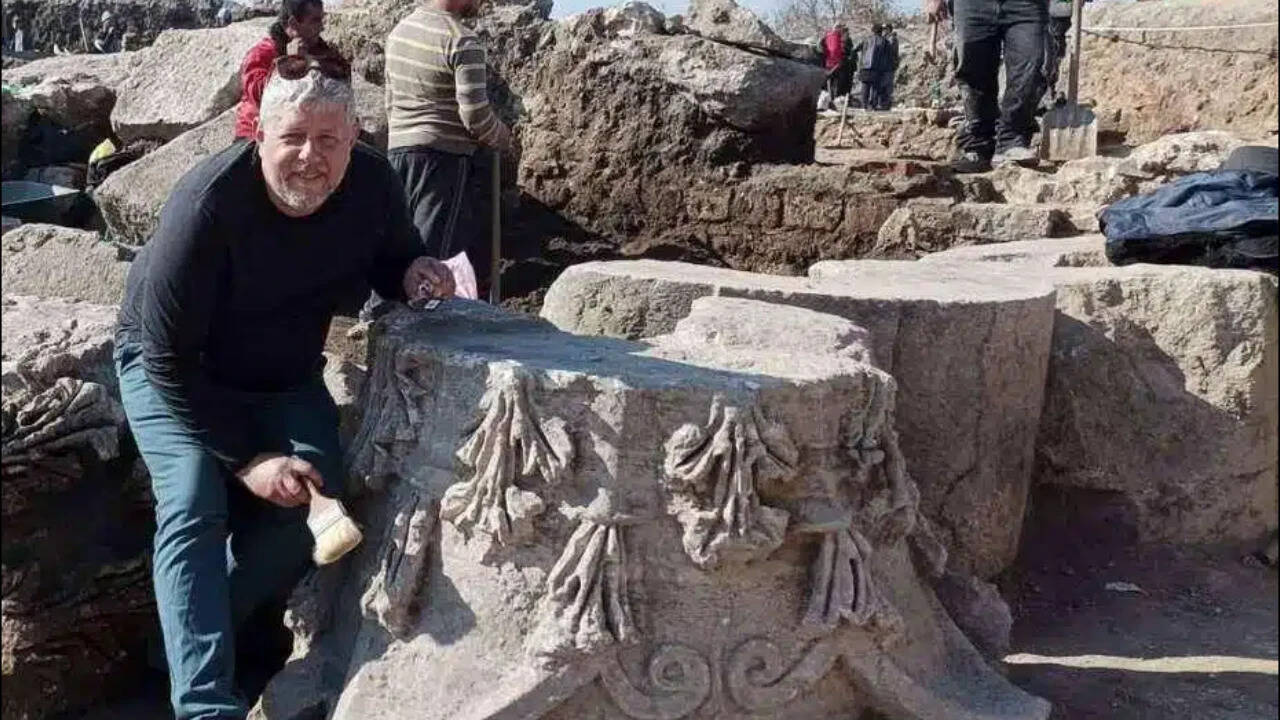
That quiet, stubborn habit—sustained across fifty years without funding, institutional backing, or the promise that anyone would ever care—has just rewritten a piece of Roman history. Archaeologists examining the collection assembled on his family's land have confirmed that these scattered fragments belong to a lost, 1,900-year-old Roman triumphal or monumental arch erected in honor of Emperor Trajan.
Stop and let the weight of that sink in. Not a coin. Not a potsherd. A monumental imperial arch, standing along a vital Roman artery in the province of Dalmatia, vanished so completely from the surface of the earth that only one man's refusal to ignore the dirt brought it back into human memory.
The Architecture of Obsession
To understand why this matters, you first have to understand how an architect looks at a ruin.
When I first started walking ancient sites in the Balkans years ago, I made the classic amateur mistake: I looked for walls. I looked for columns still standing against the sky, for mosaics rotted open under corrugated tin roofs, for the obvious theater of antiquity. If a field looked like a sheep pasture, I treated it like a sheep pasture. It took an older surveyor—a man with knees ruined from crouching in trenches—to teach me how to read the ground. He picked up a fist-sized chunk of limestone from a drainage ditch and showed me a flat, dressed plane less than three inches wide. "Nature hates a straight edge," he told me. "When you see a line that doesn't wobble, someone paid a mason to sweat for it."
That is the curse and the gift of architectural training. Once your eyes are calibrated to proportion, load-bearing logic, and classical ornamentation, you cannot turn it off. You do not see rubble. You see the ghost of a blueprint.
Imagine our retired architect in Dicmo—let's call him Marko for a moment, though his real name is less important than the rhythm of his decades—walking his family's property in the 1970s. Yugoslavia was modernizing fast. Tractors were getting heavier, plows were biting deeper into the earth, and rural communities were focused on the future, not the imperial dust beneath their boots. Every spring thaw pushed new stones to the surface. Most neighbors saw nuisance. Marko saw entablature.
Consider what happens next when a single person decides to become the unofficial custodian of a mystery.
There is no glamour in rescuing heavy limestone. A modest architectural fragment—a piece of an architrave, a section of a cornice with weathered dentils, a block bearing the faint curve of a Latin inscription—can easily weigh eighty, a hundred, two hundred pounds. You do not slip it into your pocket. You lever it out of the mud with an iron bar. You load it into a wheelbarrow or the trunk of an old car. You scrape your knuckles raw. You stack it beside your house while neighbors wonder aloud why you are hoarding rocks when there is plenty of limestone sitting free on every hillside in Dalmatia.
Doubt creeps in during year ten. It settles into your bones by year twenty-five. What if these blocks are just the remains of a modest local villa? What if they are pieces of an early Christian basilica, or a forgotten medieval farmstead, or scattered fill hauled in from miles away to shore up a muddy track? Without a stratigraphic excavation, without a team of epigraphers translating inscriptions under raking light, a pile of carved stones in a yard looks suspiciously like eccentricity.
Yet he kept going. Forty years. Forty-five. Nearly fifty.
Why a Roman Arch Vanishes in the First Place
People often ask how something as massive as a Roman arch—built of quarried stone, engineered to celebrate an emperor who ruled from the sands of Mesopotamia to the mists of Britannia—can simply disappear. We picture Rome as permanent, all marble forums and indestructible aqueducts.
The truth is far more brutal and entirely human.
When the Western Roman Empire fractured and central authority evaporated in Dalmatia during late antiquity and the early medieval migrations, monumental architecture underwent a sudden, pragmatic demotion. A triumphal arch straddling a Roman road was no longer a symbol of imperial glory. It was a pre-cut quarry.
Think about the economics of survival in the seventh or eighth century. Quarrying fresh stone from a mountain face requires iron tools, timber for wedges, oxen, ropes, and organized labor. Dismantling an abandoned Roman monument requires only a crowbar and a willingness to let the past feed the present. Over centuries, local builders pried apart the blocks of Trajan's arch. The finest ashlar blocks were hauled off to build parish churches, defensive towers, lime kilns, and sturdy farmhouses. Inscriptions were turned face-inward so the flat backs could serve as lintels over barn doors. What remained—the cracked moldings, the awkward corner fragments, the pieces too battered to lay neatly in a wall—was left to sink into the plow zone.
Earth is patient. Leaves rot into loam; winter rains wash silt down from the surrounding karst hills; roots pry apart cracks and pull masonry downward. Within a few generations, a monument meant to last eternity becomes an uneven bump in a pasture. Within a millennium, even the memory that an arch ever stood there is gone.
Dicmo sits in a natural corridor—a flat, fertile polje tucked between rugged mountain ridges that separate the Adriatic coast from the deep interior of the Dinaric Alps. In antiquity, this was not a sleepy backwater. It was a vital transit zone connecting the bustling coastal capital of Salona—one of the largest cities in the Roman world, just a short journey away near modern Split—with the military camps and mining districts of the interior, including Aequum and Tilurium.
Roads were the nervous system of Rome. And along those roads, monuments were the punctuation marks.
The Fingerprint of Trajan
When archaeologists finally examined the decades-long collection gathered from the family land in Dicmo, the puzzle pieces snapped together with a clarity that stunned even seasoned specialists.
The proportions of the moldings, the style of the relief carving, and the surviving fragments of monumental lettering pointed directly to the early second century AD—the reign of Marcus Ulpius Traianus, better known as Trajan.
To grasp the emotional weight of that identification, picture the Roman world around 100 to 117 AD. Trajan was the Optimus Princeps—the "Best Ruler"—an emperor born in Spain who pushed the borders of the empire to their greatest geographical extent. After his brutal, triumphant campaigns across the Danube in Dacia, immense wealth flowed back into the empire. But Trajan did not merely hoard gold in Rome; he poured resources into infrastructure across the provinces. He rebuilt roads, constructed bridges, drained marshes, and fortified frontiers.
In Dalmatia, upgrading the road network linking Salona to the Danube frontier was a strategic necessity. Troops, supplies, tax revenues, and imperial dispatches moved constantly along these corridors. And wherever Rome invested heavily in roads and civic loyalty, local elites and imperial administrators erected arches.
An arch in the Roman provinces was never just decoration. It was an ideological threshold.
Imagine being a traveler—a legionary marching home after twenty years on the frontier, a merchant driving mule trains loaded with salt and olive oil, or a local Illyrian farmer taking produce to market—and rounding a bend in the Dicmo valley to see gleaming white limestone rising out of the plain. Above your head, carved in crisp, deep-cut Roman capitals designed to catch the Balkan sun, ran the titles of Trajan: Imperator, Caesar, Nerva Traianus Augustus, Germanicus, Dacicus. Passing beneath that vault meant stepping inside the tangible reach of Roman order. It declared, without a single soldier needing to draw a sword, You are standing in the emperor's domain.
Then, for nearly two thousand years, that message went silent.
What Institutions Miss
There is an uncomfortable truth buried inside this discovery that professional archaeology rarely likes to admit out loud.
Modern heritage preservation is chronically underfunded, reactive, and stretched thin across thousands of square miles of territory. In regions like Croatia, where you can scarcely dig a trench for a water pipe without hitting an Illyrian burial mound, a Roman villa, or a medieval cemetery, state archaeologists are perpetually fighting fires. They race from one emergency salvage dig to the next ahead of highway construction, hotel developments, and urban sprawl.
They cannot walk every family orchard in Dicmo every spring for fifty years.
If that retired architect had waited for an official survey team to knock on his gate, Trajan's arch would still be scattered across those fields—or worse, shattered by deep-tilling machinery and ground into roadbed gravel. Official archaeology found the monument only because one private citizen possessed two traits no grant application can replicate: lifelong proximity and professional obsession.
Consider the sheer friction he had to overcome. Collecting antiquities privately is a delicate, often misunderstood gray zone in Europe. In many countries, people who find carved stones on their land hide them out of fear that the state will swoop in, halt farming on their property, and entangle them in endless bureaucracy. Others sell them quietly to private collectors, stripping the stones of their geographic context and rendering them scientifically useless.
What makes the Dicmo story extraordinary is that the architect did neither. He treated the land as an archive, keeping the fragments together on the very soil where they had fallen, preserving their provenance until experts could read the whole story.
How to Read a Shattered Monument
You might wonder how archaeologists can look at a collection of broken stones—none of them stacked in their original positions—and confidently declare, This was a monumental arch for Trajan.
It works much like forensic reconstruction, or assembling a jigsaw puzzle when eighty percent of the pieces are missing and the box lid was burned centuries ago.
First comes the geometry. A freestanding Roman arch has an unmistakable structural vocabulary. Unlike a rectangular temple or a basilica, an arch requires voussoirs—wedge-shaped stones engineered to transfer weight outward and downward across an open span. Even a partial voussoir betrays the exact radius of the arch's curve. Measure three or four curved fragments, run the math, and suddenly you know whether you are looking at a modest doorway or a towering gateway wide enough for Roman wagons.
Next comes the ornamentation. Roman architectural decoration followed strict imperial fashions, almost like a visual timestamp. The way an acanthus leaf is drilled on a Corinthian capital, the depth of the shadow lines in a dentil frieze, the profile of a cyma recta molding—these details shifted subtly from the Flavian dynasty to Trajan, and from Trajan to Hadrian. Trained eyes can date a six-inch fragment of carved cornice within a couple of decades.
Finally, there is the epigraphy—the lettering. Roman monumental inscriptions were masterpieces of graphic design. Masons laid them out with compasses and straightedges, carving V-shaped channels that created razor-sharp shadows in bright daylight. Even when an inscription is shattered into fragments bearing only two or three letters each, epigraphers can match the exact height of the letters, the spacing between lines, and the imperial titulature. When the fragments yield sequences that fit Trajan's specific victory titles—and match known dedications along Dalmatian roads—the hypothesis hardens into certainty.
What once looked like a pile of weathered yard rocks suddenly resolves, in the mind's eye, into a towering limestone gateway straddling an ancient highway.
The Quiet Heroism of Paying Attention
We live in an era obsessed with spectacle and speed. We celebrate breakthroughs that happen overnight, discoveries made by satellites scanning jungles with lasers, or algorithms sifting millions of data points in seconds. Those tools are remarkable. I have marveled at lidar maps revealing entire Maya cities beneath canopy cover that human eyes missed for centuries.
Yet lidar cannot see a single carved cornice half-buried in a plowed field in Dicmo. Algorithms do not walk the same hundred acres every autumn after the rain washes the dust off the stones.
There is something deeply moving—almost subversive—about a person dedicating fifty years of quiet, unapplauded labor to saving pieces of a world that vanished two millennia ago. He knew he would never rebuild the arch himself. He knew that for most of his life, the only audience for his collection would be himself, his family, and the wind blowing down from the mountains.
He did it anyway because an architect understands a fundamental truth about human civilization: we are built on top of what came before, and when we let the foundations vanish without a trace, we make ourselves smaller.
Next time you walk across an old field, a riverbank, or a stretch of rocky ground anywhere in the world, slow down for ten seconds. Look at the stones at your feet. Almost all of them will be ordinary geology, shaped by frost and gravity.
Except every once in a while, one of them has a straight edge that nature never made—waiting half a century for someone patient enough to pick it up.