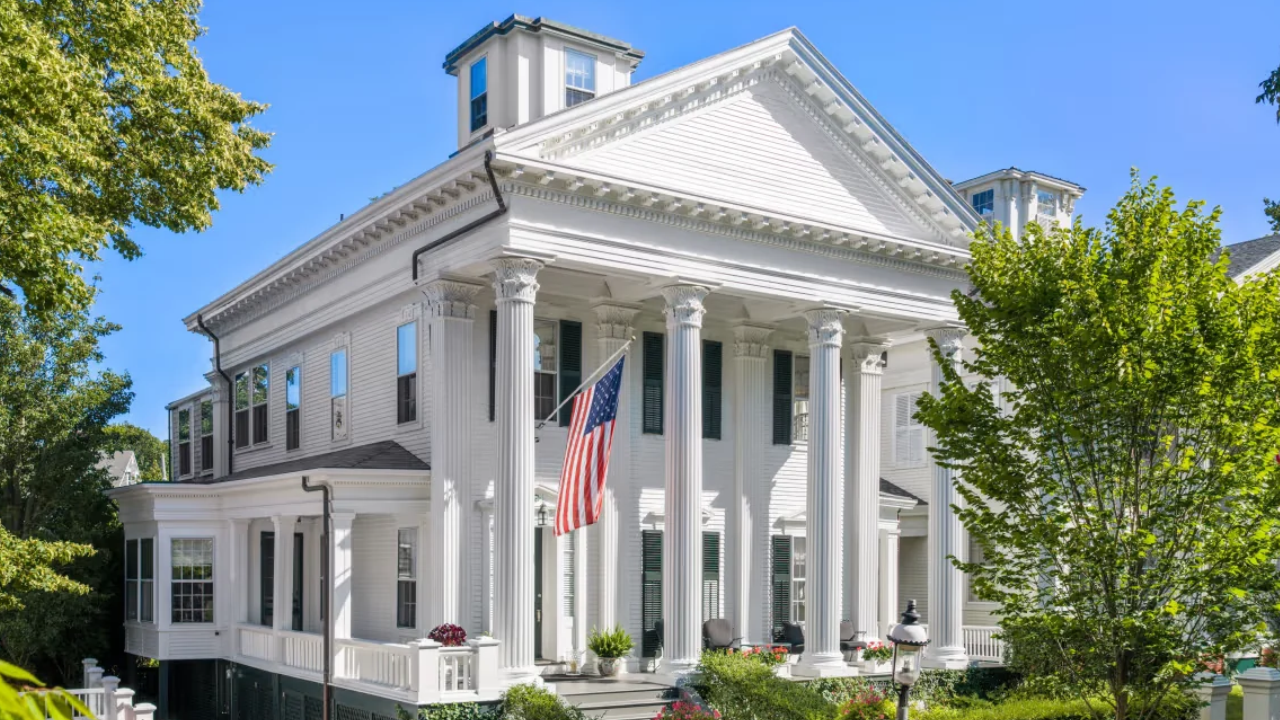
Fifteen million, two hundred and fifty thousand dollars.
Say the number out loud, and it sounds like an abstraction—a line item on a private wealth ledger, a record-breaking headline meant to dazzle commuters scrolling on their morning trains, or the price tag of a superyacht that never touches a working harbor. When the Hadwen-Wright House at 94 Main Street in Nantucket closed for $15.25 million, the real estate tickers spat out the metrics with predictable breathless efficiency. Built in 1846. Greek Revival. Whaling fortune. Historic preservation.
And then, buried in the subheadings like a footnote to an architectural tour, came the detail that actually matters: hidden cistern preserved.
Most people read past those three words without blinking. They picture a dusty brick hole in the dirt, a quirky relic of nineteenth-century plumbing that a wealthy buyer indulged the way one might keep an antique brass telescope in a sun-drenched parlor. If you have ever walked the cobblestone spine of Nantucket’s Main Street in the dead of February—when the summer ferries are dry-docked, the hydrangeas are brittle skeletons, and the Atlantic wind screams off the shoals with enough force to rattle the teeth in your skull—you know better. You know that on a sandbar thirty miles off the coast of Cape Cod, water is not a utility. It is survival.
To understand why a subterranean brick chamber beneath a $15.25 million mansion is the beating heart of the entire transaction, you have to strip away the manicured boxwoods, the white-gloved provenance, and the romantic haze of coastal luxury. You have to look at what happens when immense wealth collides with fragile, unforgiving geography.
The Architecture of Anxiety
Walk up to 94 Main Street today, and the house greets you with the quiet, imposing symmetry of the Greek Revival era. Four fluted Ionic columns anchor the front portico, holding up a heavy pediment that looks less like a New England cottage and more like a temple transported from Athens to the North Atlantic. It was built for Eunice Hadwen, daughter of Joseph Starbuck—a man whose ships hunted sperm whales across the Pacific and brought back liquid gold in wooden casks—and her husband, William Hadwen, a silversmith turned whale-oil merchant.
In 1846, Nantucket was at the zenith of its global power and the precipice of its ruin. That very summer, the Great Fire of 1846 tore through the town’s wooden core, reducing thirty-six acres of wharves, warehouses, and homes to smoking ash because the town’s water supply ran dry mid-blaze.
Pause and let that sink in. Imagine standing on a windswept island surrounded by an infinite ocean, watching your livelihood burn to the ground because you cannot drink, pump, or throw salt water onto the flames without ruining everything it touches, and your fresh water has vanished.
That is the invisible terror baked into the mortar of the Hadwen-Wright House. When the builders dug beneath the foundation in 1846 to construct a massive, vaulted brick cistern capable of holding thousands of gallons of rainwater channeled from the roof, they were not indulging an aesthetic whim. They were building a fortress against scarcity.
Consider a hypothetical buyer today—let’s call him Arthur, a composite of the modern principals who actually trade in eight-figure island real estate. Arthur comes from a world of frictionless abundance. In Manhattan or Greenwich, water arrives through municipal pressure; power returns via automated backup generators within seven seconds of an outage; problems are solved by wiring money to contractors. When Arthur first steps through the front door of 94 Main Street, his eyes are drawn to the twelve-foot ceilings, the hand-carved mahogany banisters, and the original heart-pine floorboards wide enough to lay a dining table across. He sees status. He sees permanence.
Then the inspector hands him a flashlight and leads him down the steep cellar stairs.
Down there, away from the curated sunlight of Upper Main Street, the air smells of damp lime, salt, and cool earth. The flashlight beam sweeps across a curved dome of nineteenth-century brickwork, mortared with hydraulic cement designed to hold water under pressure without weeping a drop. There is no marble. There is no designer hardware. Yet, standing in that cellar, Arthur experiences the exact emotional shift that separates a tourist from a steward. He realizes he hasn't just bought a house. He has bought a machine designed to keep human beings alive on an isolated rock in the middle of the sea.
Why Preservation Is Never Nostalgia
There is a persistent, comfortable myth among outsiders that historic preservation on islands like Nantucket is just rich people playing dress-up in the past. Critics look at the Nantucket Historic District Commission—a body famous for regulating everything from shingle weathering to the exact shade of white trim—and see red tape masquerading as taste.
Having spent years watching old coastal structures survive—and fail—against the Atlantic, I can tell you that this view gets the mechanics of survival completely backward.
Think of a nineteenth-century coastal mansion like a wooden hull built for blue-water sailing. Modern construction is built like a fiberglass speedboat: light, rigid, sealed tight with synthetic foams and vapor barriers, and utterly dependent on mechanical HVAC systems to keep from rotting from the inside out. When a modern coastal house loses power during a winter nor'easter, moisture gets trapped inside the walls, drywall turns to papier-mâché, and black mold blooms within seventy-two hours.
Old houses like the Hadwen-Wright House were built to breathe. Their plaster is lime-based, allowing moisture to pass through and evaporate harmlessly. Their framing is old-growth timber, dense with natural resins that repel insects and rot far better than any modern kiln-dried pine from a big-box lumberyard. And their subterranean cisterns? They represent an engineering logic that modern municipalities are only now scrambling to rediscover: decentralized water resilience.
During the renovation and stewardship of 94 Main Street, preserving that hidden cistern was not the easy path. In high-end residential construction, basement square footage is pure gold. A developer looking strictly at cost-per-square-foot sees an antique brick water tank and sees dead space—an obstacle in the way of a temperature-controlled wine cellar, a home theater, or a private wellness spa. Demolition is fast. You bring in a jackhammer crew, haul the brick out in wheelbarrows, pour a flat concrete slab, and add 400 square feet of "habitable luxury" to the listing sheet.
Preserving it requires the exact opposite: patience, specialized masonry knowledge that almost nobody practices anymore, and a willingness to leave money on the table in service of structural integrity. Brick cisterns act as thermal and hydrological anchors. Ripping a massive vaulted masonry structure out of a high-water-table island basement changes how groundwater presses against the remaining foundation walls. You pull one thread out of an 1846 engineering tapestry—excuse me, out of an 1846 engineering weave—and the whole garment begins to sag.
The Invisible Stakes of the $15.25 Million Price Tag
When headlines announce that a historic property has fetched $15.25 million, the public conversation immediately splits into two predictable camps. One side marvels at the appreciation of coastal real estate; the other laments that regular working families have been priced out of paradise.
Both reactions miss the deeper tension playing out beneath the surface of Nantucket’s real estate market.
The island is currently caught in a quiet civil war between two incompatible visions of wealth. On one side are the "teardown speculators"—buyers who acquire historic lots not for the buildings sitting on them, but for the dirt underneath, scraping away century-old craftsmanship to erect sprawling, standardized mega-compounds with infinity pools and subterranean bowling alleys. On the other side are the preservation buyers, the ones willing to pay a massive premium—$15.25 million in the case of 94 Main Street—precisely because the bones of the original architecture remain intact.
Here is the uncomfortable truth that rarely makes it into real estate press releases: historic preservation at this level is wildly expensive, deeply frustrating, and fraught with uncertainty.
Ask anyone who has restored a nineteenth-century Greek Revival home on an island where every bag of lime mortar, every custom-milled cedar clapboard, and every master carpenter has to arrive via the Steamship Authority ferry. You open a wall to update the electrical wiring, and you find a structural beam notched by a shipwright in 1847 that requires three weeks of custom ironwork to reinforce without disturbing the plaster ceiling in the room above. You pay three times mainland labor rates. You wait months for historic board approvals. At two in the morning, when sideways rain lashes the antique wavy-glass windows, you wonder why on earth you didn't just buy a turn-key villa in Palm Beach where everything is new, warranty-backed, and predictable.
I have stood in basements like the one at 94 Main Street with owners who looked genuinely terrified by the responsibility they had just purchased. Because when you buy a landmark, you never truly own it. You are merely the current name on a lease that stretches backward to the whaling captains and forward to generations you will never meet. If you let the roof leak, if you let the foundation crack, if you smash the cistern to build a screening room, you aren't just hurting your own resale value. You are erasing physical evidence of how human beings once adapted to one of the harshest maritime environments in North America.
What the Water Remembers
Look closely at the details of the Hadwen-Wright House sale, and you start to see why this specific closing sent a ripple through architectural circles far beyond Massachusetts.
The house sits on the "Three Bricks" stretch of Upper Main Street—a row of stately homes built by Joseph Starbuck for his sons, flanked by the twin Greek Revival mansions he built for his daughters, Eunice Hadwen and Mary Swain. For nearly two centuries, this single block has served as a physical timeline of American ambition. The wealth that built these fluted columns came from the slaughter of whales in the far corners of the Pacific, a brutal, extractive industry that lit the lamps of London and New York before kerosene rendered it obsolete overnight.
When the whaling industry collapsed in the 1850s, Nantucket didn't gracefully transition into a resort town. It went broke. Population plummeted by more than half. Houses stood empty, paint peeling in the salt air, roofs sagging under winter snows. The island survived the late nineteenth century only because people were too poor to tear down the old buildings and replace them with Victorian monstrosities. Poverty preserved Nantucket’s architecture long enough for twentieth-century wealth to discover it.
And inside the cellar of 94 Main Street, that hidden cistern waited through all of it. It held water during the Civil War. It sat silent through the Great Depression, when mainlanders bought historic Nantucket homes for a few thousand dollars just to escape the summer heat. It endured the hurricanes of 1938 and 1944, the blizzards of 1978, and the slow, inexorable rise of the surrounding Atlantic.
Today, as coastal communities across the globe confront rising sea levels, saltwater intrusion into freshwater aquifers, and aging municipal infrastructure, that nineteenth-century brick chamber suddenly looks less like a museum piece and more like a blueprint. Nantucket draws its drinking water from a sole-source aquifer beneath the island—a fragile lens of fresh water floating atop heavier salt water. Every new swimming pool, every irrigated lawn, every oversized guest house puts pressure on that lens.
The builders of 1846 understood something we spent the twentieth century trying to forget: you cannot separate a house from the ecological limits of the ground it stands on. When rain fell on the slate and wood shingles of the Hadwen-Wright House, the gutters didn't dump it into a storm drain to wash out to sea. They captured it, filtered it through charcoal and sand, and stored it in the cool dark beneath the house.
The Real Price of Permanence
If you walk past 94 Main Street tonight, the house will look much as it did when William and Eunice Hadwen first lit whale-oil lamps behind its front windows. Warm amber light spills across the white Ionic columns. The brick sidewalk, uneven from centuries of frost heaves and tree roots, glistens faintly with evening fog rolling in from the harbor.
Passersby will pause on the cobblestones, pull out their phones, and snap a photo. Someone in the group will inevitably mention the price—fifteen and a quarter million dollars—and shake their head at the sheer excess of modern wealth.
They are looking at the wrong part of the house.
Anyone with enough liquidity can buy columns, manicured hedges, and a prestigious zip code. What cannot be manufactured, rushed, or bought off a showroom floor is continuity—the unbroken chain of human ingenuity that connects a shipwright’s hand-hewn beam to a modern preservationist’s restraint.
Down beneath the wide-plank floors, past the cellar stairs and behind the heavy masonry door, the curved brick dome of the cistern sits cool, dark, and intact. Outside, the Atlantic wind still howls off the shoals, indifferent to real estate records, indifferent to fortunes won and lost, waiting to test whatever we leave standing on the sand.