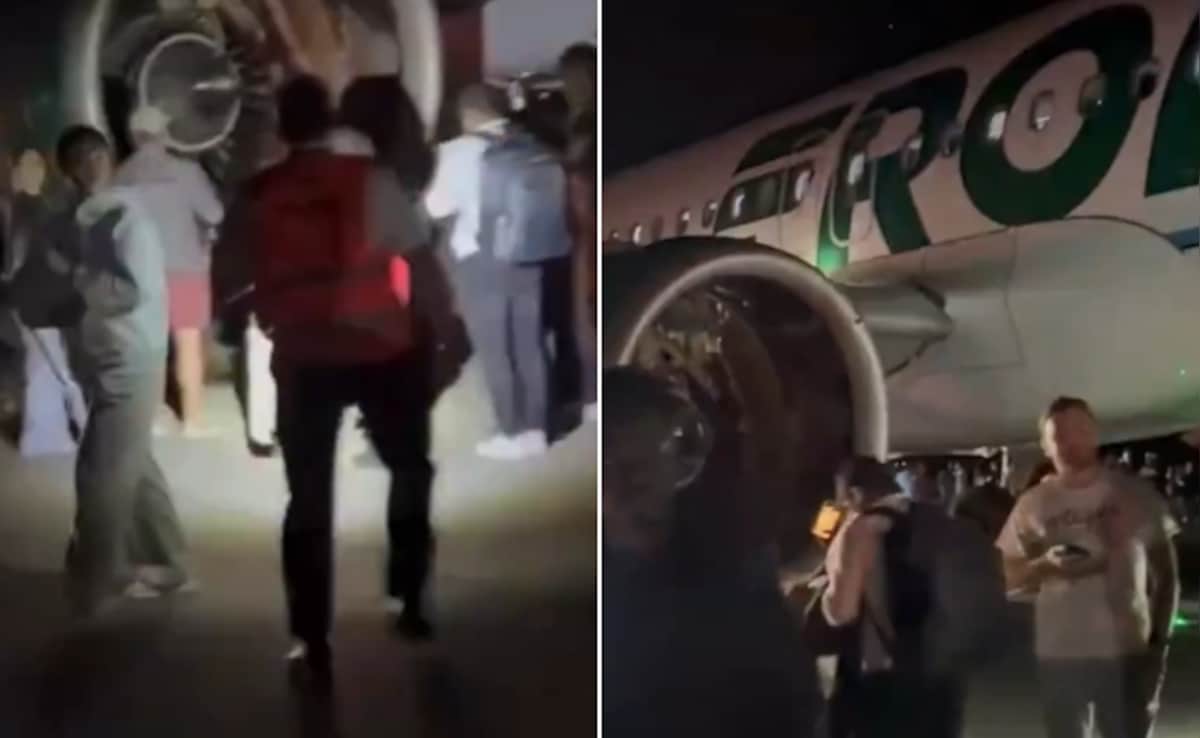
The audio is chilling not for its drama, but for its flat, professional detachment. "We think we just hit someone," the pilot reports to the tower. There is no screaming, no frantic gear-shifting in tone. Just a pilot realizing that a multi-million dollar machine has just ended a human life on a slab of concrete designed to be one of the most controlled environments on earth. This recent tragedy on a United States runway is not a freak accident. It is a systemic failure of high-tech surveillance and low-tech communication that has been brewing for decades.
Airports are fortresses. We undergo intrusive body scans, our luggage is X-rayed by machines capable of detecting microscopic traces of nitrates, and perimeter fences are topped with razor wire. Yet, the runway remains a vulnerability. When a person is struck and killed on an active runway, it represents a total collapse of the "Swiss Cheese" model of safety. Too many holes aligned at once.
The primary question is simple. How does a human being walk into the path of a departing or landing aircraft without a single alarm sounding? The answer lies in the crumbling effectiveness of Ground Movement Radar and the terrifying reliance on the human eye in an age of automated flight.
The Myth of Total Surveillance
Most major commercial airports rely on a system known as ASDE-X (Airport Surface Detection Equipment, Model X). It is an expensive, sophisticated suite of tools designed to track every moving part on the airfield. It integrates radar, multilateration, and ADS-B data to give controllers a "god view" of the tarmac.
But ASDE-X has a dirty secret. It is tuned to find metal.
The system is designed to prevent "runway incursions," which usually means one plane wandering into the path of another. It filters out "clutter"—birds, rain, wind-blown debris—to keep the screen from becoming a chaotic mess of false positives. A human body, lacking a transponder and possessing a small radar cross-section, often falls right into that filter. Unless a person is driving a vehicle with a registered beacon, they are essentially invisible to the very technology meant to keep the runway clear.
This creates a "dark zone" where the only line of defense is the naked eye of an air traffic controller, often sitting in a tower hundreds of feet up and potentially miles away from the incident site. During night operations or low-visibility weather, that defense is non-existent.
Why Perimeter Security Fails
Investigative looks into recent runway fatalities often point toward the fence line. We assume a breach. We assume a security failure. However, the harder truth is that many of these victims are individuals with authorized access—contractors, maintenance crews, or ground staff—who suffer from "habituation."
When you spend eight hours a day, five days a week, surrounded by the roar of jet engines, the danger loses its edge. The runway ceases to be a lethal zone and becomes just another workplace.
The Psychology of Habituation
- Auditory Masking: In a busy airport environment, the directional sound of a single approaching aircraft can be drowned out by the ambient roar of auxiliary power units and distant takeoffs.
- Visual Compression: From a distance, a plane moving at 150 knots toward you doesn't look like it's moving fast. It looks like it's growing larger, until the final three seconds when the rate of closure becomes inescapable.
- Communication Gaps: Ground crews often operate on different radio frequencies than the pilots and the tower. If a maintenance worker wanders fifty feet past a safety line, the pilot landing a mile away has no direct way to hear or see the warning until it is too late.
The Technology That Exists But Isn't Used
We have the tech to stop this. We simply haven't bought it yet.
Thermal imaging and AI-driven optical sensors can differentiate between a plastic bag and a human being with startling accuracy. Systems like "Foreign Object Debris" (FOD) detection use millimeter-wave radar to find a single dropped bolt on a runway. If a system can find a bolt, it can certainly find a person.
The barrier is cost and bureaucracy. Installing FOD detection across every major runway in the U.S. would cost billions. Most airport authorities weigh that cost against the statistical rarity of a human strike. They choose to accept the risk, relying on legacy radar and "look out the window" protocols. It is a cold, actuarial calculation that looks fine on a spreadsheet until a pilot has to call the tower to report a body on the asphalt.
The Pilot's Impossible Position
Consider the physics. A Boeing 737 on short final is a 150,000-pound projectile traveling at roughly 170 miles per hour. The pilots are focused on the "touchdown zone," monitoring airspeed, glideslope, and crosswinds. Their peripheral vision is limited. Even with high-intensity landing lights, a person wearing dark clothing on a rain-slicked runway is virtually invisible until the aircraft is within a few hundred feet.
At that speed, the distance covered in the time it takes for a pilot to blink is greater than the distance required to steer clear. There is no "swerving" a commercial airliner. There is only the impact and the subsequent, haunting radio call.
Broken Chains of Command
The FAA and the NTSB will look at the "chain of events." They will find that a gate was left unlatched, or a radio was set to the wrong channel, or a supervisor didn't account for a team member during a shift change.
These are the "hows." The "why" is more damning. The "why" is that we have built a multi-billion dollar aviation infrastructure that prioritizes the movement of metal and fuel over the granular tracking of life on the ground. We have automated the flight deck, but we have left the safety of the ground to 1940s-era visual scans and 1980s-era radar logic.
The industry likes to call these "isolated incidents." But when you look at the increasing frequency of near-misses and ground incursions over the last three years, a pattern emerges. The system is stressed. Staffing shortages in towers mean controllers are working mandatory overtime, leading to fatigue. Ground crews are being squeezed for faster turnarounds.
When you increase the speed of a system without upgrading its safety net, people die.
The Infrastructure Gap
- Legacy Radar: Most towers still use primary radar that struggles with non-metallic targets.
- Frequency Congestion: Critical warnings often get "stepped on" during busy radio traffic.
- Inadequate Lighting: Many taxiway-runway intersections lack the high-intensity "wig-wag" lights that provide a visual stop sign for ground personnel.
The standard response to these tragedies is a "safety stand-down." Managers will hold meetings. They will remind workers to wear their high-visibility vests. They will check the locks on the perimeter fences. These are cosmetic fixes for a structural problem.
True safety requires a move away from human-dependent monitoring. We need integrated sensor fusion—combining infrared, optical, and radar data—into a single, automated alarm system that triggers the moment an unauthorized heat signature enters a runway box.
Until then, we are just waiting for the next pilot to key the mic and report that they hit something. They didn't hit "something." They hit the limit of an outdated safety system.
Demand that your local airport authority provides a transparent audit of their ground detection capabilities. Ask if they use FOD detection or if they are still relying on a controller with a pair of binoculars. The technology to save lives is sitting on a shelf. It’s time to put it on the tarmac.