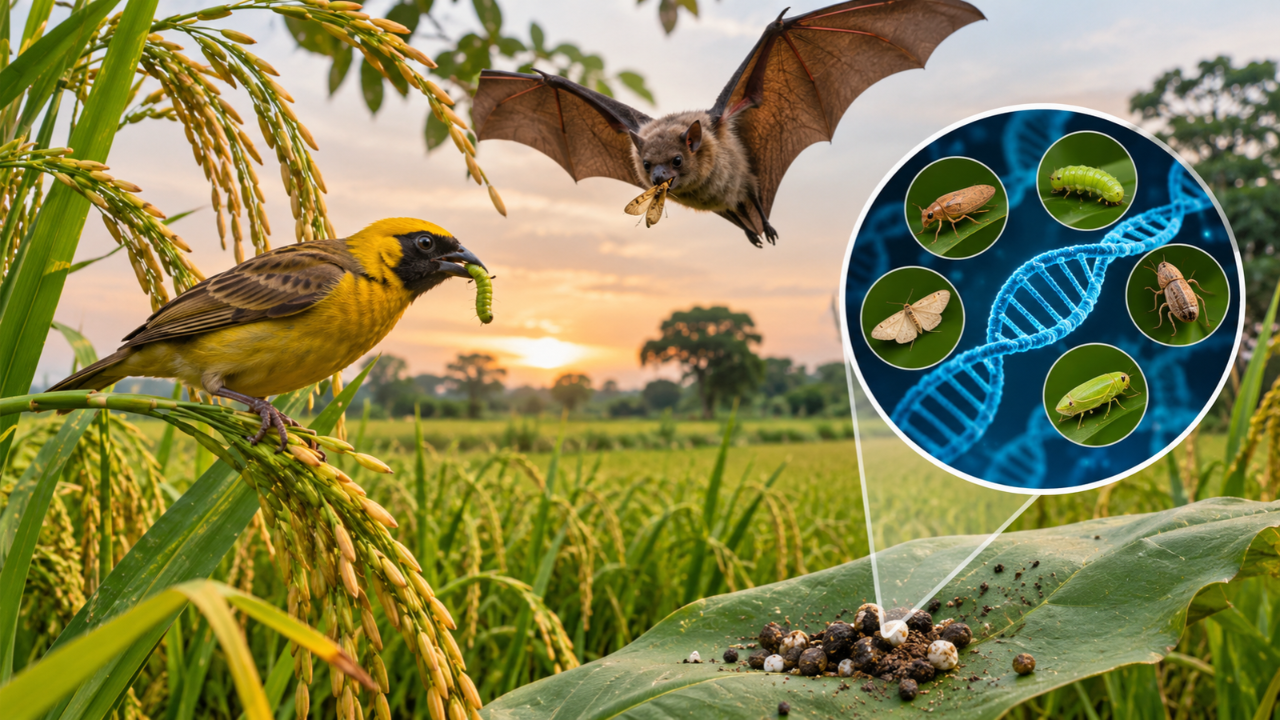
Walk into almost any rice field in West Africa and ask the farmer what they think of the birds flying overhead. You won't get a warm response. Most growers see birds as pure enemies—grain thieves that descend in flocks right before harvest and wipe out months of backbreaking work. Bats don't fare much better in local reputation, often dismissed as spooky night-fliers or outright nuisances roosting in eaves and palms.
That perspective is costing farmers money.
Recent DNA metabarcoding research analyzing fecal samples from birds and bats across West African rice agroecosystems uncovered a massive blind spot in how we manage crop protection. Scientists identified DNA from 87 distinct rice pest species inside the droppings of insectivorous birds and bats. Instead of just raiding crops, these flying predators are running a massive, round-the-clock pest control operation that saves harvests before bugs ever reach outbreak levels.
Let's be honest about what's happening here. Farmers spend scarce cash on synthetic insecticides to kill stem borers, leafhoppers, and grain-sucking bugs. Meanwhile, they actively chase away, trap, or destroy the habitat of the very animals eating those exact insects for free.
How DNA Analysis Exposed the Hidden Pest Control Crew
For decades, figuring out what wild birds and bats ate meant either staring through binoculars for hundreds of hours or dissecting dead animals to peer at pulverized bug parts under a microscope. Neither method works well for tiny, soft-bodied insects like planthoppers or midges. By the time a bat chews up a moth or a leafhopper, there's nothing left to identify visually.
DNA metabarcoding changed everything.
Researchers collected guano and fecal pellets from mist-netted birds and bats foraging over rice paddies in West Africa—specifically looking at agricultural zones in countries like Benin and surrounding regions where rice is a staple crop. By extracting fragmented insect DNA from those droppings and matching the genetic sequences against global barcode reference libraries, the team reconstructed the exact menu of these predators down to the species level.
The numbers aren't subtle. Across the sampled predator communities, genetic traces of 87 known rice-feeding arthropods turned up.
We're talking about heavy hitters in West African rice production:
- Lepidopteran stem borers (like Chilo and Sesamia species) whose larvae tunnel straight through rice stalks and cause "deadhearts" and "whiteheads"
- Sap-sucking planthoppers and leafhoppers (Nilaparvata, Nephotettix, and Cofana species) that drain plant vigor and transmit devastating viral diseases
- Rice bugs and stink bugs that pierce developing grains, leaving behind chalky, shriveled kernels that fetch next to nothing at market
- Defoliating beetles and grasshoppers that strip leaf area during vegetative growth
Here's the kicker. Many of these pests are nocturnal or crepuscular. Moths laying eggs on rice stems don't fly around at noon when a farmer is walking the bunds. They move at dusk and after dark—precisely when insectivorous bats clock in for their shift.
The Day and Night Shift Over West African Rice Paddies
If you only watch a rice field during the middle of the day, you miss half the ecological machinery keeping that crop alive. Pest suppression in wetland and upland rice works like a tag-team match between daytime birds and nighttime bats.
During daylight hours, swallows, bee-eaters, weavers, warblers, and kingfishers patrol the canopy and water surface. While certain granivorous birds—like the infamous red-billed quelea (Quelea quelea) or village weavers during grain-filling—genuinely do hammer ripening rice, lumping all birds into one "pest" bucket is a massive mistake. Barn swallows (Hirundo rustica), yellow wagtails, and various cisticolas aren't interested in your rice grains. Their beaks are built for snatching flies, beetles, hoppers, and moths off leaves and out of mid-air.
Then the sun drops.
As diurnal birds head to roost, free-tailed bats, slit-faced bats, and leaf-nosed bats emerge from tree hollows, rock crevices, and building roofs. Using echolocation, a single small insectivorous bat can consume anywhere from half to nearly its full body weight in insects every single night. When hundreds of bats forage over a valley bottom rice scheme, they intercept gravid female moths before those moths ever lay the eggs that hatch into stem-boring caterpillars.
Think about the math on that. One female stem borer moth eaten by a bat at 8:00 PM prevents roughly 100 to 300 eggs from being deposited on rice leaves by midnight. No eggs means no caterpillars boring inside the stem where contact insecticides can't even reach them.
Why Farmers Keep Sabotaging Their Own Free Allies
Knowing that 87 rice pests end up in bird and bat stomachs raises an obvious question. Why aren't farmers rolling out the red carpet for them?
I've seen how agricultural extension advice plays out on the ground, and the disconnect comes down to three practical realities.
First, damage is visible while prevention is invisible. When a flock of weavers strips a corner of a paddy a week before harvest, the loss stares you right in the face. You see the shattered panicles and empty husks. When a colony of free-tailed bats eats ten thousand rice leafhoppers over three weeks, nothing dramatic happens—your rice just stays green and grows normally. Humans are wired to react to obvious losses and ignore silent protection.
Second, broad-spectrum pesticides create a double trap. Smallholder farmers often spray organophosphates or pyrethroids at the first sign of leaf damage. Those chemicals don't just kill target pests. They wipe out the insect prey base that keeps insectivorous birds and bats hunting over those fields, and they poison the predators directly when birds eat contaminated, dying bugs. Once the natural predators leave or die off, secondary pests rebound faster than before, locking the farmer into a chemical treadmill they can't afford.
Third, habitat clearing removes roosts and perches. Modernizing rice perimeters often means bulldozing every scattered tree, shrubby field border, and dead palm trunk to maximize square footage. Without nearby trees for birds to perch on between hunting swoops, or old structures and tree cavities for bats to roost in during the day, predator activity drops off a cliff within a couple hundred meters of field edges.
What the DNA Data Actually Tells Us About Species Overlap
One of the most interesting takeaways from the DNA metabarcoding study isn't just the raw count of 87 pest species. It's the dietary partitioning—how different bird and bat species specialize on different parts of the pest complex.
No single predator eats everything.
Aerial hawkers like swallows and swifts catch flying adult moths, beetles, and winged planthoppers above the crop canopy. Foliage-gleaning birds like warblers and prinias work down inside the rice tillers, picking off larvae, nymphs, and resting bugs that never take flight. Meanwhile, bats vary by echolocation frequency and wing shape; high-flying free-tailed bats sweep open airspace above irrigated plains, while more maneuverable bats glean insects right off vegetation surfaces along irrigation canals and swamp margins.
This diversity matters because rice pests attack the plant at every growth stage:
- Seedling and tillering stage: Whorl maggots, caseworms, and early stem borers attack young shoots.
- Stem elongation and booting: Yellow and striped stem borers tunnel inside stalks, cutting off nutrient flow.
- Flowering and grain filling: Rice bugs, stink bugs, and panicle-feeding caterpillars attack developing kernels directly.
Because those 87 pest species span different insect orders—Lepidoptera (moths), Hemiptera (true bugs and hoppers), Coleoptera (beetles), Diptera (flies), and Orthoptera (grasshoppers)—you need a diverse community of birds and bats present throughout the entire cropping cycle. Wipe out one group of predators, and you leave a specific growth stage of your rice exposed.
The Bird Deterrent Dilemma Nobody Talks About
Let's address the elephant in the paddy. You can't tell a West African rice farmer to ignore grain-eating birds when flocks can wipe out 30% to 100% of an unguarded field during the milk and dough stages. Bird scaring—whether hiring kids to shout and sling stones, stringing reflective tape, or using mist nets—takes up huge amounts of labor and money.
The problem is indiscriminate control.
When farmers put up fine-mesh mist nets around fields to catch seed-eating queleas and weavers, those nets don't discriminate. They entangle and kill insectivorous swallows, flycatchers, kingfishers, and low-flying bats at dusk. Poisoning roosts or spraying avicides is even worse, wiping out non-target insectivores across entire watersheds.
And here's the irony: grain-eating birds are only a threat during a narrow 3-to-4-week window when rice grains are soft and ripening. For the other 10 to 12 weeks of the growing season, rice fields have zero grain to steal. During that entire vegetative period, almost every bird and bat flying over the paddy is either neutral or actively eating crop pests.
Even some birds known for eating grain—like certain weaver species—switch heavily to insects when feeding their chicks. Protein is mandatory for nestling growth, which means breeding colonies near rice wetlands often harvest thousands of caterpillars and grasshoppers daily before touching a single rice panicle.
Where This Research Has Limits (And What We Still Don't Know)
Before we declare birds and bats the sole saviors of African rice farming, we need to be honest about what DNA metabarcoding can and cannot prove.
DNA in guano tells you presence, not exact volume. Detecting the genetic sequence of a striped stem borer in a bat pellet confirms the bat ate at least one moth, not whether it ate one or fifty. Researchers use "frequency of occurrence"—how many individual fecal samples contain a given pest's DNA—to estimate how important that prey item is across the predator population. High frequency across dozens of samples points to heavy predation, while a single detection might just be an opportunistic snack.
There's also the scavenging and secondary predation caveat. If a spider eats a rice leafhopper, and a warbler eats that spider, DNA analysis of the bird's droppings might pick up both the spider and the leafhopper inside the spider's gut. Scientists filter and interpret data carefully to account for this, but food webs in tropical wetlands are messy.
Finally, ecological pest control works on a landscape scale, not on a single isolated half-hectare plot. If you protect bats on your farm while your neighbor sprays heavy broad-spectrum insecticides every ten days, local insect and predator populations will still take a beating.
Practical Shifts That Turn Birds and Bats Into Farm Infrastructure
If you're managing rice production, advising smallholder cooperatives, or designing agricultural extension programs in West Africa, you don't need a multi-million-dollar grant to put these findings to work. You just need to stop fighting free labor and make a few structural adjustments around the paddies.
1. Install Simple Perches During Vegetative Growth
Insectivorous birds like rollers, bee-eaters, shrikes, and kingfishers are "sit-and-wait" hunters. They don't want to burn energy hovering endlessly over an open, treeless rice plain. Stick 2-to-3-meter bamboo poles or wooden T-perches into the bunds every 30 to 50 meters right after transplanting. Birds will immediately use them as hunting stations to scan the crop canopy for grasshoppers, beetles, and moths. Once the rice begins heading and entering the milky grain stage, pull the poles out so seed-eating birds don't use them as staging posts.
2. Protect Existing Roost Trees and Install Bat Boxes
Never clear large hollow trees, palms, or rocky outcrops bordering wetland valleys unless absolutely necessary for water flow. Where natural roosts are scarce, mounting simple wooden multi-chamber bat boxes on tall poles or the eaves of storage sheds gives free-tailed and leaf-nosed bats secure daytime shelter right next to their feeding grounds. Keep roost sites undisturbed—smoking out bats or sealing roof gaps during breeding seasons destroys local colonies that take years to rebuild.
3. Time Your Bird-Scaring to Match Crop Phenology
Stop treating birds as year-round enemies. Concentrate scaring labor, reflective ribbons, and acoustic deterrents strictly during the grain-filling to harvest window. During the first two months after planting or transplanting, leave the airspace open so swallows, wagtails, and swifts can sweep the fields undisturbed.
4. Ditch Preventive Calendar Spraying
Spraying insecticides on a fixed calendar schedule—whether pests are present or not—is the fastest way to kill off your natural predators and waste money. Scout fields weekly for actual economic thresholds (like visible deadhearts or high hopper counts per hill). When intervention is genuinely needed, choose targeted biopesticides like Bacillus thuringiensis (Bt) or neem-based extracts rather than broad-spectrum neurotoxins that poison bats and birds through the food chain.
5. Leave Semi-Natural Strips Along Main Canals
Keeping narrow strips of native flowering shrubs and grasses along primary irrigation embankments provides daytime resting cover for beneficial insects and foraging corridors for foliage-gleaning birds, without interfering with paddy cultivation or water management.
DNA evidence has finally settled an old argument in tropical agriculture. Those 87 pest species found in bird and bat droppings aren't a curiosity for biologists—they're proof that an intact aerial predator community is already doing heavy agronomic lifting across West Africa. Treat those birds and bats as part of your crop protection budget, give them places to perch and roost, and stop spraying chemicals that kill your best workers.