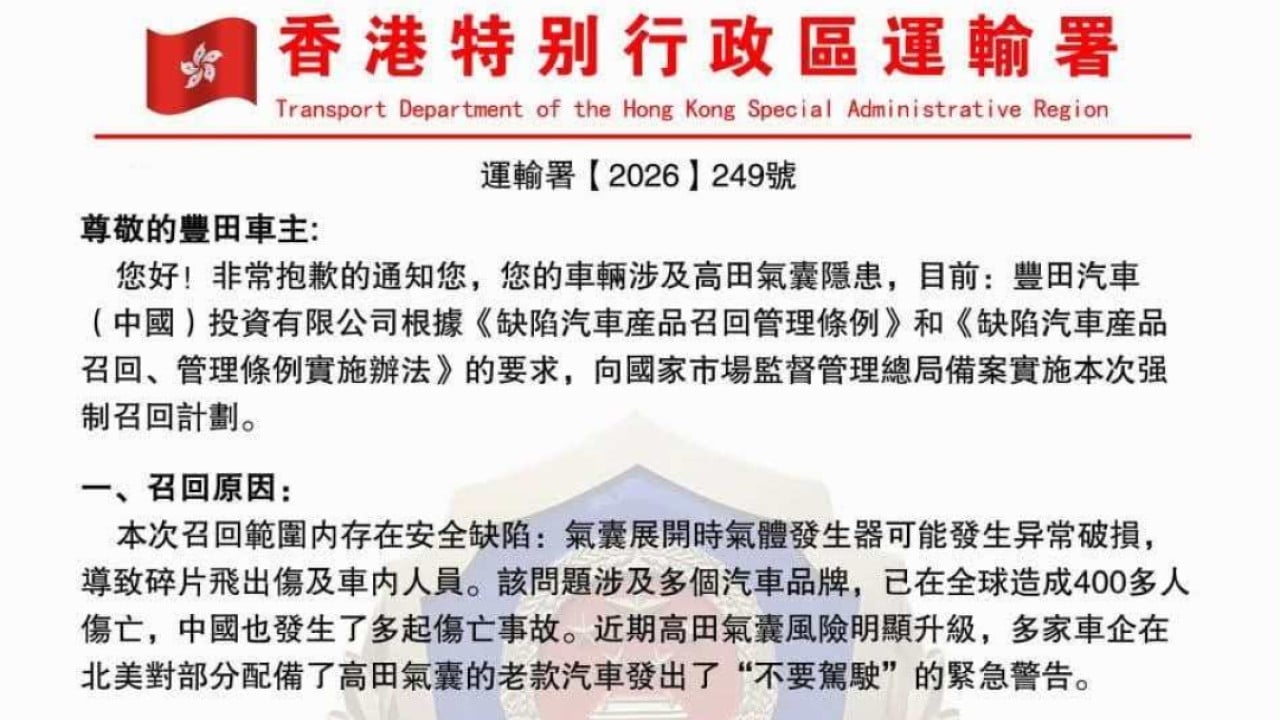
Every few months, a local newsroom publishes the exact same public service announcement. Fake Toyota airbag recall messages are circulating on WhatsApp. Do not click the link. Verify with Crown Motors. Stay vigilant.
It is lazy journalism. It treats a systemic failure of corporate communication and telecom security like a simple IQ test for gullible motorists. Recently making news lately: Why the Qatar-Turkiye Defence Pact is Actually a Dangerous Trap for Both Nations.
If you think the primary danger here is a poorly spelled text message from an unknown number, you are looking at the decoy while the real heist happens behind your back. The actual threat isn't the sophistication of the scammers. It is the friction-heavy, archaic way automakers, insurers, and regulators handle vehicle safety notifications—and how that exact friction creates a vacuum that cybercriminals effortlessly fill.
The Illusion of "Just Don't Click"
Cybersecurity advice in Hong Kong rarely evolves past the digital equivalent of "just say no." Warnings about phishing campaigns rely entirely on the assumption that consumers have infinite attention spans, perfect recall of their vehicle's maintenance history, and zero anxiety when told their steering wheel might explode. Further information regarding the matter are detailed by The Washington Post.
Takata airbag recalls are not a fictional boogeyman. Over the past decade, defective ammonium-nitrate inflators triggered the largest automotive safety recall in history, affecting tens of millions of vehicles globally across dozens of brands, including Toyota, Honda, and Nissan. People died from metal shrapnel tearing through cabin interiors during minor fender-benders.
Scammers know this. They weaponize legitimate fear.
When a Hong Kong driver receives a WhatsApp message claiming their Toyota has an urgent airbag defect, their brain does not immediately run a forensic audit on the sender's metadata. It pictures their family sitting in the passenger seat. Telling people to "simply ignore suspicious texts" ignores human psychology. Worse, it shifts 100% of the security burden onto the end user while letting the institutions that own the customer relationship off the hook.
Why Official Recall Channels Are Broken by Design
I have spent years consulting on enterprise crisis communication and digital trust architectures across Asia. Every time a phishing wave hits a major consumer brand, the internal post-mortem looks identical. The PR team drafts a press release warning customers about "fraudulent third-party communications." Legal signs off. Nobody fixes the underlying user experience.
Look at how a legitimate automotive recall actually works in Hong Kong:
- Fragmented ownership records: Cars change hands frequently in the secondary market. Unless a second-hand buyer proactively registers their chassis number with the authorized distributor—like Crown Motors for Toyota—the official database has no idea who owns the car.
- Snail-mail inertia: Traditional recall notices still rely heavily on physical letters sent to registered addresses linked to the Transport Department. In a city where people move apartments every two years and ignore paper mail until tax season, letters vanish into the void.
- Clunky verification portals: Try checking a VIN (Vehicle Identification Number) on a regional distributor website on a mobile browser. You are often met with desktop-era forms, CAPTCHA loops, or instructions to call a hotline during business hours.
Scammers beat official channels on convenience. A single WhatsApp message with a one-tap link offers immediate resolution to a high-stakes problem. Until legitimate institutions make verification faster and cleaner than a phishing lure, criminals will keep winning the click-through battle.
The Anatomy of a Modern WhatsApp Smishing Operation
Forget the outdated caricature of a lone hacker typing in a dark room. The campaigns targeting Hong Kong drivers are industrial operations run like B2B software companies.
They buy leaked databases from unrelated breaches—parking apps, insurance comparison portals, car wash loyalty programs, e-commerce checkouts. They cross-reference phone numbers with vehicle ownership indicators. If you ever entered your license plate number into a third-party promo form for a free car detailing voucher, your phone number is sitting in a segmented list labeled "HK Car Owners."
From there, the attack chain is ruthlessly efficient:
- Spoofed urgency: The message mimics the tone of a regulatory compliance notice, often referencing local standards or offering a small "inspection subsidy" or "fuel voucher" to sweeten the deal.
- Typosquatted infrastructure: The link points to a domain registered hours earlier using cheap top-level domains or subtle character swaps (
toyota-hk-recall[.]cominstead of an official corporate subdomain). - Credential and card harvesting: The landing page asks for your vehicle registration number, Hong Kong Identity Card (HKID) digits, and a small "administrative booking fee" paid via credit card—or asks you to log in via a fake banking portal to claim a compensation credit.
- Real-time relay: While you wait for a confirmation screen that never loads, an automated script feeds your credit card details and one-time password (OTP) directly into a mobile wallet tokenization flow in another country.
By the time you realize Toyota does not charge an admin fee for a mandatory safety recall, your credit limit has already been drained at an electronics boutique in Europe.
What Competitors Get Wrong About Verification
Mainstream coverage always ends with the same generic checklist: check the sender's phone number, look for grammatical errors, and call the official hotline.
That advice has a shelf life of zero.
Modern generative text tools have completely eliminated the broken-English tell. Phishing copy today is written in idiomatic Cantonese and crisp, corporate English. Meanwhile, the Hong Kong Office of the Communications Authority (OFCA) SMS Sender Registration Scheme—which uses the # prefix for verified organizations—only covers traditional SMS, not over-the-top messaging platforms like WhatsApp.
Scammers migrated to WhatsApp specifically because WhatsApp bypasses telecom carrier filtering. Anyone with a virtual SIM card and a fresh account can message thousands of users before automated anti-spam heuristics shut the number down. Relying on "visual inspection" of a WhatsApp message to spot a scam is like trying to spot counterfeit currency in a dark nightclub.
Dismantling the Common Myths Drivers Still Believe
"If they know my car model, the message must be legitimate."
Wrong. Data brokers routinely sell enriched consumer profiles. Knowing you drive a Toyota Alphard or a Prius does not prove the sender has access to Toyota's manufacturer database. It only proves your vehicle data leaked from one of the dozens of commercial apps you interacted with over the last five years.
"Apple Pay and Google Pay protect me from phishing links."
Only when used through legitimate merchant terminals. In a phishing attack, you are not tapping your phone at a point-of-sale reader. You are manually typing your 16-digit card number, expiry date, CVV, and SMS verification code into a hostile web form. The scammer uses that exact session to bind your card to their device. Once tokenized on their phone, they can tap-to-pay anywhere in the world without needing your physical card again.
"Official recalls never happen over messaging apps."
Some dealers and service centers do use WhatsApp Business accounts for routine service reminders and appointment confirmations. That is precisely why the attack works. Consumers are conditioned to interact with service advisors on WhatsApp. The mistake is trusting an inbound link rather than initiating contact through an independent channel.
The Counter-Intuitive Protocol That Actually Protects You
Stop trying to train yourself to detect fake messages. Human detection fails under stress. Instead, adopt a zero-trust routing habit that makes message authenticity completely irrelevant.
Never use an inbound link as a navigation tool
Treat every link inside an SMS, WhatsApp message, or email as non-clickable text. Even if the message comes from a verified green-tick business account, assume the link is hostile. Open a clean browser tab, type the official domain manually, or open the brand's standalone mobile app.
Bookmark your VIN and official lookup portals now
Do not wait until you receive a panicked message while stuck in Cross-Harbour Tunnel traffic. Take five minutes today. Find your 17-character VIN on your vehicle registration document (commonly known as the 牌簿 or Vehicle Registration Document in Hong Kong) or on the lower corner of your windshield. Save it in your phone's password manager alongside the direct URL for Crown Motors' official recall lookup page and the Transport Department's vehicle safety notice directory.
Separate your transactional identity
Use a dedicated virtual credit card with a low daily spending cap—say, HK$500—for all online bookings, parking apps, and loyalty registrations. Keep your primary high-limit credit cards completely air-gapped from web forms. Even if you fall for a flawless spoof one day, the attacker hits a hard financial wall immediately.
Acknowledge the trade-off
Yes, this approach adds friction to your daily routine. You cannot just tap a link in WhatsApp and book a service slot in ten seconds. You have to switch apps, paste a VIN, or call a service center directly. Convenience and security sit on opposite ends of a seesaw; every time you push convenience up, security drops. Accepting a minor ten-second inconvenience is the price of keeping your bank account intact.
The Accountability Vacuum Nobody Wants to Talk About
Until regulators force automakers and distributors to maintain real-time, opt-out digital registries tied directly to Transport Department licensing renewals—and until messaging platforms impose strict cryptographic identity verification on commercial bulk senders—these campaigns will keep cycling through Hong Kong every quarter.
Next month it will be a fake Honda brake recall. The month after that, a fake HKeToll overdue fine. The brand logo changes; the underlying exploit stays identical.
Stop waiting for news alerts to tell you which scam is trending this week. Lock down your VIN, cap your virtual cards, and treat every inbound WhatsApp link like a loaded weapon.