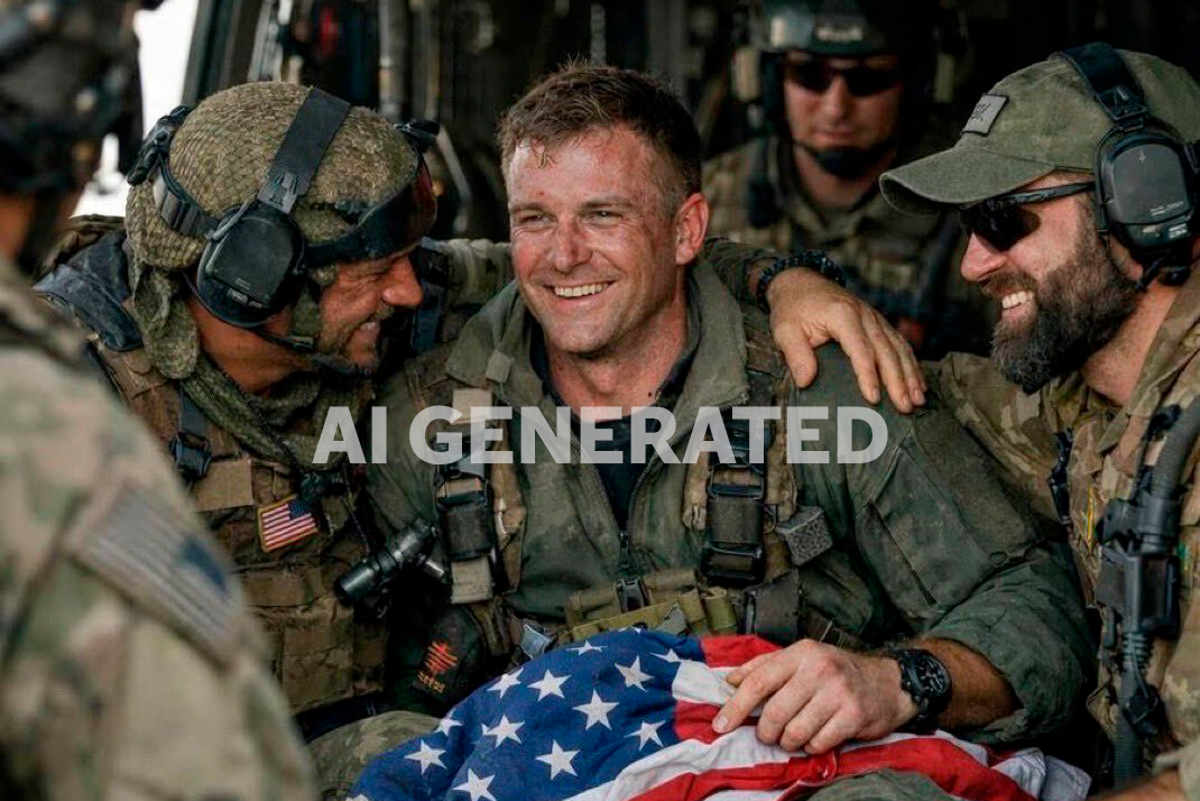
The viral image of a rugged, soot-covered airman purportedly rescued from an Iranian mission didn't exist. It was a collection of pixels birthed by a generative model, yet it racked up millions of impressions and high-profile endorsements before the "community notes" could lace up their boots. This incident represents a dangerous shift in political communication where emotional resonance now outweighs physical reality. High-profile figures are no longer just sharing bad information; they are laundering synthetic fantasies to verify their existing worldviews.
When a political movement starts substituting actual human bravery with algorithmic hallucinations, the machinery of public trust begins to strip its gears. This wasn't a simple mistake or a low-resolution meme. It was a sophisticated, if flawed, attempt to manufacture a heroic narrative during a moment of high geopolitical tension. The fallout reveals a systemic vulnerability in how we consume "news" on social platforms.
The Anatomy of a Digital Deception
The image in question featured an American serviceman in a state of cinematic distress. His gear was slightly off, the patches were nonsensical, and his fingers had that tell-tale AI blurriness. To a trained eye, it was a fake. To a partisan scroller, it was proof of a victory they desperately wanted to believe in. This is the heart of the problem. Modern influence operations don't need to be perfect; they only need to be fast.
Generative AI has lowered the cost of propaganda to nearly zero. In the past, creating a convincing fake required a studio, actors, or at least a skilled Photoshop user. Today, a single prompt can generate a "hero" in seconds. This creates a volume problem. For every one fake that gets debunked, ten more are circulating in private group chats and smaller feeds where fact-checkers never venture.
Why the Red Flags Went Unnoticed
The "uncanny valley" used to protect us. We could feel when something was wrong with a digital human. But as models improve, that valley is narrowing. The airman photo succeeded because it hit specific psychological triggers:
- Hyper-patriotism: The imagery leaned heavily into established military aesthetics.
- Urgency: It was posted during a breaking news cycle regarding Iran.
- Confirmation Bias: It provided a visual "win" for a specific political audience.
The people sharing the image weren't looking for flaws in the stitching of a flight suit. They were looking for a reason to cheer. When prominent figures with "blue check" status amplify these images, the platform's algorithm treats the content as authoritative, pushing it into the feeds of millions who assume a baseline level of vetting has occurred. It hasn't.
The Mechanics of the Viral Feedback Loop
The lifecycle of an AI-generated lie follows a predictable path. It starts in a fringe corner of the internet, often on boards where "shitposting" is the primary language. From there, it moves to mid-tier aggregators who care more about engagement than accuracy. Finally, it reaches the "stars"—the influencers and politicians who use it as fuel for their brand.
Once a high-profile account shares the image, the correction rarely catches up to the lie. Even when the post is deleted, the mental image remains. This is the "continued influence effect." People remember the emotion of the heroic rescue even after they are told the rescue never happened. The fake airman becomes a ghost in the machine, a permanent part of a false historical record.
The Problem with Platform Incentives
Social media companies are in a bind. Their business models rely on time-on-site and interaction. Outrage and triumph—even if manufactured—drive those metrics. While they have introduced tools like community notes, these are reactive measures. They are trying to put out a forest fire with a garden hose.
Furthermore, the "roasting" of these figures by the opposition often backfires. When the "other side" mocks a politician for sharing a fake photo, the politician's base often rallies around them, viewing the criticism as a pedantic attack on their values rather than a factual correction. The truth becomes secondary to the tribal conflict.
The Industrialization of Synthetic Content
We are moving out of the era of the "deepfake" as a novelty and into the era of synthetic reality as a political tool. This isn't just about one photo of an airman. It’s about the ability to generate entire events.
Imagine a scenario where a protest is entirely fabricated through AI-generated video. Or a local disaster that never happened, designed to tank a specific stock or influence a local election. The technical barriers are gone. The only thing left is the ethical barrier, and in the current political climate, that barrier is looking increasingly flimsy.
Identifying the Synthetic Signature
To fight back, we have to become digital detectives. The signs are there if you know where to look.
- Symmetry and Text: AI still struggles with consistent text on uniforms and perfect anatomical symmetry.
- The Glow: Many AI images have a strange, diffused light that looks more like a video game than a photograph.
- Source Provenance: If a "breaking" photo of a military operation doesn't come from a reputable news wire or a verified government account, it’s almost certainly a fabrication.
The burden of proof has shifted. We can no longer assume a photo is real because we see it on a screen. We must assume it is fake until proven otherwise.
The Cost of the Fake Hero
When we celebrate a fake airman, we diminish the real ones. There are actual men and women putting their lives on the line in dangerous regions. Their stories are messy, complicated, and often lack the cinematic lighting of an AI prompt. By opting for the "perfect" synthetic hero, we are signaling that reality isn't good enough for our politics.
This trend toward the synthetic is a retreat from the hard work of governing and reporting. It is easier to generate a victory than to win one. It is easier to share a pixelated lie than to grapple with the complexities of foreign policy. If the "stars" of our political firmament continue to trade in these digital fictions, they aren't just being "roasted" online—they are actively hollowing out the foundation of a shared reality.
The next time a heroic image flashes across your feed, don't look at the face. Look at the fingers. Look at the background. Look for the truth, because the machines are getting very good at hiding it.
Stop rewarding the fiction. Demand the record.