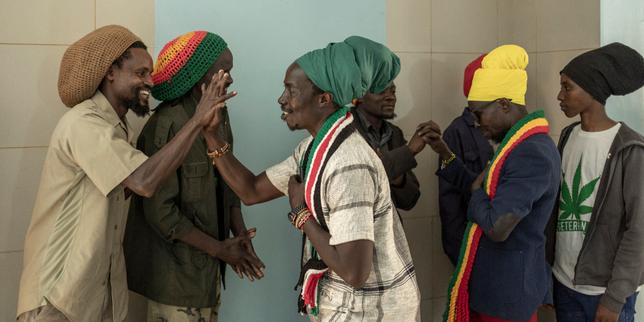
The scent of burning goat meat and exhaust fumes usually dominates the air outside the Milimani Law Courts in Nairobi. But inside the concrete corridors, the air feels different. It carries the weight of a quiet, decades-old friction. A man stands near the wooden benches, adjusting a heavy wrap of green, red, and gold fabric over his shoulders. His hair, thick ropes of graying dreadlocks, is tucked neatly into a knitted cap. His name is Ras Lwazi. He is not a criminal, a corporate litigant, or a politician. He is a father, a woodcarver, and a Rastafarian. He is here because, in the eyes of Kenyan law, his sacrament is a crime.
For years, the narrative surrounding cannabis in East Africa has been viewed through a single, narrow lens: policing. The conversation revolves around border seizures, street arrests, and the strict text of the Narcotic Drugs and Psychotropic Substances Control Act of 1994. But step away from the police blotters and enter the nyabinghi houses—the communal places of worship—and the reality shifts entirely.
This is not a debate about recreation. It is a battle for religious liberty, fought by a community tired of living in the shadows of a homeland they chose, and which they believe should choose them back.
The Plant and the Prophet
To understand why a community would take the Kenyan government to the highest court in the land, you have to understand what happens when a Rastafarian lights a chalice. It is not an act of rebellion. It is an act of communion.
In the Rastafari faith, cannabis is referred to as the Holy Herb, or bhang in the local Kiswahili dialect. They point to biblical scriptures, specifically Psalms 104:14—"He causeth the grass to grow for the cattle, and herb for the service of man"—to justify its use. It is smoked during reasonings, which are communal gatherings where faith, politics, and philosophy are debated. It is used to clear the mind, to burn away the illusions of "Babylon" (the oppressive global system), and to bring the believer closer to Jah, or God.
Consider the contradiction Ras Lwazi faces every Saturday.
A few miles away from his home, a congregation gathers in a steeple-topped church to drink wine, symbolizing the blood of Christ. No one calls the police. No one breaks down the door. Yet, when Lwazi sits in his private courtyard, chanting to the rhythm of a hand drum and inhaling the smoke of a plant that grew naturally from the African soil, he is breaking the law. He risks a multi-year prison sentence.
The law makes no distinction between a cartel trafficker smuggling bricks across the Ethiopian border and a believer burning a leaf in prayer.
A History Born of Exile
The roots of this tension run deep into the soil of the 20th century. Kenya holds a sacred place in the Rastafari imagination. When Jomo Kenyatta fought for independence, the Mau Mau freedom fighters hid in the forests of Mount Kenya, their hair matted into long locks, refusing to cut them until the land was free. To the early Rastafarians in Jamaica, these fighters were icons of resistance.
Later, when the Rastafari diaspora began returning to Africa—a movement known as repatriation—many chose Kenya. They bought land, started businesses, raised children, and built communities in places like Shashamane in neighboring Ethiopia and the outskirts of Nairobi.
They expected a homecoming. Instead, they found a legal system inherited directly from the British colonial administration, a system designed to suppress indigenous practices and police African bodies.
The Kenyan constitution, rewritten in 2010, is widely praised as one of the most progressive in the world. Article 32 explicitly guarantees freedom of conscience, religion, belief, and opinion. It states that no one shall be denied the right to manifest any religion through worship, practice, teaching, or observance.
On paper, the Rastafarians are protected. In reality, the police do not read Article 32 when they conduct sweeps in the working-class neighborhoods of Nairobi.
The Cost of the Stigma
The legal battle reached a tipping point when the Rastafari Society of Kenya filed a formal petition in the High Court. They argued that the ongoing criminalization of cannabis directly violates their constitutional right to worship.
But lawsuits take time. Meanwhile, life carries a heavy, daily tax.
The stigma is felt most sharply by the younger generation. Imagine a twenty-two-year-old artist growing up in Kibera. He wears his locks proudly, a symbol of his identity. Because of his appearance, he is a walking target for Operation Sanifisha—the periodic police crackdowns aimed at cleaning up the streets. He is stopped, searched, and often extorted for bribes simply because the state associates his hairstyle with a banned plant.
If he cannot pay the bribe, he enters the penal system.
Kenyan prisons are notorious for overcrowding. A young man arrested with a tiny amount of cannabis can spend months, sometimes years, on remand waiting for his case to be heard, sharing a cell built for ten people with fifty others. His education stops. His employment prospects vanish. His family is forced to spend their meager savings on legal fees or bribes to secure his release.
The current policy does not curb consumption. It creates a cycle of poverty and resentment.
The Regional Shift
What makes the Kenyan situation particularly agonizing for the local Rastafari community is the shifting landscape across the African continent. Kenya prides itself on being East Africa’s economic and progressive hub. Yet, on the issue of cannabis, it is falling behind its neighbors.
- Lesotho became the first African nation to legalize the cultivation of medical cannabis, turning a traditional crop into a legal economic engine.
- South Africa’s Constitutional Court ruled that the private consumption and cultivation of cannabis by adults is legal, recognizing the right to privacy.
- Rwanda and Uganda have established strict legal frameworks for the production and export of medical cannabis, eyeing the multi-billion-dollar global market.
The argument for legalization is no longer just a spiritual one; it is economic. Kenya’s economy faces massive debt pressures, high youth unemployment, and an agricultural sector vulnerable to climate change. Bhang grows incredibly well in the Kenyan climate, requiring far less water than traditional cash crops like coffee or tea.
The Rastafarians are asking for religious exemption, but their legal challenge has inadvertently forced a broader conversation. If the plant is medicinal, economic, and spiritual, why is the state spending millions of shillings every year to burn fields and lock up citizens?
The Courtroom Confrontation
Back inside the Milimani Law Courts, the state’s lawyers present their counterarguments. Their position is rooted in public health and safety. They argue that cannabis is a gateway drug, that legalization would lead to a surge in psychosis among the youth, and that the state has a duty to protect its citizens from the scourge of substance abuse.
These are familiar arguments, used by governments worldwide for a century. But they ignore the nuance of the Rastafari petition. The community is not asking for dispensaries on every corner of Nairobi. They are not advocating for corporate commercialization.
They are asking for a closed-loop system: the right to grow a specific number of plants within their places of worship, to transport the herb safely to their ceremonies, and to consume it without the fear of a heavy hand on their shoulder.
The judges listen. They take notes. The wheels of justice turn with an agonizing slowness, often taking years to reach a verdict on constitutional matters.
The Fire That Keeps Burning
Outside the courthouse, the afternoon sun beats down on the pavement. The noise of the city returns—the shouting of matatu conductors, the honking of horns, the hustle of a metropolis on the move.
Ras Lwazi walks away from the steps of the court, his head held high. He knows that whatever the judges decide, it will not change what happens when he returns home. The law can dictate what is written on a piece of paper, but it cannot dictate what a man feels in his heart when he looks at a plant that he believes was put on earth by the Creator.
For the Rastafarians of Kenya, the court case is not just about a plant. It is about validation. It is about whether a country that celebrates its diversity can find room for a minority group that refuses to conform to colonial ideas of respectability.
Until the law catches up with the constitution, the smoke will continue to rise from the small, hidden courtyards of Nairobi. It will rise in quiet defiance, a sweet-smelling prayer drifting over the tin roofs and into the African sky, waiting for the day it is finally allowed to breathe free.


