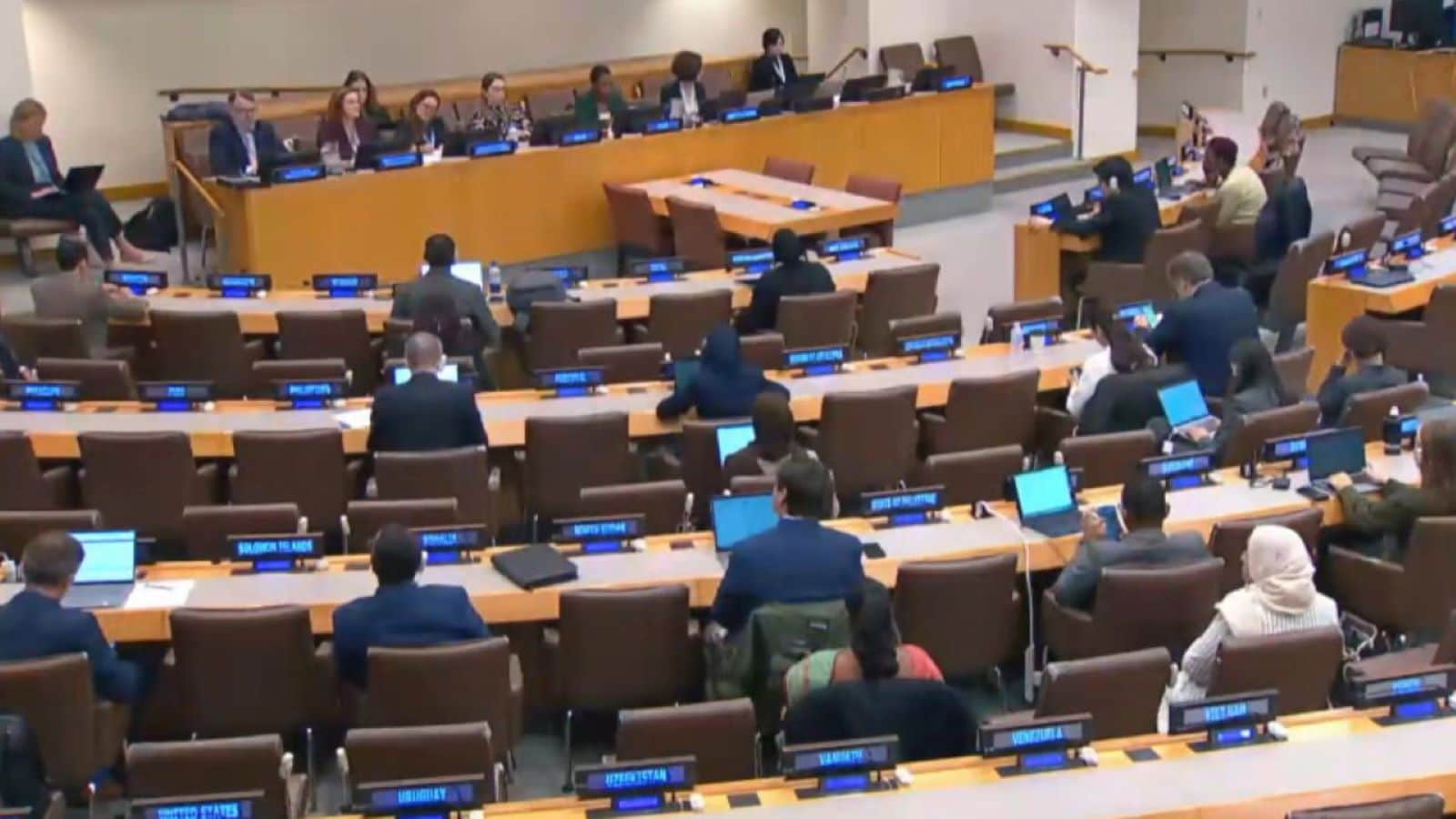
Standard diplomatic reporting treats clashes between sovereign states and United Nations mandate holders as binary soundbites: one side alleges abuse, the other cries foul. That framing misses the structural mechanics of the dispute. When UN Special Rapporteur Gina Romero presented findings to the UN General Assembly Third Committee alleging that young people in India face stigma, retaliation, detention, and digital restrictions around mental health, gender justice, and youth protests, New Delhi did not merely issue a denial. Indian First Secretary Anuj Swarup mounted a procedural and evidentiary challenge, labeling the submissions anonymous hearsay and pointing to constitutional protections under Article 19, institutional remedies, youth dialogue initiatives, and satirical protest movements as counter-evidence. This article breaks down the evidentiary fault lines, institutional trade-offs, and causal mechanisms governing that clash so readers can evaluate competing claims without relying on diplomatic theater.
The Logic Map of Standard Reporting vs. Structural Reality
Conventional news coverage of this exchange typically follows a predictable template. It summarizes the Rapporteur's headline charges, quotes the Indian envoy's rebuttal line for line, notes the broader context of student or youth demonstrations, and leaves the reader with two flatly contradictory statements.
That approach has three analytical blind spots:
- Conflating assertion with verification: Treat uncorroborated submissions and official state rebuttals as symmetrical when they operate under completely different evidentiary rules.
- Treating national scale as a single uniform condition: Applying sweeping generalizations to a country with the world's largest youth population, where state policing, local courts, and social norms vary sharply across jurisdictions.
- Ignoring causal mechanisms: Listing grievances (such as digital restrictions, detention allegations, or stigma) without mapping how legal remedies, social norms, and state security practices interact over time.
In information economics and legal analysis, this is a classic verification asymmetry. Special Rapporteurs frequently rely on confidential or anonymous testimony to protect vulnerable informants from reprisal. States, conversely, demand public, auditable proof before accepting reputational damage in multilateral forums. Both incentives are rational from their respective institutional positions, yet neither resolves ground truth on its own.
Known Facts vs. Educated Hypotheses
Separating confirmed diplomatic events from analytical inference keeps the assessment grounded.
Known Facts
- During the 81st session of the UN General Assembly Third Committee in October 2026, UN Special Rapporteur Gina Romero raised concerns regarding youth assembly, association, and expression, including claims of stigma or retaliation tied to mental health and gender justice discussions as well as protest-related allegations.
- India's First Secretary Anuj Swarup rejected the claims during the interactive dialogue, arguing they relied on anonymous and unverified submissions.
- India cited constitutional guarantees under Article 19, alongside the judiciary, press, and National Human Rights Commission, as institutional safeguards.
- New Delhi pointed to large-scale youth engagement programs such as the Viksit Bharat Young Leaders Dialogue and noted the existence of youth-led political satire—specifically referencing the Cockroach Janta Party (CJP) and talks involving leaders—as evidence of civic space.
Educated Hypotheses
- Selective visibility hypothesis: High-profile youth mobilization, structured government outreach, and satirical activism can coexist with localized police overreach or social stigma, meaning aggregate examples of openness do not automatically disprove localized friction.
- Verification-credibility loop hypothesis: When states dismiss UN reports outright as hearsay without engaging specific procedural questions, multilateral bodies may double down on broad thematic warnings, while states argue that unverified claims erode UN credibility—deepening mutual distrust rather than resolving specific grievances.
- Dual-channel stigma hypothesis: Resistance or pushback faced by young people advocating on gender justice or mental health may stem less from formal statutory bans and more from family, community, or institutional friction that operates outside formal state censorship.
The Three Pillars of the Evidentiary Clash
To move past slogans, examine the dispute across three structural pillars: Evidentiary Standards, Institutional Remedies, and Civic Space Signals.
Pillar 1: Evidentiary Standards and Anonymity Trade-Offs
Special procedures mandates are designed as early-warning and accountability mechanisms rather than criminal courts. When a Rapporteur cites anonymous or unverified submissions, the goal is often to surface patterns that might otherwise go unreported. The operational cost is lower corroboration precision.
New Delhi's counterargument rests on procedural fairness and proportion: making sweeping generalizations about hundreds of millions of young people from unnamed accounts lowers the bar for international condemnation. That critique has real analytical force when broad labels outrun documented sample sizes. At the same time, demanding full public attribution in sensitive environments can create a chilling effect if informants fear retaliation. Credible analysis requires asking not just whether a claim is verified, but how it was corroborated and what scope it actually covers.
Pillar 2: Constitutional Guarantees vs. Friction in Practice
Formal legal rights and day-to-day enforcement are distinct variables. Article 19 of the Indian Constitution establishes foundational freedoms of speech, expression, assembly, and association, supported by courts, media, and statutory bodies.
In operational terms, rights protections function through friction and throughput. Even where constitutional rights exist on paper, individuals testing boundaries during protests, online campaigns, or sensitive social advocacy may encounter delays, bail hurdles, administrative restrictions, or local pushback. Conversely, the existence of courts, press scrutiny, and human rights bodies means grievances can be contested legally and publicly rather than occurring in a total institutional vacuum. Treating formal guarantees as proof of zero friction—or treating allegations of friction as proof that formal institutions do not exist—both distort reality.
Pillar 3: Civic Space Signals and Satirical Dissent
New Delhi highlighted youth participation initiatives and the emergence of a satirical youth movement, the Cockroach Janta Party, as proof that young people can organize, critique authority, and engage officials.
From a political-systems perspective, visible satire and structured state-youth forums are meaningful indicators that public debate is not uniformly extinguished. Yet asymmetric civic space is common in large democracies: satirical or consultative channels may remain open in some arenas while friction spikes around specific protests, digital restrictions, or contentious social topics. A complete picture weighs both visible participation and specific flashpoints rather than using one to erase the other.
Cause-and-Effect Chains Standard Coverage Misses
Simple cause-and-effect stories—such as "Report alleges X, therefore X defines the system" or "Constitution guarantees Y, therefore X cannot happen"—miss how pressures compound.
- Stigma to Silence to Skewed Data: When young people face social stigma or fear of backlash around mental health or gender justice, underreporting rises. Sparse or uneven official data can make a problem look smaller in administrative records than it feels to affected groups, encouraging advocates to rely on informal testimony, which in turn invites criticism over verification.
- Digital Restrictions to Information Vacuums: Whenever authorities restrict connectivity or seize devices during unrest, public visibility drops. Lower visibility makes independent verification harder for everyone—governments, journalists, and international monitors alike—fueling competing narratives and rumor cycles.
- Rhetorical Escalation to Diplomatic Deadlock: Framing a dispute purely around institutional credibility ("hearsay" versus "repression") turns a fact-finding problem into a status contest. Once prestige is on the line, both sides defend positions harder, leaving concrete questions about specific cases, procedures, or remedies unanswered.
Tactical Evaluation Framework for Readers and Analysts
When evaluating future statements, reports, or rebuttals on youth rights and governance, apply this five-step sequence:
- Isolate the specific claim. Separate general characterizations of youth life from concrete allegations involving detention, digital curbs, legal access, or specific advocacy topics.
- Audit the evidentiary chain. Check whether a claim rests on named documentation, corroborating records, court filings, or anonymous submissions—and note what constraints explain the method.
- Check geographic and topical scope. Determine whether an example reflects a localized event, a specific protest wave, or a broad national trend across diverse states.
- Distinguish state action from societal norms. Separate government policies and policing from family, community, or workplace stigma around mental health and gender roles.
- Track institutional response mechanisms. Look at whether courts, oversight bodies, or administrative channels are actively reviewing contested actions rather than stopping at press statements.
Limitations of This Framework
No analytical checklist is a silver bullet. Verification standards can be weaponized to delay accountability when records are hard to obtain, just as broad human rights framing can overreach when sample sizes are thin. Furthermore, diplomatic exchanges at the UN occur within political dynamics that no purely technical framework can override.
Strategic Recommendation
For analysts, policymakers, and institutions tracking youth rights and public discourse, the highest-leverage move is to replace all-or-nothing diplomatic scorekeeping with structured, case-specific verification. Rather than treating UN thematic critiques and sovereign rebuttals as mutually exclusive total truths, observers should anchor assessments in verifiable records, track how legal and oversight mechanisms handle disputed incidents, and separate measurable institutional friction from broader civic participation. Expect multilateral clashes over evidence standards to intensify whenever youth movements intersect with contested governance and sensitive social norms—making disciplined source verification the single most valuable edge in reading the news.