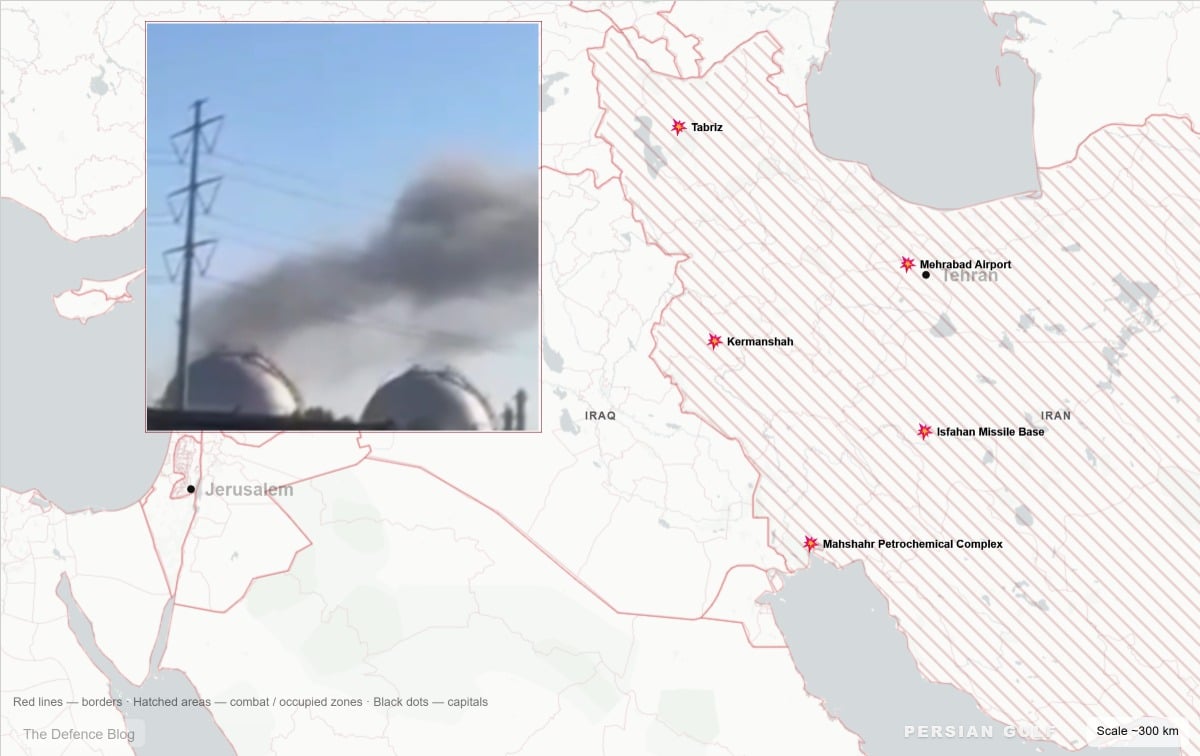
Western foreign policy consensus spent the morning regurgitating the same lazy narrative: Israel’s overnight kinetic strikes across multiple Iranian cities represent a standard "retaliatory escalatory cycle" designed to reset deterrence.
They are fundamentally misreading the board.
I have spent two decades analyzing targeted operations and military deployment networks. The frantic reporting about plumes of smoke over Isfahan and activated air defense batteries in Tehran misses the structural reality of modern industrial warfare. This is not an escalation designed to force a diplomatic pivot or secure an immediate ceasefire.
This is a clinical, logistical degradation masquerading as a political signal.
The Flawed Premise of "Political Signaling"
Traditional defense analysts view these strikes through a dated Cold War lens. They assume that State A drops ordnance near State B’s high-value infrastructure to send a message to political leaders, who will then rationally calculate the costs and dial back their proxies.
That model died a decade ago.
When 200 fighter jets cross hostile airspace to strike highly specific assembly plants, military command centers, and centrifuge production hubs, they are not attempting to win an argument. They are attempting to physically remove the adversary's capability to participate in the next industrial cycle of the conflict.
Consider the "People Also Ask" questions clogging up intelligence feeds today:
- Did the strikes destroy Iran's nuclear breakout capacity? No. No single air campaign short of a sustained multi-month operation can permanently erase deep-buried, hard-engineered infrastructure.
- Will this trigger an all-out regional war? Wrong question. The all-out war is already happening; it simply moves at the speed of supply chains, not the speed of live television.
The consensus relies on the comforting myth that both sides want to return to a status quo equilibrium. There is no equilibrium.
The Logistics of Attrition
To understand what actually happened overnight, look past the dramatic social media footage of anti-aircraft fire and analyze the target selection.
+--------------------------+----------------------------+----------------------------+
| Target Vector            | Public Consensus Narrative | Hard Logistical Reality    |
+--------------------------+----------------------------+----------------------------+
| Ballistic Storage Facilities| Strategic intimidation     | Depleting precision components|
+--------------------------+----------------------------+----------------------------+
| Component Fabrication    | Escalation management      | Creating long-term supply  |
| Sites                    |                            | bottlenecks                |
+--------------------------+----------------------------+----------------------------+
| Command and Control Hubs | Political humiliation      | Forcing decentralization    |
|                          |                            | of drone deployment networks|
+--------------------------+----------------------------+----------------------------+
When you target solid-propellant mixing facilities or precision machine shops responsible for milling drone components, you are attacking a manufacturing pipeline. You are forcing the adversary into a compounding bottleneck.
Imagine a scenario where a state possesses thousands of airframes but loses the specific, highly specialized facilities required to manufacture guidance systems or specialized fuel mixtures. The bulk inventory becomes inert. This is the calculated vulnerability being exposed. The objective is to make the production of automated precision munitions mathematically unsustainable over a multi-year horizon.
The Flaw in the Contrarian Approach
A true contrarian perspective requires acknowledging where my own analysis faces a severe bottleneck. The downside to focusing strictly on industrial degradation is that it discounts the chaotic, unpredictable nature of domestic political survival.
Military operations do not take place in a vacuum of pure logistical calculation. While a military staff may view an overnight raid as a routine inventory reduction mission, a domestic population views it as an existential violation. This creates a volatile political reality that can force a regime to take economically or militarily irrational actions simply to maintain internal authority. You cannot completely calculate away human panic and the need for public theater.
Redefining the Conflict
Stop asking whether the overnight strikes succeeded in stopping a specific missile program or forcing a change in leadership. Those are the wrong metrics.
The real question is whether the destruction of specialized manufacturing capacity moves fast enough to outpace the adversary's import of replacement machinery through secondary networks.
The standard analytical framework assumes that military force is used to achieve a definitive conclusion. In reality, modern state-on-state friction in this theater functions exactly like a high-stakes corporate restructuring: you do not eliminate the competitor entirely; you merely degrade their operational capacity until their core business model becomes too expensive to execute.
The overnight raid was not a prelude to something larger. It was the execution of a long-term attrition strategy designed to hollow out industrial defense depth from the inside out.