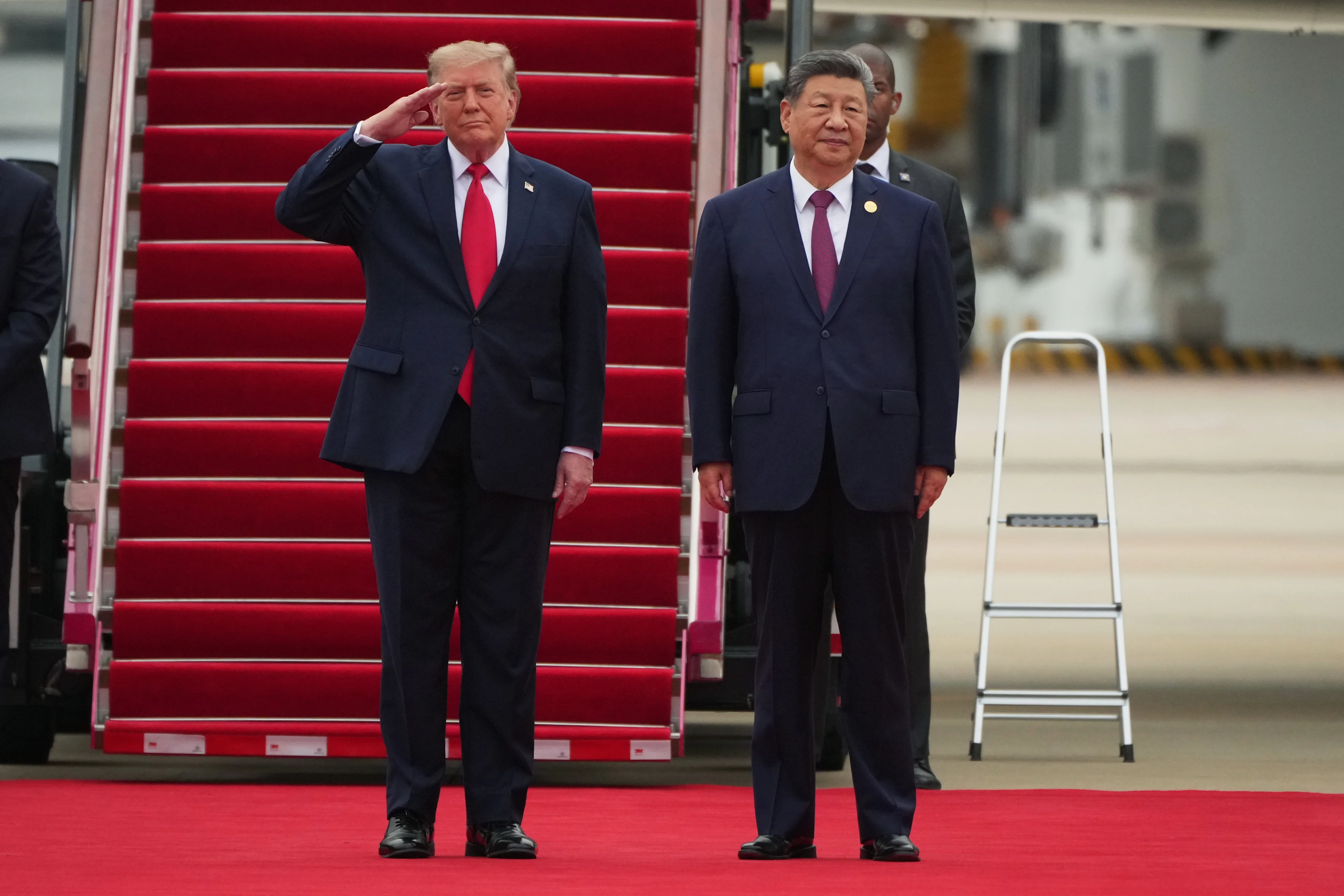
The mainstream foreign policy press is breathless right now. Donald Trump touches down in China with Vladimir Putin and Xi Jinping on the dance card, and every cable news panel is running the exact same tired script. They call it a "historic trilateral pivot." They frame it as a binary struggle between Western democracy and an authoritarian axis, or conversely, as a populist strongman brokering peace over a steak dinner.
Both sides are dead wrong. You might also find this connected coverage insightful: The Weight of the Office When the Cost of Living Collides With Power.
They are staring at the podium while the actual deal is being cut in the basement. If you read the standard coverage of Trump landing in Beijing to meet Xi and Putin, you would think global geopolitics works like a high school cafeteria table—who sits next to whom, who shakes hands first, and who flinches during the photo-op. That is amateur-hour analysis. I have spent two decades advising sovereign wealth funds, energy traders, and cross-border supply chain executives through sanctions regimes and trade wars. I have watched billion-dollar portfolios evaporate because executives believed the diplomatic press releases instead of tracking the plumbing of global capital.
When Trump, Xi, and Putin share the same airspace in China, the real story isn't ideological alignment or peace treaties. It is an emergency audit of three deeply stressed economic engines trying to prevent synchronized systemic failure without looking weak to their domestic audiences. As reported in latest coverage by BBC News, the effects are widespread.
The Lazy Consensus of the "New Yalta"
Every pundit with a blue checkmark loves a historical analogy. The current favorite is calling a Trump-Xi-Putin convergence a "New Yalta"—three great powers carving up spheres of influence on a map.
It sounds smart on television. It collapses under five seconds of scrutiny.
At Yalta in 1945, the United States held an unassailable industrial monopoly, the Soviet Union possessed a massive land army occupying Eastern Europe, and Britain was an exhausted empire holding onto a few naval chokepoints. Today, none of these three leaders holds an unassailable hand. Each walks into that room carrying massive domestic liabilities that severely restrict what they can actually give away.
- Washington's Constraint: The United States carries a debt-to-GDP ratio exceeding 120%, high debt-servicing costs, and a manufacturing base that still depends on Asian processing for critical minerals, active pharmaceutical ingredients, and sub-tier electronics. Threatening blanket tariffs makes great rally applause, until bond yields spike and domestic inflation roars back before an election cycle.
- Beijing's Constraint: China is fighting a multi-year balance-sheet recession triggered by a collapsing property sector, shrinking local government revenues, and severe youth unemployment. Xi Jinping cannot afford a total decoupling from Western consumer markets because his domestic household consumption is far too weak to absorb China's industrial overcapacity.
- Moscow's Constraint: Russia has converted its economy into a wartime production machine. While GDP numbers look superficially resilient due to state military spending, the civilian sector is starved of labor, interest rates sit at punitive levels to fight inflation, and Moscow has effectively become a junior resource vassal to Beijing—selling discounted oil and gas while buying Chinese dual-use goods in yuan.
You do not get a grand imperial bargain when all three negotiators are managing domestic triage. You get transactional horse-trading disguised as statesmanship.
What Actually Happens Behind Closed Doors
Forget the joint communiqués. Ignore the body-language experts analyzing Trump's handshake grip or Xi's facial expressions. When high-stakes bilateral and trilateral meetings happen at this level, the actual agenda boils down to three hard currencies: energy routing, industrial tariffs, and dollar settlement mechanisms.
1. The Energy and Sanctions Arbitrage
Putin is not in China to play matchmaker between Washington and Beijing. He is there to protect his lifeline. Since Western sanctions cut Russia off from European pipeline gas markets, Moscow has relied on shadow fleets and Asian buyers—primarily China and India—to keep crude revenues flowing.
Trump knows that global oil prices dictate American voter sentiment at the gas pump. If Washington tightens secondary sanctions on Chinese banks facilitating Russian energy trades, global crude spikes, wrecking American inflation targets. Conversely, if Trump signals a willingness to relax enforcement on Russian energy in exchange for a ceasefire framework in Eastern Europe, he immediately alters the calculus in Beijing. Xi Jinping loses his monopoly discount on Russian crude the moment Moscow has alternative buyers.
Watch the spread between Brent crude and Urals crude over the next thirty days. That number will tell you more about what happened in Beijing than every leaked State Department memo combined.
2. The Tariff Illusion vs. Supply Chain Reality
Mainstream coverage treats Trump's tariff threats against China as a blunt instrument—either he slaps 60% tariffs on Chinese goods and triggers a trade war, or he backs down. Both interpretations miss how modern trade actually operates.
During the first wave of U.S.-China tariffs, Chinese manufacturers didn't simply surrender American market share. They rerouted. Components were shipped from Shenzhen to factories in Vietnam, Malaysia, and Mexico for final assembly, slapping a new country-of-origin sticker on the box before crossing into U.S. ports. Meanwhile, American importers absorbed the tariff costs or passed them directly to consumers.
Xi Jinping knows Trump needs tangible "wins" to show American workers—specifically, massive purchase commitments for U.S. agricultural goods (soybeans, corn, liquefied natural gas) and visible manufacturing investments on American soil. Notice the shift: Beijing is increasingly willing to let Chinese battery and EV firms build plants inside the United States or partner via licensing deals, provided Washington drops the existential tech blockades on semiconductors.
That isn't a trade war ending. It is a cartelization of global supply chains.
3. The De-Dollarization Bluff
A popular talking point among financial doomers is that Putin and Xi are using these summits to finalize a BRICS currency that will dethrone the U.S. dollar. Trump has explicitly threatened 100% tariffs on nations that abandon the greenback.
Here is the unvarnished truth that sovereign debt traders understand and newsletter writers ignore: neither China nor Russia actually wants a free-floating reserve currency.
To become the world's reserve currency, a nation must run persistent current account deficits, open its capital accounts completely, and allow foreign investors to buy and sell its assets without restriction. If Xi Jinping opened China's capital account tomorrow, trillions of dollars in domestic Chinese savings would flee Shanghai and Shenzhen for real estate in London, equities in New York, and treasuries in Washington. The Chinese banking system would implode within a month.
Russia and China use local currency settlement (rubles and yuan) out of necessity to bypass SWIFT sanctions, not because the yuan is ready to replace the dollar. When Trump threatens tariffs over de-dollarization, he is swinging at a phantom—and Xi is happy to let him claim victory on an issue Beijing had no intention of pursuing anyway.
Dismantling the "Strongman Diplomacy" Myth
Let's address the most common questions circulating right now—and fix their broken premises.
Does a personal relationship between Trump, Xi, and Putin prevent global conflict?
No. Personal rapport between leaders is a tactical lubricant, not a structural guarantee. In international relations theory—specifically the offensive realism championed by scholars like John Mearsheimer—great powers act according to survival imperatives and relative power distributions, not personal friendships.
Richard Nixon and Mao Zedong achieved a historic diplomatic breakthrough in 1972 not because they liked each other, but because both feared the Soviet Union. Today, Trump, Xi, and Putin have intersecting short-term interests, but their long-term structural goals remain violently incompatible. Beijing wants to push U.S. naval power past the Second Island Chain in the Pacific. Moscow wants to dismantle the post-Cold War European security architecture. Washington wants to preserve dollar hegemony and industrial primacy. A warm dinner in Beijing pauses friction; it does not erase geography.
Will these meetings end the war in Ukraine?
Only if Washington and Moscow agree to freeze the conflict along current lines—and Beijing underwrites the enforcement. Putin cannot accept a peace deal that looks like a retreat to his domestic hardliners. Trump wants the financial drain of European security off the American ledger so he can pivot resources toward the Indo-Pacific.
The catch? European leaders and Kyiv have zero incentive to accept a frozen conflict unless backed by ironclad security guarantees that Moscow refuses to tolerate. If a framework emerges from China, it will not be a permanent peace treaty. It will be an armistice—a Korean Peninsula-style demilitarized stalemate that leaves sanctions partially intact and Europe footing the reconstruction bill.
Is China secretly siding with the U.S. against Russia, or vice versa?
Neither. Beijing practices strict transactional opportunism. As Henry Kissinger famously observed, America has no permanent friends or enemies, only interests—and nobody applies that doctrine more ruthlessly than the Chinese Communist Party.
China needs Russia as a secure land-based energy supplier and a strategic distraction that ties down American military bandwidth in Europe. At the same time, China needs American and European consumer markets to keep its factories humming. Xi Jinping's ideal outcome from hosting Trump alongside Putin is simple: keep Russia strong enough to survive, weak enough to remain dependent on Beijing, and keep Washington distracted enough to delay sweeping secondary sanctions on Chinese financial institutions.
The Blind Spot in My Own Thesis
Every contrarian framework has a failure mode, and pretending otherwise is intellectual dishonesty. The analytical model above assumes rational, economically driven statecraft—that leaders ultimately prioritize market stability, capital flows, and domestic solvency over ideological zeal.
History regularly punishes that assumption.
In 1914, European bankers insisted a major continental war was impossible because trade integration between Britain, Germany, and France was too deep to unwind. They were right about the economics and dead wrong about human pride. Mis calculation happens when leaders misread red lines, when domestic political survival forces an irrational escalation, or when a localized naval incident in the South China Sea or Eastern Europe spirals faster than diplomats can pick up the phone. If an unexpected kinetic shock hits while these three leaders are posturing, economic logic goes out the window overnight.
How to Position When the Cameras Turn Off
If you run a business, manage capital, or simply try to protect your purchasing power from geopolitical whiplash, stop reacting to the headlines coming out of Beijing. News cycles are engineered to provoke emotional trading and knee-jerk operational mistakes. I have watched mid-market manufacturers blow millions rushing to relocate factories from China to India or Mexico based on summit rhetoric, only to discover that their new suppliers still import 80% of their raw sub-components from Guangdong.
Do this instead:
- Audit Tier-2 and Tier-3 Supply Exposure: Knowing your direct supplier isn't in China means nothing. Map where the raw materials, specialty chemicals, and tooling originate. If a sudden tariff or export control hits rare earths or gallium, your "non-Chinese" vendor will shut down just as fast.
- Watch Sovereign Credit and Currency Flows, Not Press Conferences: Ignore the speeches. Track the offshore yuan (CNH), 10-year U.S. Treasury yields, and physical gold accumulation by central banks. Capital moves silently before policy is announced publicly.
- Price in Volatility, Not Resolution: Whether Trump, Xi, and Putin announce a "phenomenal framework" or walk away in dead silence, the era of frictionless globalization is dead. Build inventory buffers for critical inputs and structure supplier contracts with explicit tariff pass-through clauses.
The commentators will spend the next week dissecting who smiled, who frowned, and who won the optics war in China. Let them have the theater. While they argue over the script, the smart money is already repricing the risk.