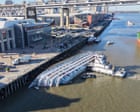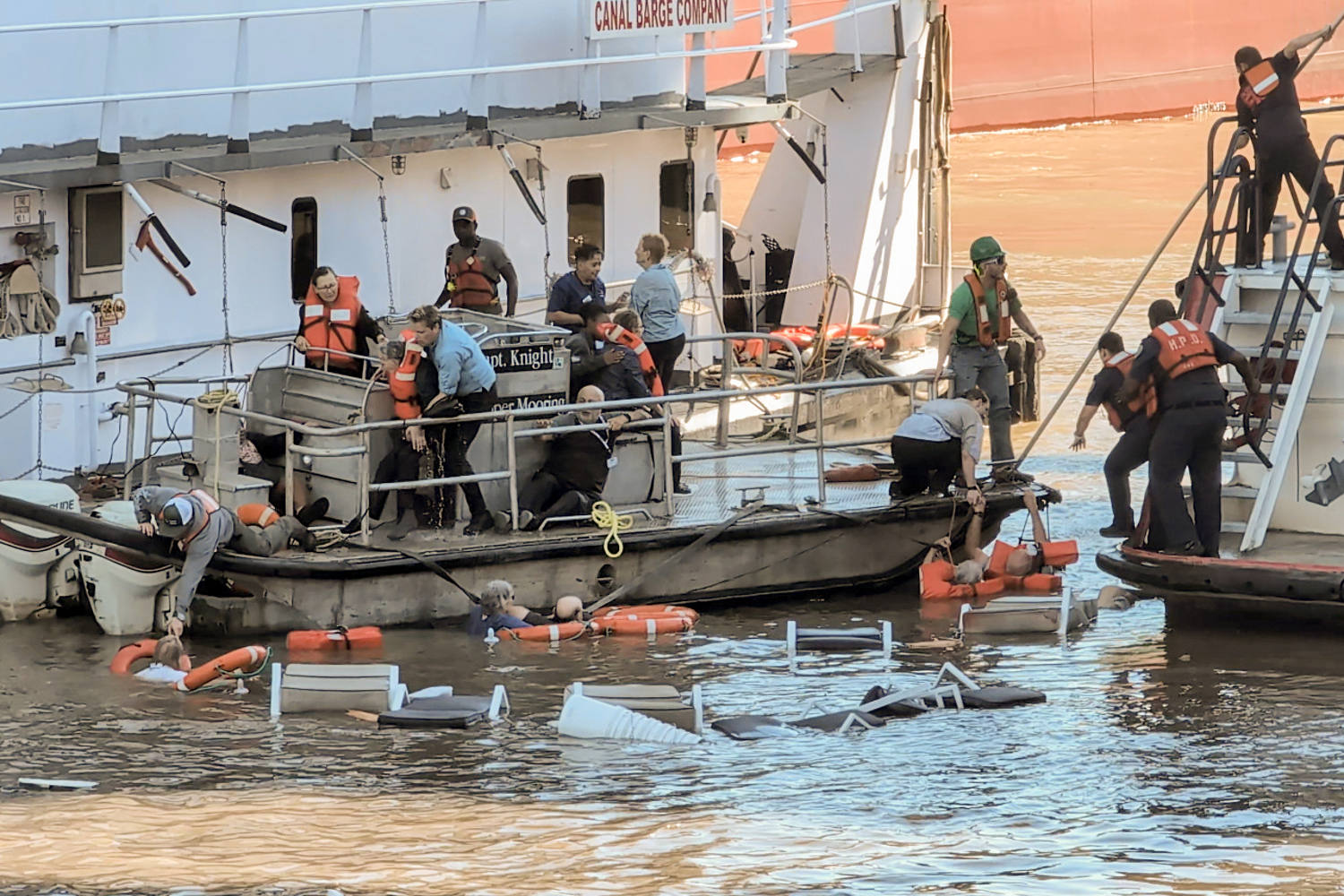
All passengers and crew members are safe and accounted for following a collision between a commercial tanker and a passenger riverboat on the Mississippi River in New Orleans. Emergency responders, local harbor police, and U.S. Coast Guard units evacuated those aboard and secured the vessels without a single reported fatality or life-threatening injury. While the immediate crisis ended in relief, the incident exposes a persistent, high-stakes vulnerability on America’s busiest commercial waterway, where massive ocean-going tankers share tight, unpredictable river bends with historic tourist paddlewheelers.
The Lower Mississippi River is not a placid canal. It is a violent, fast-moving industrial highway funneling billions of tons of grain, petrochemicals, and containerized cargo toward the Gulf of Mexico. Every day, pilots guide deep-draft vessels exceeding 600 feet in length through sharp, silt-shifting turns directly alongside the French Quarter and the Central Business District. At the exact same time, excursion boats carrying hundreds of sightseers, wedding guests, and dinner patrons crisscross those same channels. The margin for error is measured in feet and seconds.
The Physics of a Tight River Bend
To understand how an ocean-going tanker and a passenger riverboat end up colliding in broad daylight or under harbor lights, you have to understand how water moves around the Crescent City. New Orleans sits on a series of dramatic S-curves, most notably Algiers Point, one of the sharpest and most treacherous bends on the entire river system.
A laden chemical or product tanker cannot simply hit the brakes. Depending on its tonnage and whether it is moving with or against the current, a large tanker requires anywhere from half a mile to over a mile to come to a complete stop. Worse, as a ship slows down, it loses water flow over its rudder. Less water flow means less steering authority. Captains and river pilots are caught in a perpetual Catch-22 during congested traffic: slow down to avoid an obstacle, and you risk losing the very steering power needed to maneuver around it.
Meanwhile, the river itself pushes back. Strong currents, seasonal high-water surges, and eddies swirling off battures and docks create hydrodynamic forces that can physically shove a vessel sideways. When a deep-draft tanker passes near a shallower bank or another hull, bank suction and vessel interaction come into play. The displaced water creates low-pressure zones that can pull two ships toward each other like magnets, overriding standard helm corrections before a crew even realizes their heading has shifted.
Why Everyone Survived This Time
When an accident occurs on this stretch of water, survival depends entirely on immediate, coordinated emergency response and vessel construction. In this collision, the fact that everyone walked away comes down to three primary operational realities rather than sheer luck.
First, commercial passenger vessels operating on the Mississippi are subject to strict Coast Guard subchapter inspections, requiring compartmentalized hulls designed to resist rapid flooding even after a breach. Unlike recreational boats that can capsize in seconds, riverboats are built with wide beams and shallow drafts that provide high initial stability.
Second, the geography of the New Orleans harbor works in favor of rapid rescue. The Port of New Orleans maintains a dense network of tugboats, harbor police patrols, and Coast Guard sectors stationed minutes away from the downtown waterfront. In a river collision, tugboats act as immediate first responders, pushing damaged vessels toward the nearest bank to prevent them from drifting into bridge pilings or sinking in the main shipping channel.
Third, communication protocols on the river—specifically the Vessel Traffic Service (VTS) operated by the Coast Guard—ensure that surrounding commercial traffic is alerted within seconds. When a casualty occurs, nearby towboats and ferries routinely abandon their schedules to assist in passenger transfers, turning a potential mass-casualty event into an orderly evacuation.
The Hidden Friction Between Tourism and Heavy Industry
Local headlines naturally focus on the immediate human relief. Everyone is accounted for. Nobody drowned. The boats are moored. Yet veteran mariners see a troubling pattern in how these incidents are framed as isolated flukes rather than predictable outcomes of competing economic priorities.
New Orleans relies heavily on two engines that occupy the exact same physical space:
- Maritime Freight: The Lower Mississippi port complex handles roughly 500 million tons of cargo annually, making it the primary export artery for American agriculture and energy.
- Waterfront Tourism: Millions of visitors board paddlewheelers, harbor cruise vessels, and commuter ferries each year, expecting a leisurely, scenic experience on the river.
These two worlds operate on entirely different clocks and risk profiles. A tanker carrying refined petroleum products or industrial chemicals is operating on tight charter schedules, constrained by draft limits, tug availability, and tidal windows. A dinner cruise boat is operating on an entertainment schedule, often maneuvering near docks right as commercial traffic is rounding the bend.
While state-commissioned river pilots are among the most skilled shiphandlers in the world, they are forced to thread a needle that grows narrower every year. Vessels have grown significantly larger over the past two decades. Panamax and post-Panamax ships now routinely transit the lower river, displacing vastly more water and leaving less physical room in the channel for smaller excursion craft to pass safely.
Mechanical Failure Versus Human Factor
Every marine casualty investigation by the U.S. Coast Guard and the National Transportation Safety Board (NTSB) eventually boils down to a familiar set of variables: mechanical failure, environmental conditions, or breakdowns in bridge resource management.
Consider a hypothetical scenario common to river collisions. Imagine a tanker experiences a sudden loss of propulsion or a steering gear fault—a "blackout" in maritime parlance—just as it enters a bend. Even if backup generators kick in within thirty seconds, thirty seconds in a four-knot current moves a 70,000-ton hull more than two hundred feet off its intended track. If a passenger boat is overtaking or crossing near the bow at that exact moment, there is nowhere for either vessel to go.
Even without a mechanical failure, radio congestion on VHF Channels 13 and 67 can delay critical passing agreements. Pilots rely on crisp, unambiguous voice communication to confirm which side they will pass on—port-to-port or starboard-to-starboard. When multiple towboats pushing thirty-barge strings, ocean tankers, and local ferries are all talking over one another during a shift change or squall, a single misunderstood transmission can put two hulls on a collision course.
What Official Investigations Actually Change
Following a high-profile collision, government agencies launch formal inquiries. Investigators pull data from the Voyage Data Recorder (VDR)—the maritime equivalent of an aircraft's black box—to review radar overlays, helm orders, engine RPMs, and bridge audio. They administer mandatory drug and alcohol testing to all involved crew members and inspect maintenance logs for deferred repairs.
These investigations often produce thorough technical reports twelve to twenty-four months after the paint has been scraped off the hulls. Occasionally, they lead to tightened safety advisories, updated VTS reporting checkpoints, or civil penalties against operators who failed to maintain a proper lookout under Rule 5 of the Inland Navigation Rules.
What they rarely change is the fundamental geometry of the river. You cannot widen the Mississippi at Algiers Point without demolishing historic neighborhoods, and you cannot halt global shipping to give tour boats an empty waterway. As long as deep-draft tankers and passenger riverboats share the same narrow bends, river safety rests entirely on split-second human judgment and mechanical reliability—a slim margin that held up this time, but offers zero guarantees for the next vessel rounding the curve.