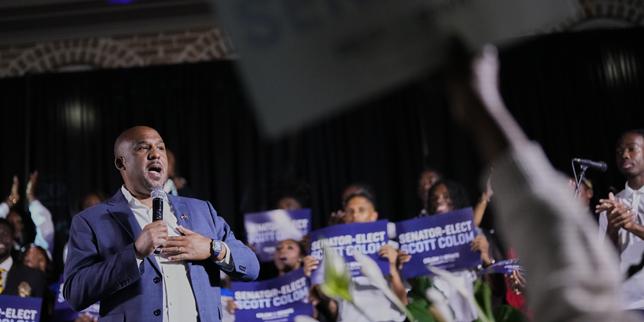
National political forecasters didn't just miss the call in Mississippi. They stopped looking at the map altogether.
When Democrat Scott Colom unseated incumbent Republican Senator Cindy Hyde-Smith in the November 2026 midterms, the result sent shockwaves through Washington. Not because the math was impossible, though. It shocked the political establishment because national strategists had spent decades writing off the Magnolia State as a lost cause.
Let's look at the numbers that actually mattered. Colom, a 43-year-old district attorney from Columbus, didn't just pull off a statistical fluke. He became the first Black U.S. senator elected from Mississippi since Blanche K. Bruce left office in 1881—ending a 145-year gap that stretches all the way back to the Reconstruction era. He is also the first Democrat to represent Mississippi in the Senate since John C. Stennis retired in 1989, and the first challenger to unseat a sitting Mississippi senator since 1942.
Most pundits assumed deep-red Mississippi was untouchable. They were wrong.
How National Strategists Misread the Mississippi Electorate
If you spend enough time watching national election coverage, you start hearing the same lazy shorthand about the Deep South. Analysts look at top-line presidential margins, shrug, and tell donors to spend their money in Pennsylvania or Michigan instead.
Colom saw a completely different reality on the ground. During the final stretch of the race, he bluntly told NBC News that the national Democratic Party hadn't even been trying in his home state. His math was straightforward. African Americans make up roughly 38% of Mississippi's population and consistently vote Democratic at rates between 90% and 95%. You don't need a miracle to win with that kind of base. You need high turnout, relentless local organizing, and a message that peels off a modest slice of frustrated rural voters.
Early on, almost nobody bought it. Colom admitted after the race that donors wouldn't even return his phone calls in the beginning. Fewer than ten people showed up to his first town hall in Jackson.
Yet those early empty rooms masked a quiet shift. Midterms are fundamentally turnout elections, and Mississippi saw turnout surge roughly 35% higher than in the previous midterm cycle. When you combine a massive demographic floor with an incumbent who seemed caught off guard by a real fight, the "safe red seat" narrative falls apart fast.
The Viral Beef Ad That Changed the Race
Elections rarely turn on policy white papers. They turn on moments that make voters feel like a politician isn't living in the same economy they are.
For Cindy Hyde-Smith, who had held the seat since 2018, that moment came during an interview about rising grocery costs. Asked about the high price of beef, the Republican incumbent brushed off the concern by saying, "you have so many proteins to choose from".
Colom, working alongside his twin brother and his campaign manager, pounced on the clip. They scripted a short, sharp social media ad featuring everyday Mississippians reacting with disbelief to the "pick another protein" line. Colom closed the spot with a simple punchline: "Pick another senator instead".
It worked because it didn't sound like a focus-grouped Washington attack ad. According to data from Sprout Social cited by The Guardian, 70% of Gen Z respondents follow at least one politician on social media, and younger voters overwhelmingly get their midterm news from social feeds rather than traditional outlets. Colom's digital team understood that authenticity beats polish every single time.
While Hyde-Smith relied on traditional incumbency advantages, Colom used digital video to drive small-dollar donations and start conversations at kitchen tables across the state. By the third quarter of 2026, Colom raised over $1.87 million in a single quarter—outraising Hyde-Smith more than two-to-one and pushing his total haul past $4.4 million.
A Week of Affidavit Ballots and Grassroots Grit
Forget the idea of an Election Night blowout. The 2026 Mississippi Senate race came down to pure procedural endurance.
When polls closed on November 3, the race was razor-thin. At one point during the initial tally, Colom led by just 24 votes out of nearly a million cast. For more than a week, the outcome hung on absentee and affidavit ballots—the provisional ballots cast when a voter's eligibility can't be immediately verified at their precinct.
What happened during those eight days is the part of the story most national headlines glossed over.
The Battle Inside County Clerks' Offices
In states with strict voting rules, close elections are won or lost in local election commissioners' offices long after the TV cameras pack up. Overnight, young organizers and legal observers from groups like the Mississippi NAACP, ACLU, Southern Poverty Law Center, Fair Fight, and Mississippi Votes fanned out across county offices to monitor the count.
They watched every provisional ballot get reviewed. In Harrison County alone, observers documented 25 affidavit ballots getting tossed out simply because a poll worker in East Long Beach forgot to sign them—an administrative mistake that had nothing to do with the voters themselves.
Having trained eyes in those rooms prevented valid ballots from quietly disappearing. By November 11 and 12, major networks including the Associated Press and CBS News finally projected Colom the winner, with preliminary results showing him edging out Hyde-Smith by roughly 8,000 votes—49.36% to 48.54%, while independent candidate Ty Pinkins took 2.1%.
145 Years Between Reconstruction and Tougaloo College
To understand why crowds wept at Colom's victory rally at Tougaloo College, you have to look beyond the 2026 midterm map.
Mississippi sent the first two Black U.S. senators in American history to Washington during Reconstruction:
- Hiram Revels, who took office in 1870 after the post-Civil War state legislature elected him.
- Blanche K. Bruce, who served a full term from 1875 until 1881.
Then came the violent rollback of Reconstruction, Jim Crow laws, poll taxes, and literacy tests. For more than a century, Black Mississippians were systematically locked out of the ballot box. Even after the Voting Rights Act of 1965 dismantled formal barriers, statewide offices remained out of reach for Black candidates.
Even the last Democrat to hold a Mississippi Senate seat—John C. Stennis, who served until 1989—was a product of that older, segregated political era. Colom doesn't just represent a party flip. He represents a complete generational transformation of what a winning coalition in Mississippi actually looks like.
Why Colom’s Prosecutor Background Mattered
Critics often assume a Democrat winning in the Deep South must either run as a conservative clone or hide their party label. Colom did neither. Instead, he leaned heavily on his ten-year record as district attorney for Mississippi's 16th Judicial District, covering Clay, Lowndes, Noxubee, and Oktibbeha counties.
He already knew how to beat entrenched incumbents. Back in 2015, Colom unseated Forrest Allgood, a district attorney who had held the job for nearly three decades. As DA, Colom built a reputation around prosecuting violent crime and public corruption—including convicting a corrupt sheriff and securing a 105-year prison sentence in a high-profile assault and kidnapping case at Mississippi State University.
That track record neutralized the standard Republican attack line that Democrats are soft on crime. Even more telling, when President Joe Biden nominated Colom to a federal district judgeship in 2022, Colom initially earned bipartisan backing from former Republican governors Phil Bryant and Haley Barbour, as well as GOP Senator Roger Wicker—though Senate procedural hurdles eventually stalled the nomination.
Voters in places like Columbus and Starkville already knew him as a pragmatic prosecutor, not a caricature from cable news.
What This Upset Means for Future Elections
Colom takes the oath of office on January 3, 2027, giving Democrats an eighth flipped Senate seat in a wave election year. Within weeks of his victory, he was already holding town halls in deep-red counties like Itawamba—where he won just 16% of the vote—answering tough questions on healthcare, ethics, data centers, and how he plans to work alongside Republican Senator Roger Wicker.
If you follow politics, campaign strategy, or civic organizing, stop treating statewide partisan leans as permanent laws of nature. The biggest lesson from Mississippi in 2026 is simple: uncontested states stay uncontested only until someone refuses to accept the conventional wisdom. Watch how Colom governs alongside a Republican senior senator, pay close attention to local ballot-cure and affidavit rules in your own county before the next election cycle, and track how regional Democratic organizations allocate resources in the South heading into 2028.


