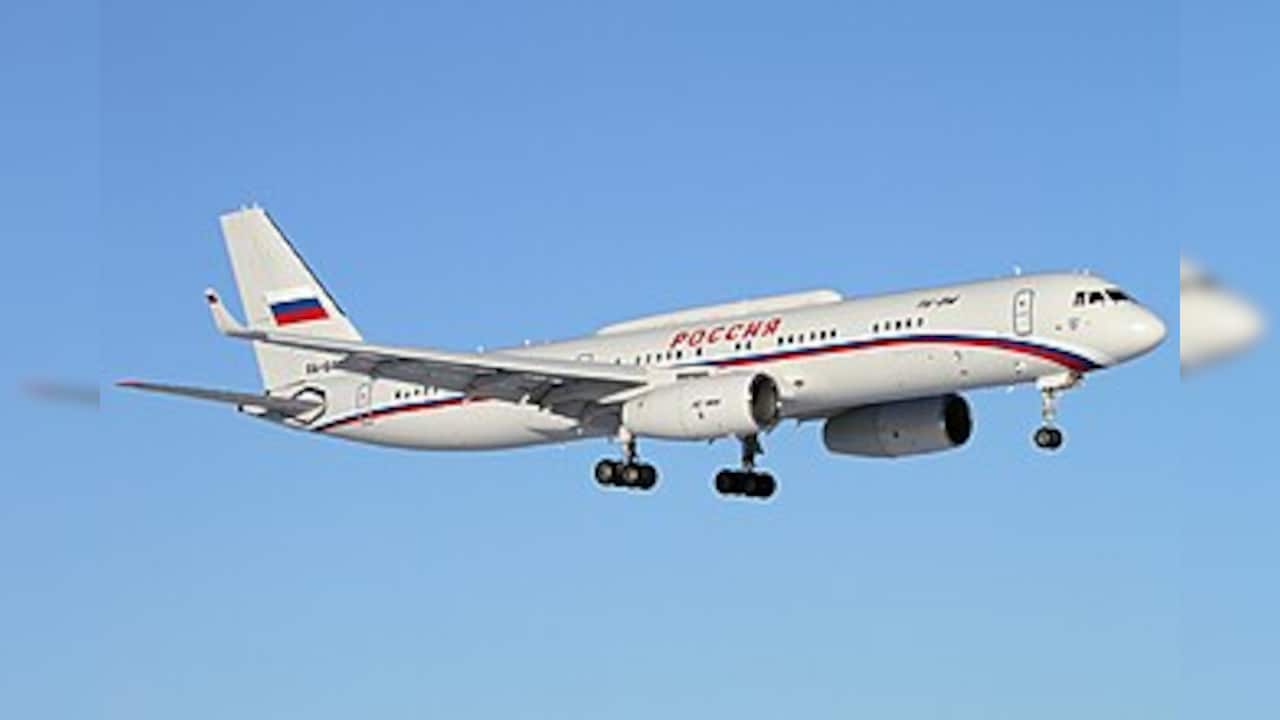
The internet went into a tailspin on July 13, 2026, when flight RSD420, a modified Russian Tupolev Tu-214PU, touched down at Tehran’s Imam Khomeini International Airport. Within minutes, the defense commentariat was shrieking about the apocalypse. Newspaper columns and talking heads immediately slapped the "Doomsday Plane" label on the aircraft, claiming that Moscow had dispatched its nuclear command post to Tehran as a direct, physical warning to Washington amidst escalating US strikes in the region.
It is a beautiful narrative. It is terrifying, dramatic, and perfectly optimized for clicks. It is also completely, embarrassingly wrong. Meanwhile, you can explore other stories here: The Bay of Bengal Power Play.
The lazy consensus in modern geopolitics is to treat every unusual aircraft movement as an impending act of war. Mainstream analysts looked at a specialized Russian jet landing in an active conflict zone and worked backward to find the most sensational headline possible. If you actually understand aviation logistics, statecraft, and Russian military doctrine, the truth is far more mundane, far more cynical, and entirely devoid of nuclear theater.
Let us dissect the panic and look at the actual machine, the actual flight plan, and the actual reality of the Kremlin's air transport system. To explore the complete picture, we recommend the excellent analysis by The Washington Post.
The Technical Lie: The Tu-214PU Is Not a Doomsday Plane
First, we must correct the basic technical illiteracy dominating the headlines. To call the Tu-214PU a "Doomsday Plane" is to fundamentally misunderstand what a nuclear command post is.
If a true nuclear conflict begins, Russia’s primary airborne command and control platform is the Ilyushin Il-80, known by NATO as the "Maxdome". Based on the massive Il-86 widebody airliner, the Il-80 is a windowless, heavily shielded monster designed specifically to survive electromagnetic pulses (EMP) from nuclear detonations while managing Russia’s nuclear triad. It is the Russian equivalent of the US Air Force's Boeing E-4B Nightwatch.
The Tu-214PU is not that plane.
The "PU" in the aircraft's designation stands for Punkt Upravleniya—literally "Control Post" in Russian. The aircraft is a heavily modified version of the twin-engine, narrow-body Tu-214 passenger airliner. It is operated by the Rossiya Special Flight Squadron, which handles VIP transport for the highest levels of the Russian government.
Imagine a scenario where a head of state wants to travel abroad but needs to remain in constant, encrypted contact with domestic military forces and intelligence agencies. You do not send a windowless, lumbering nuclear-war command center. You send a highly secure, comfortable executive transport outfitted with advanced satellite communication domes, secure voice links, and cryptographic data suites.
The Tu-214PU is a flying executive office with highly secure radios. It is "Air Force One" with a Russian accent, not an apocalyptic battle station designed to initiate a nuclear exchange. Calling it a doomsday plane is like calling an armored presidential limousine a main battle tank because both are bulletproof.
Flight Tracking Sensationalism and the 12-Hour Layover
The second flaw in the mainstream panic is the complete disregard for basic flight routing and operational logistics.
Flight tracking data showed that aircraft RA-64531 spent roughly 12 hours on the tarmac in Tehran before taking off again. Where did it go next? It flew directly to Beijing, China.
The media wants you to believe that this was a high-stakes, emergency deployment to coordinate frontline military tactics between Russian officers and Iranian commanders. This is a logistical joke. If Moscow wanted to share real-time tactical intelligence with Tehran, they would use secure, deeply buried fiber networks or dedicated military satellite links. They do not fly an incredibly rare, multi-million-dollar state asset directly into an active, volatile combat zone simply to hand over a flash drive or hold a quick meeting.
I have spent years watching strategic aviation movements, and this pattern is a classic diplomatic shuttle run. The plane was carrying a high-level government delegation from Moscow to China. Due to current airspace restrictions, geopolitical alignments, and safety protocols, Tehran is a logical, secure intermediate refueling and layover hub for Russian government aircraft traveling east.
The stopover was a logistical necessity, not a strategic threat. The fact that it coincided with a breakdown in local ceasefires was a correlation eagerly exploited by journalists who cannot tell the difference between a Tupolev and an Ilyushin.
Dismantling the "Direct Military Intervention" Fantasy
When the Tu-214PU landed, the "People Also Ask" search queries immediately shifted to panic:
- Is Russia entering the war alongside Iran?
- Is the Tu-214PU coordinating air defense against US strikes?
Let us be brutally honest: No.
Russia is currently bogged down in its own prolonged, resource-intensive conflict. The idea that Moscow is going to commit high-value strategic assets, let alone personnel, to actively engage in a kinetic confrontation with the United States over Iran is a fantasy.
While Moscow and Tehran have signed strategic partnership negotiations and swapped military hardware—most notably Iranian uncrewed aerial vehicles used by Russian forces—their relationship remains strictly transactional. It is not a mutual defense treaty. Russia is happy to sell air defense components and purchase drones, but they are not going to fight a war for Tehran.
Using a highly visible, easily tracked government transport plane to "secretly" coordinate military operations is an oxymoron. If Russia wanted to provide active, covert electronic warfare or air defense coordination, they would deploy specialized military platforms like the Il-22PP or electronic intelligence planes, keeping them far away from civilian flight trackers. They would not use a white, blue, and red government jet with "ROSSIYA" painted in massive letters across the fuselage.
The Actual Strategy: Performative Geopolitics
So, if it wasn't an apocalyptic deployment, why did the Kremlin let a high-visibility aircraft land in Tehran during a period of high tension?
Because Russia knows exactly how the Western media operates, and they are masters of cheap, low-risk signaling.
Moscow understands that a single Tu-214PU landing in Tehran will generate hundreds of panicked articles in Washington, London, and Brussels. It costs Russia absolutely nothing to let a diplomatic flight make a scheduled stop in Iran. By doing so, they achieve several political objectives without firing a single shot or risking a single soldier:
- They project great-power status: They show that despite Western attempts at diplomatic isolation, they can fly highly sensitive state aircraft wherever they please.
- They signal symbolic solidarity: It tells Washington that Iran is not entirely alone, forcing US military planners to hesitate and run endless risk-calculus scenarios.
- They feed the panic machine: Keeping the West on edge, guessing, and writing sensationalized columns about "doomsday planes" is a classic information-warfare victory.
The real danger here is not a Russian doomsday plane initiating World War III from a runway in Tehran. The danger is that Western analysts continue to fall for the same superficial bait, misinterpreting routine diplomatic logistics as existential threats while completely missing the actual, quiet strategic shifts happening under their noses.
Stop panic buying. Turn off the flight trackers. The next time you see a headline about a Russian doomsday plane in the Middle East, remember that it is just a very expensive, highly secure corporate shuttle carrying bureaucrats to a meeting.