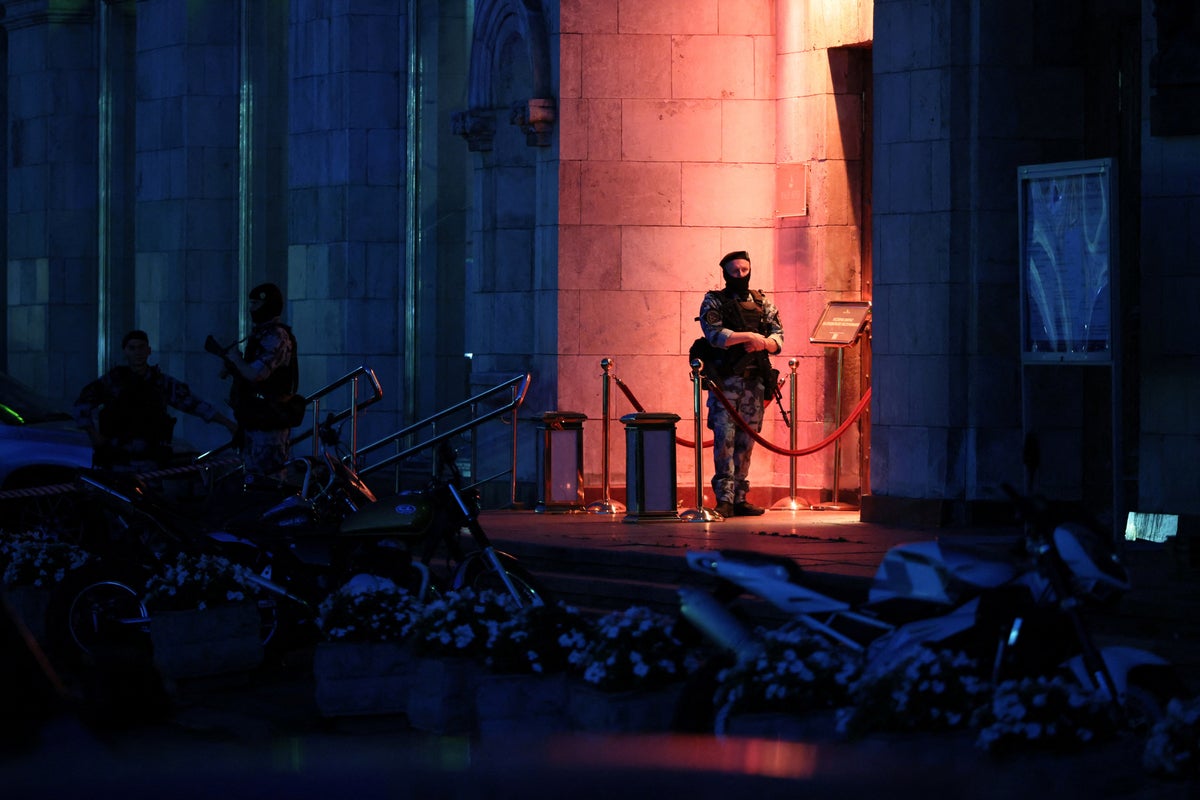
Another explosion near a Moscow restaurant. Three dead. The wire services rush to push the notification. Commentators dust off their templates about escalation, intelligence failures, and the slow creep of the front lines into the Russian capital.
It is lazy journalism at its finest. It treats a complex web of decentralized friction like a traditional chess match where every move has a neat, predictable label.
Stop looking at the smoke. Look at the mechanics.
When casual observers see localized kinetic strikes deep inside a major power's urban core, they immediately scream about turning points. They want a neat narrative. They want to believe that a single blast near a cafe signals a dramatic pivot in military capability or a sudden crack in state security.
I have spent decades watching how asymmetric kinetic actions operate in urban zones under heavy surveillance. The reality is far more mundane, far more brutal, and entirely detached from the grand strategic theater everyone thinks they are watching.
The Myth of the Strategic Shock
The lazy consensus in mainstream reporting is simple: kinetic actions in metropolitan centers equal psychological pressure on the leadership, which equals structural policy shifts.
It is completely backwards.
Modern state apparatuses built on heavy internal security do not wobble because a local device goes off. In fact, localized incidents often achieve the exact opposite of what casual analysts assume. They reinforce the state's domestic monopoly on narrative. They provide immediate justification for tighter control, expanded surveillance authorities, and the suppression of remaining gray areas in civil society.
When you study urban asymmetric operations historically—from Belfast to Algiers to modern high-density zones—you realize that tactical noise rarely translates to strategic leverage. It creates headlines. It moves stock tickers momentarily. It generates panic on social feeds.
It does not rewrite a geopolitical doctrine.
To understand why these events keep happening and why they matter so little to the overarching trajectory of the conflict, we have to strip away the emotional hysteria of the news cycle and look at the logistics of modern urban friction.
The Mechanics of Low-Signature Warfare
Let us define terms clearly because the vocabulary around modern conflict is broken.
When people hear "bomb near a restaurant," they imagine elite operatives executing a Hollywood-style infiltration, complete with forged papers, tactical gear, and months of surveillance.
That belongs in a script, not reality.
Low-signature warfare relies on hyper-local outsourcing. It uses gig economy economics applied to violence. A courier who doesn't know what they are carrying. A dormant digital wallet funded through privacy-focused crypto tumblers. A pre-positioned cache assembled from commercially available components that evade standard chemical sniffers at checkpoints.
This is not state-on-state conventional brilliance. This is the Uber-fication of sabotage.
When you have a massive urban sprawl with millions of daily transactions, porous supply chains, and an endless stream of migrant labor moving through grey-market jobs, zero-friction security is a mathematical impossibility. No amount of facial recognition cameras or internal passport checks can stop a determined cell from renting a basement apartment, assembling a low-yield device using off-the-shelf fertilizer derivatives, and triggering it via a disposable burner phone.
The state knows this. The security services inside Moscow do not lose sleep over a localized blast because they view it as an operational tax of empire. Just as modern Western cities accept a baseline of public disorder or lone-wolf threats as the cost of open infrastructure, highly centralized authoritarian states budget for a certain volume of domestic friction.
The Fallacy of Escalation Dominance
Every time an incident occurs in Moscow or St. Petersburg, the pundit class floods the airwaves with warnings about crossing red lines.
What red lines?
The threshold for escalation was crossed the moment regular armor crossed international borders years ago. Everything happening now is just noise in the system. Treating a restaurant explosion as a dangerous new escalation is like panicking over a thunderstorm during a hurricane.
The mistake lies in viewing escalation as a ladder where each rung is higher and more dangerous than the last. Modern conflict is not a ladder. It is a swamp. You do not climb higher; you sink deeper into a messy, stagnant quagmire where actions lose their distinct categories and blur into continuous, grinding attrition.
Imagine a scenario where every major capital city on earth operates under a permanent low-grade threat of localized kinetic disruption. That is not a temporary emergency state. That is the new baseline of global security.
If you keep waiting for the catastrophic tipping point that forces a sudden peace treaty or an unconditional surrender through urban sabotage, you are misreading the last century of military history. Nations do not collapse because a cafe windows shatter three miles from the Kremlin. They collapse when their economic engine seizes, their currency turns to wallpaper, and their logistics chains starve at the source.
A localized blast is a symptom, not a disease.
Why the Media Keeps Getting It Wrong
The incentive structure of modern news guarantees bad analysis.
A wire service cannot run a headline that says: "Routine Asymmetric Friction Continues in Urban Center With Zero Strategic Impact." That doesn't get clicks. That doesn't fuel the 24-hour dopamine loop of the conflict watcher.
Instead, editors dress up localized tragedies as grand turning points. They take a tactical event—which requires local police work, forensic accounting, and counter-intelligence grinding—and elevate it to a grand strategic duel between presidents.
This creates a dangerous cognitive distortion among the public. People begin to measure the health of a multi-year interstate conflict the way they measure a football game: counting touchdowns, injuries, and sudden momentum shifts.
Warfare is not sports. It is an industrial process of resource destruction.
While the internet obsesses over who planted a device near a soup kitchen or a terrace cafe, real power is shifting quietly in power plants, central banks, semiconductor supply chains, and drone assembly lines thousands of miles away from Moscow's restaurant district.
The Brutal Truth About Domestic Security
Let us address the uncomfortable reality that nobody in the political class wants to admit.
Total security is a lie sold by politicians to justify budgets and by tech vendors to sell software licenses. In any society of over ten million people, with fluid borders, massive black-market labor pools, and widespread digital anonymity tools, security is merely a game of statistical triage.
The security apparatus in Moscow is not failing because an incident occurred. It is functioning exactly as a massive, bureaucratic apparatus functions: absorbing shocks, containing fallout, and using the event to tighten internal screws.
Every time a bomb goes off, the state gets an excuse to install ten thousand more cameras, restrict foreign remittances further, crush independent NGOs, and round up anyone who looks at a local police officer sideways.
If the objective of the people orchestrating these deep-penetration actions is to trigger a popular uprising or force the regime to back down, they are achieving the exact opposite. They are feeding the beast they are trying to starve.
History shows that external pressure on an enclosed state invariably consolidates internal loyalty, or at least forces passive compliance through sheer exhaustion. When citizens feel threatened from both the outside world and internal chaos, they huddle closer to the center of gravity, no matter how toxic that center might be.
Stop Watching the Shadows
If you want to understand where this conflict is heading, stop reading the breaking news alerts about smoke in provincial suburbs or capital side streets.
Watch the freight rail schedules. Track the metallurgical output of remote industrial towns in the Urals. Monitor the cost of heavy industrial lubricants and the availability of precision machine tools.
Those are the metrics that dictate survival.
The rest is just theater designed to keep you glued to a screen, mistaking tactical noise for strategic reality.
Turn off the notifications. Look at the balance sheets. The smoke clears by morning; the math remains.