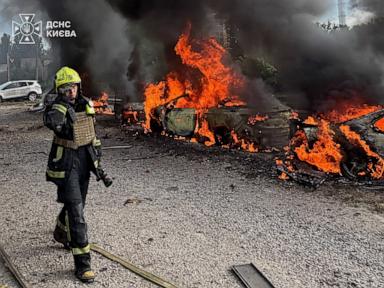
Sixteen injured. Property damage reported. Sirens wailing across the Dnipro. The routine is nauseatingly familiar, and so is the journalism that packages it. Every time air defense batteries light up the night sky over Ukraine’s capital, international newsrooms scramble to publish the exact same formulaic dispatch. They tally the casualties, quote the municipal updates, broadcast grainy footage of burning debris, and wrap it all in a shroud of moral outrage.
It is lazy, reactive storytelling that completely misunderstands the mechanics of modern attrition warfare. Recently making waves recently: The Line in the Sand Written in Ink and Silence.
By reducing a sophisticated multi-domain campaign of urban coercion down to a daily police blotter of injured civilians and shattered windows, the mainstream media does the aggressor's work for them. They turn a brutal, calculated exercise in logistical exhaustion into a depressing soap opera. If you want to understand what is actually happening in Kyiv, you have to stop looking at the ambulance counts and start looking at the balance sheets, the industrial supply chains, and the psychology of adaptation.
The Comforting Illusion of the Casualty Count
The lazy consensus in modern conflict reporting is that the primary metric of an attack's success or failure is its body count. Every headline leads with the wounded, transforming a strategic chess match into a humanitarian tragedy meant solely to provoke emotional exhaustion in foreign readers. This approach is not just manipulative; it is analytically bankrupt. Additional details regarding the matter are explored by Associated Press.
When a barrage of missiles and loitering munitions targets a metropolis of three million people, a tally of sixteen injured is neither a humanitarian catastrophe nor a military triumph. It is a statistical artifact of early warning systems, reinforced concrete, civil defense discipline, and probability. Yet, the framing implies that if the number were zero, the attack didn't happen, and if it were higher, the regime in Moscow is somehow achieving its strategic objectives.
Both conclusions are dangerously wrong.
The strategy behind targeting a capital city from twelve hundred miles away is rarely about inflicting mass casualties in a single night. Mass murder is a byproduct, not the primary KPI. The real objective is cognitive and economic erosion. It is about forcing an entire nation to redirect scarce capital toward air defense replenishment, driving up insurance premiums for grain shipments, keeping foreign investors perpetually hesitant, and burning through the psychological reserves of a population that has endured years of interrupted sleep.
When journalists focus exclusively on the sixteen injured, they miss the invisible war. They ignore the factory floor operating in a basement three miles away, the supply chain manager rerouting transformers around destroyed substations, and the software engineer compiling drone interception telemetry while the walls shake. Focusing purely on the blood spilled on the pavement blinds us to the steel being forged underneath it.
The Economics of Exhaustion Versus Interception Math
To understand why these capital strikes persist despite yielding diminishing military returns, you have to look at the cold, unromantic math of military economics. This is where most commentators completely lose the plot. They talk about "iron domes" and "patriot batteries" as if they were magic force fields operating outside the laws of physics and fiscal reality.
Let us define the core variables. Interceptor missiles cost millions of dollars apiece. Certain classes of attack drones and loitering munitions cost a fraction of that amount. This is the fundamental asymmetry of modern air defense. No nation on earth, regardless of foreign aid packages and industrial mobilization, can indefinitely sustain a one-to-one financial exchange ratio where high-end kinetic interceptors are expended to swat away cheap mass-produced ordnance.
The conventional narrative praises every successful interception rate—ninety percent shot down, eighty-five percent neutralized—as a triumph of Western technology. And militarily, protecting human lives on the ground is the immediate priority. But from a long-term strategic perspective, the attacker’s calculus is not predicated on hitting a specific ministry building. It is predicated on depletion.
Imagine a scenario where a defensive alliance spends ten billion dollars over six months neutralizing incoming projectiles that cost the adversary a few hundred million to manufacture and launch. Who is winning that war of attrition? The physical capital destroyed on the ground in Kyiv is secondary to the financial capital consumed in the air over it.
Commentators who cheer every successful interception without calculating the burn rate of the defense inventory are suffering from short-term bias. The aggressor knows they cannot conquer the capital with night raids. They are playing a macroeconomic game of attrition, attempting to starve the defense of its most expensive, irreplaceable assets. Ignoring this economic reality because it lacks the dramatic punch of a burning apartment building is journalistic malpractice.
Why Modern Urban Resilience Defeats Strategic Terror
For decades, military theorists operated under the assumption that urban bombing campaigns would break civilian morale and force governments to sue for peace. The Blitz in London, the firebombing of Dresden, the rolling raids over Hanoi—the historical precedent was built on the idea that terror from the sky would eventually cause civil society to fracture.
That playbook is dead. In the twenty-first century, it has been replaced by the iron law of decentralized resilience.
Kyiv today is not a fragile network of centralized administrative nodes waiting to collapse under pressure. It is a hyper-connected, deeply decentralized grid of micro-economies, remote workforces, peer-to-peer logistics, and hardened civil infrastructure. When a transformer is hit, generators spin up within minutes. When a residential block is struck, municipal crews clear the rubble and restore window glazing before the evening news cycle even finishes editing its footage.
This is what observers from peaceful capitals fail to grasp. Resilience is not a static trait; it is an active, continuously running software loop. The population has developed an institutional memory for crisis response that rivals any emergency management agency on the planet. People do not panic because panic has been optimized out of their daily routines. They calculate risk, adjust their commute, check on their neighbors, and get back to work.
When an attack injures sixteen people, it is a tragedy for those individuals and their families. But on a societal scale, it produces the exact opposite of what the planners in the Kremlin intend. Instead of sowing division, terror, and defeatism, indiscriminate strikes harden collective resolve. They eliminate whatever lingering political ambiguity existed among the population. They provide daily, visceral proof that compromise with an aggressor who targets civilian neighborhoods is an illusion.
The media consistently underestimates the psychological immunity that prolonged exposure builds. You cannot terrorize a population that has already processed the worst-case scenario and decided to keep living anyway.
The Media Echo Chamber And The Danger of Static Narratives
The greatest vulnerability in how the West consumes this war is not tactical; it is cognitive. We are trapped in a feedback loop of our own making, consuming news through a lens of perpetual shock and temporary sympathy.
Every few weeks, a major strike hits Kyiv. The same cycle kicks in: urgent push notifications, breaking news banners, emotional opinion pieces about our collective moral failure, followed by a quiet lull until the next kinetic event. This episodic journalism creates a false narrative of stagnation. It makes the conflict look like a frozen stalemate punctuated only by random acts of violence.
This is fundamentally false. The war is moving at a blistering technological and tactical pace. While headline writers obsess over the immediate aftermath of a drone strike, engineers on both sides are iterating weapon guidance systems, electronic warfare jamming profiles, and counter-UAV swarm tactics on a weekly basis.
Consider the evolution of air defense itself. Two years ago, defending a capital city meant relying exclusively on expensive, fixed-site surface-to-air missile batteries. Today, it involves decentralized mobile fire teams equipped with heavy machine guns, acoustic sensors, thermal cameras, and truck-mounted lasers. It is a dynamic, learning ecosystem. Yet, you rarely read about this systemic transformation in mainstream reports because it requires actual domain expertise rather than emotional adjectives.
When journalists treat every attack as an isolated tragedy rather than a data point in a continuous technological arms race, they fail their readers. They reduce a complex geopolitical pivot point to a weather report. "Rain in Kyiv today, bring your umbrella." It is insulting to the people living through the reality and dangerous for policymakers trying to understand the trajectory of the conflict.
The Real Metric of Success Is Not What Bleeds But What Adapts
Let us dispense with the pretense that reporting sixteen injuries gives us any meaningful insight into the outcome of this war. Blood and broken glass are the visible symptoms of a much deeper, colder struggle over industrial capacity, technological innovation, and societal endurance.
The side that wins this conflict will not be the one that absorbs a barrage without flinching. It will be the one that designs a cheaper interceptor, secures a more resilient supply chain, manufactures its own critical components without relying on erratic foreign aid cycles, and adapts its economy to function under perpetual siege.
Every time a missile hits a street in Kyiv and the media responds with the same shallow chorus of shock, the real combatants are already back at their desks, rewriting software code, recalculating fuel reserves, and redesigning tomorrow's defense architecture. Stop counting the wounded as if they were a scorecard for geopolitics. Start looking at the engineers, the logicians, and the innovators who are rewriting the rules of modern defense while the rest of the world watches through a cracked camera lens.


