The European defense establishment is currently gripped by a collective delusion. Western military analysts, politicians, and defense contractors are lining up to praise Ukraine’s "drone wisdom," treating the battlefields of Eastern Europe as a silicon-infused masterclass in modern warfare. The dominant media narrative is simple: cheap, commercial first-person view (FPV) drones have democratized air power, rendering traditional, expensive Western military hardware obsolete. European leaders want to copy-paste this decentralized, software-first approach to defense.
They are learning exactly the wrong lessons.
The belief that European nations can simply adopt Ukraine’s makeshift, ad-hoc drone strategy to secure the continent is not just naive; it is strategically illiterate. What works for a nation fighting an existential war of attrition with a massive, localized citizen-developer pipeline will fail catastrophically when forced into the rigid, peacetime regulatory frameworks of NATO and the European Union.
We are glorifying a desperate, brilliant survival tactic and mistaking it for a sustainable defense strategy.
The Myth of the Cheap FPV Savior
Every week, a new article celebrates how a $500 off-the-shelf quadcopter modified with a 3D-printed trigger mechanism can destroy a multi-million-dollar main battle tank. The tech-optimist crowd loves this narrative. It feels like Silicon Valley disrupting a legacy industry.
But this math completely ignores the brutal reality of electronic warfare (EW) scale.
In the early days of the conflict, commercial drones operated with terrifying efficacy. Today, the attrition rate is staggering. Russian electronic warfare systems, such as the Pole-21 and Borisoglebsk-2, jam wide swaths of the radio frequency spectrum. When a single EW jamming system can render thousands of commercial drones blind and useless overnight, the cost-benefit analysis flips.
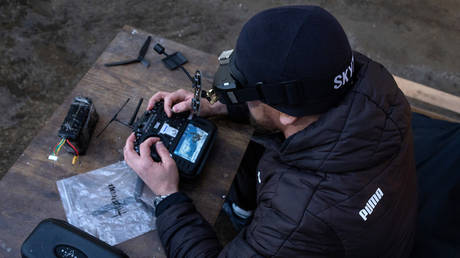
To bypass this jamming, Ukrainian engineers must constantly change control frequencies, solder new boards, and rewrite custom flight control software in field tents. This is a hyper-localized cat-and-mouse game.
Imagine a scenario where a bureaucratic European military, bound by strict procurement rules and safety certifications, tries to update its drone firmware. In Brussels or Paris, a software patch requires six months of compliance testing, environmental impact assessments, and radio spectrum frequency approvals. By the time the patch is approved, the adversary has already changed their jamming algorithms three times.
You cannot scale a MacGyver-style supply chain across twenty-seven sovereign nations with unionized defense factory workers.
The Logistics Nightmare Nobody Talks About
The "drone wisdom" narrative focuses heavily on the front-end victory—the dramatic video of a drone striking a bunker. It conveniently ignores the backend nightmare.
Ukraine’s drone ecosystem relies on an unprecedented, fragile network of volunteer organizations, decentralized workshops, and direct-from-China component sourcing. Thousands of individual parts—motors, electronic speed controllers (ESCs), carbon fiber frames, and camera modules—are smuggled or bulk-shipped via postal services from Asian markets.
This is not a robust military supply chain; it is an agile hobbyist network operating on adrenaline and existential dread.
If Western Europe faces a peer conflict, China can shut off the component spigot with a single export restriction order. European defense giants like BAE Systems, Rheinmetall, and Leonardo cannot build their state defense strategies on the availability of DJI parts or cheap Shenzhen-manufactured chips.
When European leaders say they want to adopt "drone wisdom," what they are actually saying is they want the cheap results without doing the hard work of rebuilding their own industrial base. They want to substitute heavy industrial manufacturing—which Europe has neglected for thirty years—with cheap consumer electronics.
Dismantling the "People Also Ask" Delusions
When military tech forums discuss this shift, the same flawed questions appear repeatedly. Let's address them with cold reality.
Can software-defined drones replace traditional artillery and armor?
Absolutely not. Drones are precision snipers; artillery is a sledgehammer. A drone carries a payload of a few pounds and requires optimal weather conditions, a clear line of sight, and an unjammed spectrum. A 155mm artillery shell functions in a blizzard, ignores electronic jamming, and can sustain a barrage that levels grid squares. Relying on drones to replace heavy armor and artillery is an intellectual cop-out used by governments that want to avoid the massive capital expenditure required to rebuild ammunition factories.
Why can't NATO just build its own agile drone fleet?
Because NATO is built on the concept of interoperability and strict standardization (STANAG). Every piece of equipment must be certified to not interfere with hospital radios, civilian cell towers, or aviation frequencies. Ukraine's drone success relies on breaking every civilian rule in the book. If a French drone unit operates on the same frequencies used by civilian air traffic control during an exercise, the exercise gets shut down. The Western regulatory state is fundamentally incompatible with the chaotic, rule-breaking ethos that makes commercial drones effective in war.
Is AI autonomous flight the answer to electronic warfare?
Tech executives love to pitch terminal guidance AI—where a drone switches to machine vision to track a target once it loses its radio link. While this works in laboratory settings and controlled demos, the real world is messy. Mud, smoke, camouflage, burning vehicles, and changing light conditions completely baffle standard computer vision algorithms. True, reliable, un-jammable autonomous AI flight at scale requires immense onboard processing power that cannot currently be sustained by a cheap, lightweight battery.
The Multi-Billion Dollar Procurement Trap
I have watched defense ministries spend tens of millions of dollars trying to replicate "agile startup culture" within their procurement departments. It always ends the same way. They set up a shiny innovation hub, hire consultants who use words like "scrum" and "sprint," and buy thousands of commercial quadcopters.
Three years later, those drones are sitting in a warehouse, obsolete, because the lithium batteries have degraded and the software hasn't been updated since the contract expired.
The Western defense procurement system is optimized to prevent failure and avoid corruption, which means it moves at a glacial pace. A traditional defense program—like the F-35 or a new frigate—takes a decade to move from blueprint to deployment. Commercial drone tech cycles occur every six weeks. Trying to merge these two systems creates a toxic mismatch.
You end up paying legacy defense contractor prices for consumer-grade tech. A drone that costs $1,000 to build in a Ukrainian basement ends up costing $80,000 once a Western defense prime adds its overhead, safety documentation, profit margins, and compliance certifications.
The Missing Link: Mass and Attrition
The ultimate flaw in the European infatuation with drone wisdom is a misunderstanding of scale. Ukraine uses tens of thousands of drones per month. The level of attrition is spectacular.
European militaries are accustomed to treating high-tech assets like precious family heirlooms. They buy forty high-end Reapers or Eurofighters and expect them to last twenty years. They do not have the mental model required to treat aerial platforms as disposable ammunition.
If France or Germany entered a high-intensity conflict today, their entire inventory of advanced drones would likely be wiped out or jammed out of the sky within forty-eight hours. They do not have the manufacturing infrastructure to replenish them on Monday morning.
Stop Studying the Exception
Ukraine's drone success is an extraordinary anomaly born of specific geography, a tech-literate population fighting for survival, and a temporary gap in traditional military doctrine. It is an inspiration, but it is a terrible blueprint for peacetime nations.
By focusing on the shiny object of drone warfare, European leaders are distracting themselves from their glaring, structural vulnerabilities: a lack of deep magazine capacity, non-existent domestic semiconductor manufacturing, a shortage of basic artillery shells, and an ossified defense bureaucracy that treats software as an afterthought.
Stop trying to copy the desperate improvisations of a nation fighting under siege. If Europe wants to secure its borders, it needs to stop buying hobbyist quadcopters, stop listening to tech-evangelist hype, and start doing the heavy, unglamorous work of rebuilding its core industrial defense capacity. Anything less is just security theater paid for with tax dollars.