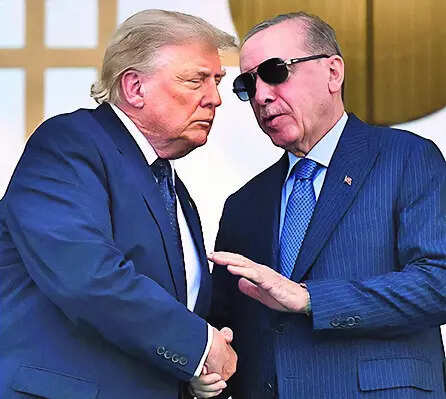
NATO just dropped a $50 billion message on the table in Ankara, and it wasn't a subtle one. For years, the narrative around the transatlantic alliance has been a repetitive loop. Donald Trump criticizes Europe for freeloading, European leaders scramble to promise they'll do better, and the cycle repeats. But at the recent defense summit in Turkey, the old script broke. Europe decided to flash its cash.
The alliance didn't just talk about abstract spending targets or issue vague communiqués. They rolled out concrete, massive procurement contracts that shift the balance of military industrial power. While the media loves to focus on the personal dynamics between Trump and Turkish President Recep Tayyip Erdogan, the real story is the money moving behind the scenes. Europe is buying its way into a new era of self-reliance, even if it has to buy some American hardware to keep Washington happy in the short term.
The Fifty Billion Dollar Proof Product
If you want to understand how terrified European leaders are of a potential U.S. military pullback, look at the sheer scale of the contracts signed in Ankara. We're talking about $50 billion in defense industry deals. This isn't money pledged for 2035. This is cash hitting corporate ledgers now.
The alliance is executing a deliberate strategy to show Trump that the continent is finally taking its own security seriously. Secretary-General Mark Rutte even brought a chart nicknamed "The Trump Trillion" to show that European allies and Canada have poured $1.2 trillion into defense since 2017.
But the real shift isn't just the total amount spent. It's where that money is going.
Sourcing Locally and Ditching Boeing
For decades, Europe relied on American-made Boeing E-3 Sentry AWACS planes for airborne radar detection. They were the eyes in the sky for the alliance. Not anymore. Eleven NATO countries teamed up to sign a $5 billion deal with Swedish aerospace firm Saab AB to buy up to ten GlobalEye surveillance aircraft.
This is a massive blow to U.S. defense contractors. European capitals chose a continental alternative over Boeing's E-7A. It signals a growing desire to ensure European safety isn't entirely tethered to the political whims of the White House.
The Transatlantic Compromise
Europe can't go completely cold turkey on American weapons. The defense industrial base on the continent is still too fragmented to build everything from scratch. So, the Ankara deals represent a calculated mix of strategic independence and necessary appeasement.
- Northrop Grumman Scores: Denmark, Finland, Germany, and Norway are dropping $2.7 billion on five high-altitude Triton surveillance drones. It's a capability Europe literally cannot build itself right now.
- The AMRAAM Expansion: A coalition of nine nations, including the UK, Germany, and Belgium, signed an agreement with RTX Raytheon to explore expanding AMRAAM missile production directly on European soil.
- The ATACMS Deal: Lockheed Martin and Germany's Rheinmetall are working on a deal to co-produce ATACMS missiles in Germany. It’s the first time these short-range missiles will be manufactured outside the United States.
The Obsession with Drones and Space
The war in Ukraine completely upended modern military doctrine, and the new NATO contracts reflect that bloody reality. The alliance announced a massive $40 billion investment in counter-drone capabilities over the next five years.
They aren't just buying jammers and anti-drone missiles. NATO is launching a curated counter-drone marketplace to fast-track procurement. Think of it as an Amazon-style platform where approved, tested systems can be bought instantly by member states without years of bureaucratic red tape. They also plan to quintuple the number of trained drone operators by the end of 2027.
Beyond the dirt and mud of drone warfare, the alliance is quietly building a presence in orbit. Eight nations launched the Hybrid Alliance Layered Operations in Space (HALO). The goal is to tie separate, nationally-owned military satellites into a single, networked mega-constellation. If a conflict breaks out, the alliance won't be guessing about intelligence-sharing. They’ll have a unified, real-time eye in space for communication and missile tracking.
The F-35 Dilemma and the Chemistry in Ankara
You can't talk about a summit in Turkey without addressing the elephant in the room. Trump arrived in Ankara and immediately shook up the geopolitical chessboard by dangling the return of the F-35 stealth fighter program to Turkey.
Back in 2019, Turkey was kicked out of the program after Erdogan bought a Russian S-400 missile defense system. It was a massive diplomatic fracture. Yet, Trump openly mused about lifting the sanctions, citing a personal "chemistry" with Erdogan. "Turkey's been, in many ways, much more loyal than other countries that we think would be loyal," Trump remarked.
Lifting those sanctions isn't simple. U.S. law still restricts the sale as long as that Russian hardware sits on Turkish soil. The mere suggestion of the deal immediately drew furious pushback from allies like Israel. Prime Minister Benjamin Netanyahu went on television to warn that giving Turkey that kind of airpower would upset the balance of power in the Middle East.
But while the politicians bicker over jet fighters and personal relationships, the underlying machinery of NATO is moving forward. European nations are signing checks because they know the security environment has changed permanently. The era of cheap defense is over, and no amount of political drama in Washington will change the fact that Europe is finally arming itself.
The smart play for European defense firms right now is to lean into joint procurement and local manufacturing partnerships. The roadmap is clear. Watch the development of the new generic NATO 155mm artillery ammunition prototype. It's being funded by nine allies to ensure that everyone's big guns can use the exact same bullets. That's the unglamorous, highly profitable reality of a mobilized Europe.
To understand the full scope of this shift, take a look at the NATO Missile Production Deal details which outlines exactly how European allies are partnering with American defense companies to build massive missile supply chains directly on the continent.


