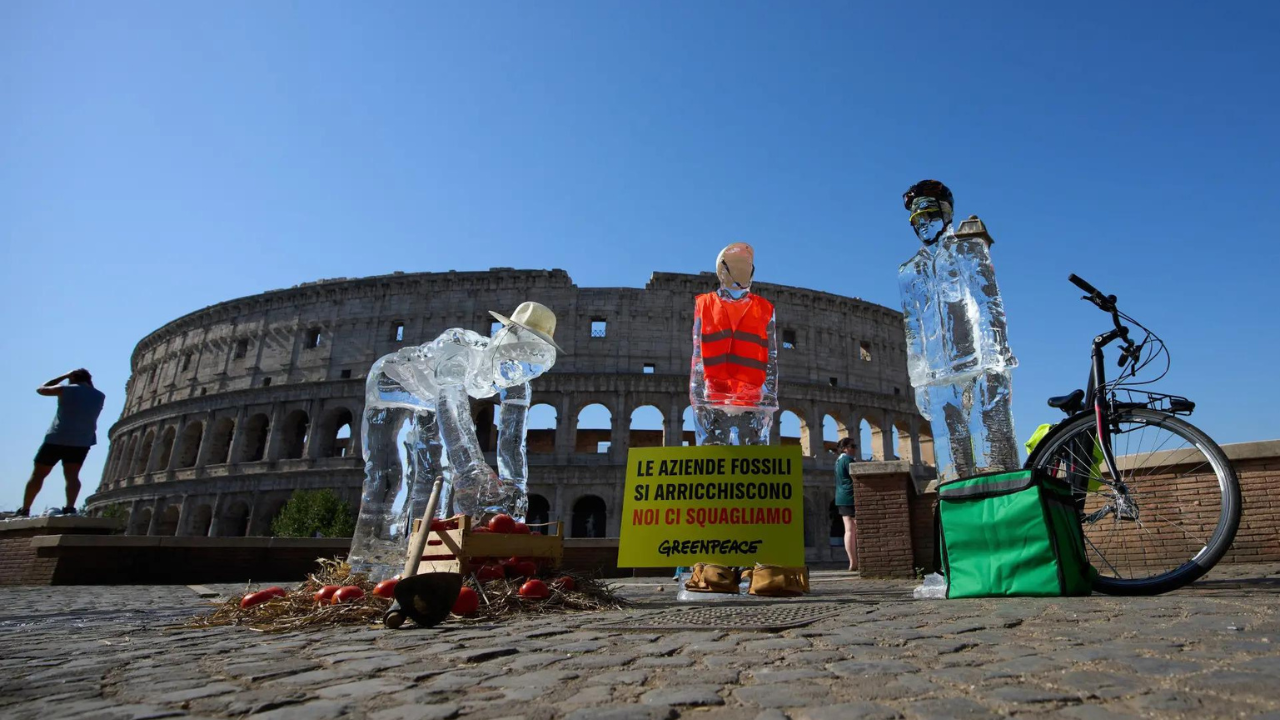
Every summer, the media machine spins up the exact same panic script. Headlines flash red about Italy, France, and Germany melting under record temperatures, painting a picture of an apocalyptic continent turning into a desert. Tourists faint near the Colosseum. Broadcasters warn of boiling asphalt and collapsing grids.
It is lazy journalism built on a foundation of thermal theatre.
I have spent the last decade tracking energy infrastructure and macroeconomics across the continent, and I am tired of the lazy consensus. The narrative that Europe is simply suffering from an unmanageable weather anomaly is a convenient smokescreen. It masks structural policy failures, bureaucratic gridlock, and an ideological refusal to build the heavy infrastructure required for modern life.
Europe is not just facing extreme heat. Europe is paying the price for a generation of economic self-sabotage disguised as green piety.
The Weather Isn't New The Vulnerability Is
Let us look at the actual data without the hysterical red color grading on weather maps. Heatwaves in Southern and Central Europe are not a novel meteorological event. The historical record shows severe heat events across the Mediterranean and the Rhône Valley dating back centuries. The 2003 European heatwave killed tens of thousands, largely because urban elderly care infrastructure was nonexistent and air conditioning was viewed as an American aesthetic crime rather than a medical necessity.
What has changed is not the physics of the atmosphere, but the fragility of the grid.
When temperatures spike in Rome, Paris, or Berlin, the electricity networks strain to the breaking point. The lazy consensus blames the sun. The honest analyst blames decades of underinvestment in base-load power, aggressive decommissioning of reliable nuclear and fossil capacity before storage technology was remotely ready, and a regulatory environment that treats grid expansion like an environmental crime.
Imagine a scenario where a major French nuclear plant has to throttle output because river water used for cooling is too warm. Environmentalists cheer it as a victory for nature. Industry insiders watch billions of euros of reliable, zero-carbon power vanish from the grid, forcing the country to scramble for expensive, imported fossil gas or coal-fired backups from neighbors. That is not a climate success story. That is economic illiteracy with a halo.
The Air Conditioning Taboo
There is a deep-seated cultural prejudice in Western Europe against climate control. For decades, urban elites in Paris and Berlin treated air conditioning as a vulgar, energy-guzzling symbol of American excess. Older apartment buildings lack the structural capacity for retrofitting split units. Historic preservation laws make putting an external condenser unit on a Haussmann-style facade practically illegal.
So what happens when July arrives? People suffer. Productivity craters. Hospitals fill up with vulnerable populations suffering from heat exhaustion.
Instead of rethinking architectural codes or subsidizing modern, high-efficiency heat pump and cooling infrastructure, governments issue patronizing advisories telling citizens to close their shutters and drink tap water. It is medieval governance applied to a modern industrial society.
When you criminalize the tools of basic human comfort under the banner of carbon minimalism, you aren't saving the planet. You are simply lowering the standard of living for millions of citizens who cannot afford to escape to a coastal villa in Greece for two months out of the year.
The Energy Transition Mirage
Let us address the elephant in the room: the grid mismatch.
Europe's politicians love cutting ribbons for wind farms and solar arrays. Solar generation spikes during peak summer heatwaves, which sounds like a neat alignment of supply and demand. Except, photovoltaic panels lose efficiency as temperatures climb past 25 degrees Celsius. Furthermore, transmission lines sag and lose capacity when ambient air temperatures soar, restricting the very energy being generated just when urban centers need it most to power cooling systems.
I have seen energy firms blow millions trying to balance localized micro-grids that rely entirely on intermittent sources while politicians block the construction of high-voltage transmission corridors because a local constituency doesn't want power lines spoiling their view.
You cannot run a modern industrial economy on good intentions and wishful thinking. When the wind stops blowing during a stagnant summer high-pressure system, and solar panels are choking on their own thermal efficiency losses, the system breaks.
Germany’s decision to phase out nuclear power while attempting to transition entirely to renewables left the nation uniquely exposed. When the heat hits, they are forced to rely on coal-fired generation to keep the air conditioning running in Frankfurt. The irony is so thick you could cut it with a knife, yet the political class doubles down on the narrative that the weather is the primary culprit.
The Real Crisis Is Competitiveness
This brings us to the core economic casualty of the summer panic cycle.
When energy prices spike due to summer grid strain and structural supply deficits, industrial production takes a direct hit. Chemical plants in Germany, manufacturing hubs in Northern Italy, and agricultural sectors across France face sudden cost shocks. Corporations are quietly reallocating capital away from Europe toward regions with stable, predictable energy frameworks.
The continent is sleepwalking into permanent economic stagnation while politicians focus on carbon accounting metrics that look good on paper but fail the reality test of a hot Tuesday afternoon in July.
Stop pretending this is an unstoppable act of nature that we can only endure by suffering. It is a man-made engineering and regulatory failure built on decades of bad choices.
Fix the zoning laws. Modernize the grid. Embrace cooling as public health infrastructure rather than a luxury sin. Stop apologizing for wanting to live and work at a comfortable temperature.
The heat will return next year. The choice of whether Europe remains paralyzed by it belongs entirely to us.