Language in international diplomacy functions as an instrument of strategic alignment. When political figures invoke historical terminology from past alliances, the choice is rarely accidental. It represents a deliberate retrieval of shared historical equity to reframe contemporary friction. A striking case appears in the recurring appropriation of the term "gung-ho," a phrase widely recognized in Western vernacular as a descriptor of aggressive enthusiasm, yet rooted in a starkly different economic and organizational reality from wartime China. Tracing the trajectory of this phrase exposes a mechanism of linguistic mutation where administrative terminology transforms into a military motto, and eventually into a rhetorical tool for modern statecraft.
The Economic Mechanics of Gonghe
The genesis of the term rests not in military doctrine, but in industrial survival economics during the Second Sino-Japanese War. Following the invasion of China's coastal industrial centers in 1937, millions of refugees fled inland, leaving the country economically vulnerable and deprived of manufacturing infrastructure. To counter this industrial collapse, international advisors including New Zealander Rewi Alley, alongside Chinese economists and political organizers, conceptualized the Chinese Industrial Cooperatives movement.
The formal Chinese name was gōngyè hézuòshè, which translates directly to industrial cooperative. For operational convenience, administrators truncated the four-character title into a two-character abbreviation: gōnghé, combining the first character of "industry" (gōng) and the first character of "cooperation" (hé).
This abbreviation designated a specific socio-economic model. These cooperatives were decentralized micro-manufacturing units designed to keep refugees employed, produce essential goods such as blankets, uniforms, and medical supplies, and decentralize production to prevent total destruction by aerial bombardment. The core function of gōnghé was structural survival through coordinated labor and collective resource management. It denoted an economic methodology of collective production rather than an emotional state of mind.
The Translator Error and Military Adaptation
The transition of gōnghé into Western consciousness occurred through the mediation of United States Marine Corps Lieutenant Colonel Evans Carlson. Stationed as an observer in China during the late 1930s, Carlson observed the operations of the Chinese Industrial Cooperatives and spent time embedded with Chinese guerrilla forces. He became deeply impressed by their egalitarian command structures, ideological unity, and decentralized operational
The Etymological Distortion of Gung Ho and the Mechanics of Statecraft
news
Language undergoes predictable degradation when translated across political and cultural boundaries. The phrase gung-ho offers a primary case study in semantic inversion. Originally denoting cooperative industrial production and collective survival during a devastating military conflict, the term mutated within Western armed forces into an indicator of aggressive zeal and unthinking compliance. When modern heads of state invoke shared historical touchstones, they engage in a similar process of translation and distortion, stripping complex political realities down to utility-driven narratives designed for domestic consumption and tactical posturing.
The Semantic Drift of a Cooperative Slogan
In contemporary English lexicon, describing an individual or organization as gung-ho implies reckless enthusiasm, blind obedience, or an excess of militant passion. This modern definition stands in direct opposition to the original etymological root. The term derives from the Chinese compound gōnghé, an abbreviation for Zhōngguó Gōngyè Hépùshè, translated as the Chinese Industrial Cooperatives.
During the Second Sino-Japanese War, industrial capacity in coastal China fell rapidly under imperial occupation. The cooperative movement emerged as an economic survival mechanism, mobilizing displaced artisans, refugees, and workers into decentralized production units. These cooperatives functioned on principles of mutual aid, shared equity, and collective labor management. The abbreviation combined gōng, meaning work, with hé, meaning peace or harmony. Thus, the original semantic value centered on collaborative endurance, economic resilience, and structured solidarity rather than militaristic fervor or individual bravado.
Institutional Origins and Wartime Logistics
To understand how a term signifying labor cooperatives became associated with elite military shock troops, one must examine the specific institutional conduits of World War II. Rewi Alley, a New Zealand activist, and Edgar Snow, an American journalist, played instrumental roles in publicizing the industrial cooperative movement. Their writings documented how ordinary citizens manufactured essential goods—blankets, medical supplies, shoes—under constant threat of aerial bombardment.
Concurrently, military observers stationed in China analyzed the irregular warfare tactics employed by Chinese communist and nationalist forces against Japanese supply lines. Evans Carlson, an officer in the United States Marine Corps who served as an official observer, observed the integration of political indoctrination, egalitarian social structures, and guerrilla tactics. Carlson sought to instill a similar ideological cohesion within his own command. Upon taking charge of the Second Marine Raider Battalion, he adopted the abbreviation gōnghé as a battalion motto, intending to evoke the spirit of unity and shared sacrifice he witnessed among Chinese partisans.
The Military Translation and Cultural Misinterpretation
Military adoption accelerated the semantic shift. Within the closed ecosystem of the United States Marine Corps, foreign terminology frequently underwent rapid reinterpretation. Marines under Carlson's command heard the Chinese abbreviation chanted or used as a rallying cry. Phonetically adapted to gung-ho, the term lost its institutional connection to industrial production and labor organization.
The cultural translation substituted collective economic survival with operational aggressiveness. By the mid-twentieth century, Hollywood war films and post-war literature cemented this redefined meaning in the public consciousness. The transformation completed a full cycle: a phrase invented to describe factory workers organizing for survival during an invasion became a shorthand descriptor for unchecked combat aggression. This linguistic trajectory illustrates how imported concepts often shed their institutional complexity upon entering a dominant cultural framework, retaining only the surface aesthetic useful to the receiving institution.
Historical Memory as a Diplomatic Instrument
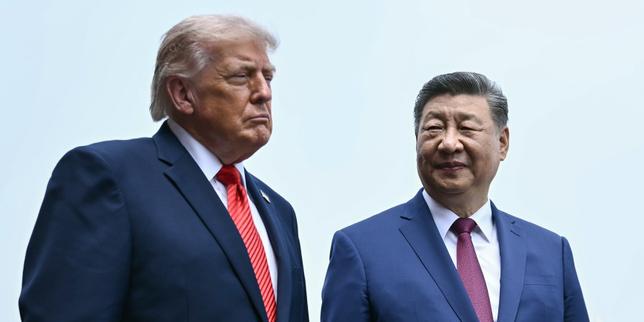
Political leaders frequently manipulate historical memory to construct strategic narratives. When figures such as Donald Trump or Xi Jinping reference shared historical episodes between the United States and China, they do not engage in historical preservation; they practice diplomatic instrumentalism.
Bilateral statecraft requires symbolic currency. Historical epochs that feature alignment, such as the cooperation between American volunteers and Chinese forces against Japanese imperialism during the 1930s and 1940s, provide a ready-made repository of positive sentiment. By invoking these shared vectors, leaders attempt to bypass contemporary structural friction, substituting complex geopolitical competition with nostalgic appeals to past partnership.
This mechanism operates on a cost-reduction principle in public diplomacy. Establishing a cooperative baseline through current economic or security agreements requires arduous negotiation and compromise. Invoking historical precedents allows a leader to establish a rhetorical foundation of mutual respect without altering material policy. The past functions as a malleable asset, deployed when structural tensions run high and retired when specific bargaining objectives are met or abandoned.
Structural Asymmetries in Bilateral Narrative Construction
While both Washington and Beijing utilize historical references, the structural deployment of history differs significantly based on political architecture. In centralized political systems, historical narratives are curated to reinforce long-term strategic trajectories and ideological continuity. References to shared history serve as pedagogical tools for domestic audiences, signaling state priorities and establishing the parameters of permissible international engagement.
In decentralized political systems, historical references often function as tactical instruments designed for short-term news cycles or immediate negotiating leverage. The invocation of past cooperation can shift abruptly depending on electoral shifts or changes in legislative majorities. This creates a fundamental asymmetry in bilateral communication. One party approaches history as an enduring strategic framework, while the other treats it as an ephemeral rhetorical device.
Recognizing this divergence exposes the limitations of relying on historical symbolism in modern statecraft. Shared history does not create shared incentives. The structural drivers of contemporary competition—technological supremacy, supply chain sovereignty, regional security architectures, and economic paradigms—operate independently of historical goodwill. When leaders evoke moments of past alignment, they obscure current structural divergences behind a facade of diplomatic continuity.
Strategic Imperatives in Bilateral Signaling
Evaluating state rhetoric requires stripping away historical sentimentality to analyze underlying material interests. The operational reality of the bilateral relationship between the United States and China is defined by zero-sum competition in critical domains. In this environment, historical references operate as noise rather than signal.
Observers must separate public signaling from operational reality. Diplomatic language designed to evoke cooperation masks hard security calculations and industrial policy maneuvers. Analysts who focus on rhetorical olive branches miss the structural mechanics driving defense procurement, export controls, and technological decoupling. The study of international relations demands an analytical shift away from what leaders say about the past toward what states do in the present.