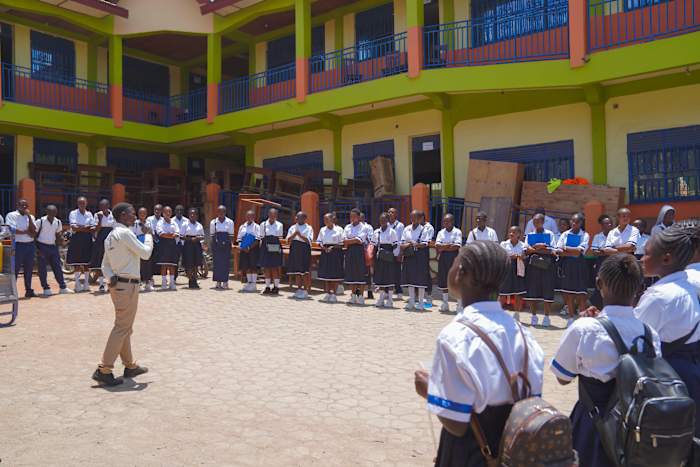
The operational friction between public health preservation and institutional continuity reaches a critical breaking point when administrative mandates collide with acute epidemiological crises. Across the eastern provinces of the Democratic Republic of Congo, the national academic calendar resumed under the weight of an escalating pathogen event. With confirmed infections crossing six thousand instances and case fatality metrics scaling near three thousand deaths, the decision by state ministries to open doors in Ituri province reveals a profound misalignment between central planning and hyper-localized biological threat vectors.
This institutional friction cannot be understood through qualitative complaints alone. It requires analyzing the structural cost function that governs public sector decisions during a biological emergency, where the institutional incentive to maintain educational continuity clashes directly with the biological incentive of localized containment. Don't miss our recent post on this related article.
The baseline parameters of the current crisis define an environment entirely hostile to traditional administrative procedures. Driven by the rare Bundibugyo strain of the virus, the transmission vectors operate within a zone crippled by historical insecurity, chronic population displacement, and concurrent labor strikes by healthcare personnel demanding back pay. Unlike historical outbreaks managed in controlled clinical or peri-urban environments, this dynamic expands outward through nearly sixty distinct health zones. When central authorities enforce a uniform school resumption timeline across such fragmented terrain, they generate systemic vulnerabilities that propagate exponentially through dense classroom environments.
The operational architecture of rural and semi-urban Congolese schools lacks the structural capacity to function as infection control nodes. Educational facilities rely on shared hydration stations, high-density seating configurations, and manual attendance tracking that fails to capture real-time symptom onset. While municipal authorities point to distributed noncontact infrared thermometers and basic chlorine-wash basins as primary defenses, the supply chain logistics required to maintain these consumables break down entirely outside urban centers. Greg Ramm of Save the Children noted that remote distribution channels experience severe throttling, leaving rural school administrators with zero inventory within days of term commencement. To read more about the background here, Healthline provides an excellent summary.
Compounding these supply vulnerabilities is the severe age-stratified vulnerability profile of the specific viral strain. Epidemiological data indicates that children aged four and below experience a case fatality rate reaching sixty percent. While primary school cohorts skew slightly older, the presence of younger siblings accompanying students or attending early-childhood units within the same architectural footprint creates a high-fatality transmission amplifier. The state's risk calculation treats educational institutions as static administrative units, ignoring their actual function as dynamic mixing bowls where asymptomatic or early-stage carriers interact across household units before returning to high-density communities.
Parental and educator resistance, manifested through low initial turnouts in government-operated facilities and union-led calls for operational delays, represents a rational response to perceived institutional abandonment. When teachers refuse to enter classrooms without guaranteed safety interventions, they are executing a risk mitigation strategy that the state fails to provide. The local teachers' union in Ituri did not reject education per se; rather, they contested the absence of a pre-reopening epidemiological audit. By forcing attendance without establishing verifiable biosecurity baselines, the administration externalizes the cost of containment onto poorly equipped educators and students.
This dynamic generates a severe feedback loop within the broader containment apparatus. When schools function as unmonitored vectors, community transmission accelerates outside the tracking network managed by response teams. Unmonitored chains of infection bypass the contact-tracing matrix, rendering epidemiological forecasting models obsolete. Parents keep children home not merely out of generalized panic, but because the expected utility of classroom learning drops below zero when weighed against a sixty percent mortality risk for young dependents. Consequently, absenteeism spikes, instructional quality degrades, and trust in public administration erodes further, making future public health compliance increasingly difficult to secure.
The economic and logistical constraints facing the response underscore why administrative decree cannot substitute for infrastructural capacity. Without approved, widely deployed commercial vaccines or standardized pharmaceutical treatments for the Bundibugyo strain, non-pharmaceutical interventions remain the sole barrier against total transmission saturation. Yet, these interventions require continuous capital injection, uninterrupted supply chains, and absolute community buy-in—three variables currently absent in eastern Congo. International financing remains sluggish, leaving emergency coordinators underfunded precisely as geographic spread accelerates.
To break this destructive cycle, the response strategy must pivot from rigid calendar enforcement to a decentralized, threshold-based operational model. Ministries of education must decouple school start dates from national uniformity, delegating closure and reopening authorities directly to local health zone committees equipped with real-time transmission metrics. Institutional continuity must be preserved through decentralized, community-embedded micro-learning pods supported by mobile radio instruction rather than centralized brick-and-mortar congregation, thereby neutralizing the density-driven transmission multipliers that currently threaten the region's demographic future.