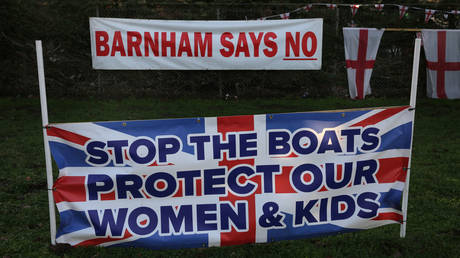
When residents of a small English village hold a symbolic referendum to secede from the United Kingdom, the headlines write themselves. Parish polls asking whether a community should break away from Westminster over central government migrant accommodation plans have recently made waves across British media, following a string of symbolic secession votes in rural areas.
These votes carry zero legal weight. Under British constitutional law, a parish council cannot declare independence, withhold taxes, or override Home Office directives. Yet treating these ballots as mere eccentric rural theater misses the real story. They are the latest, sharpest symptom of a profound breakdown between Westminster's centralized asylum housing strategy and the capacity of small local authorities to absorb sudden demographic shifts. Building on this topic, you can find more in: Why Capturing El Chapo Isidro Proves the Kingpin Strategy is a Total Failure.
The Mechanics of a Symbolic Secession
To understand how a village ends up voting on independence, you first have to understand a little-known piece of British local government legislation. Under the Local Government Act 1972, electors in any English parish can demand a parish poll. All it takes is ten registered electors—or one-third of those present at a parish meeting, whichever is less—to force a formal ballot on any question relating to parish affairs.
The local district or borough council is legally required to administer and fund the poll, even though the outcome is entirely non-binding. Turnout is typically low, often hovering in the teens or twenties, and the ballot boxes sit in village halls rather than high-stakes regional counting centers. Analysts at Al Jazeera have shared their thoughts on this trend.
In recent instances where villages have voted to "leave the UK," the trigger has been consistent. The Home Office, facing an acute backlog in the asylum system and intense pressure to end the costly use of commercial hotels, has turned toward large-scale sites. Former Royal Air Force bases, disused military barracks, and isolated rural hotels have become primary targets for housing hundreds—sometimes thousands—of single adult male asylum seekers.
When a community of 1,500 people suddenly learns that 800 or 1,500 newcomers will be housed on its doorstep without prior consultation, standard planning channels feel entirely useless. The parish poll becomes a megaphone. It is a way to force national television crews onto the village green when letters to Members of Parliament go unanswered.
Why Westminster Bypasses Local Planning
The friction is baked into how the UK government procures emergency accommodation. Normally, changing the use of a massive site—say, turning a former military airfield into high-density residential housing—requires months or years of local planning applications, environmental impact assessments, and infrastructure reviews.
The Home Office bypasses this through Special Development Orders and emergency Crown development powers. These legal mechanisms allow ministers to approve sites rapidly by citing national urgency, stripping local district councils of their traditional veto power.
From Whitehall's perspective, the math is brutal and unforgiving. Accommodation costs for the asylum system have ballooned into the billions of pounds annually. Keeping thousands of people in commercial hotels drains the Treasury and provokes widespread political anger across the country. Moving asylum seekers onto surplus government land or large, isolated sites looks, on a spreadsheet in London, like a fast and fiscally responsible exit ramp.
On the ground, that spreadsheet collides with physical reality.
The Infrastructure Bottleneck Nobody Prices In
Rural England is not built for sudden population spikes. Unlike major cities, which possess elastic public transit networks, large hospital trusts, and established multicultural support charities, villages operate on razor-thin infrastructure margins.
Consider a hypothetical rural parish of 2,000 residents. Its primary care surgery might have two general practitioners serving an aging population, with appointment wait times already stretching past three weeks. The local bus service might run once an hour between 8:00 AM and 6:00 PM. Street lighting is minimal, pavements often disappear at the edge of the village center, and the nearest police station with a full-time response team could be twenty miles away.
When the Home Office places several hundred asylum seekers—who are legally barred from working while their claims are processed and receive a minimal weekly allowance—into a rural site, they have nowhere to go and nothing to do. They walk along unlit country roads into the nearest village center. Local healthcare clinics face immediate pressure to provide complex physical and mental health assessments, often requiring translation services that rural practices simply do not have on retainer.
Local councils argue that the central government funds the bricks and mortar of the accommodation while leaving the surrounding community to absorb the hidden operational costs. Policing, emergency medical calls, and community cohesion initiatives fall onto local budgets that have already been hollowed out over more than a decade of austerity.
Political Theater vs Genuine Grievances
Critics of these parish secession votes point out—accurately—that the ballots are often organized or amplified by hardline political activists and fringe groups looking to score points on immigration. In several cases, turnout has been heavily skewed toward opponents of the schemes, while residents who support helping asylum seekers or who simply view the ballot as a waste of local taxpayer money stay home.
Writing off the entire phenomenon as astroturfing, however, is an analytical mistake. Activists can only light a fire where dry timber already exists.
The timber here is a deep, bipartisan frustration with democratic deficit. Even residents who express sympathy for people fleeing conflict frequently voice anger at the secrecy surrounding Home Office site selections. In numerous cases across England, local councillors and MPs have learned about major accommodation plans through leaked documents or press reports rather than direct briefings from civil servants.
When people feel their elected local representatives have been stripped of authority, trust in institutional politics evaporates. A vote to "leave the UK" is rarely a serious proposal to erect border checkpoints at the edge of the parish. It is a blunt, populist expression of a simple demand: if we have no say in how we are governed, why are we part of the system?
Historical Echoes of English Localism
This kind of hyper-local rebellion has deep roots in British political history. Long before modern immigration debates, English parishes used symbolic defiance to protest central government overreach.
During the 1970s and 1980s, towns and villages regularly declared themselves "nuclear-free zones" or passed symbolic motions of independence to protest local government boundary reorganizations that merged historic counties into anonymous administrative districts. In 1977, the town of Hay-on-Wye famously declared itself an independent kingdom—complete with its own passports and cabinet—as a publicity stunt to draw attention to economic neglect in the Welsh Marches.
What separates the current wave of parish polls from the playful eccentricity of Hay-on-Wye is the underlying tension. Today's votes are driven by fear, economic anxiety, and a sharp polarization over national border policy. They reflect a widening cultural and geographic chasm between metropolitan decision-makers and rural communities that feel treated as convenient dumping grounds for national policy failures.
The Trap Facing Both Major Parties
For any government in Westminster, the asylum housing dilemma offers no clean political exits.
If ministers halt the use of large rural sites and former military bases, they are forced back into relying on hotels in towns and cities, driving up daily costs and sparking protests in suburban high streets. If they push ahead with rural dispersal using emergency planning powers, they trigger legal challenges from district councils, alienate rural voters, and hand easy headlines to populist challengers.
Judicial reviews launched by local authorities have already delayed or complicated several flagship Home Office sites, eating up millions in legal fees and administrative overhead. Meanwhile, the core driver of the crisis—the speed and efficiency of asylum claim processing—remains the decisive bottleneck. Until claims are processed swiftly enough to either grant refugee status or execute removals, the physical footprint required to house applicants will continue to expand.
What Happens After the Ballot Boxes Close
Once the parish poll results are announced and the television vans pack up their satellite dishes, nothing changes legally. The parish remains subject to the laws of England and Wales. Council tax bills still arrive on schedule. If the Home Office decides to proceed with an accommodation site, the parish council has no mechanism to physically block the gates.
Yet the political consequences linger. Local district councillors face immense pressure from constituents to launch expensive legal challenges against the central government, diverting funds away from local roads, waste collection, and social care. Community cohesion suffers before a single asylum seeker even arrives, poisoned by months of rumor, social media misinformation, and adversarial public meetings.
Real solutions require dismantling the secrecy that fuels these revolts in the first place. That means mandatory early consultation with local authorities before contracts are signed, upfront funding guarantees for rural police forces and GP surgeries, and strict caps on site populations relative to the size of the host community.
Until Westminster stops treating local consent as an administrative obstacle to be bypassed, more English villages will keep reaching for the most dramatic protest tool they have left—even if it only exists on paper.


