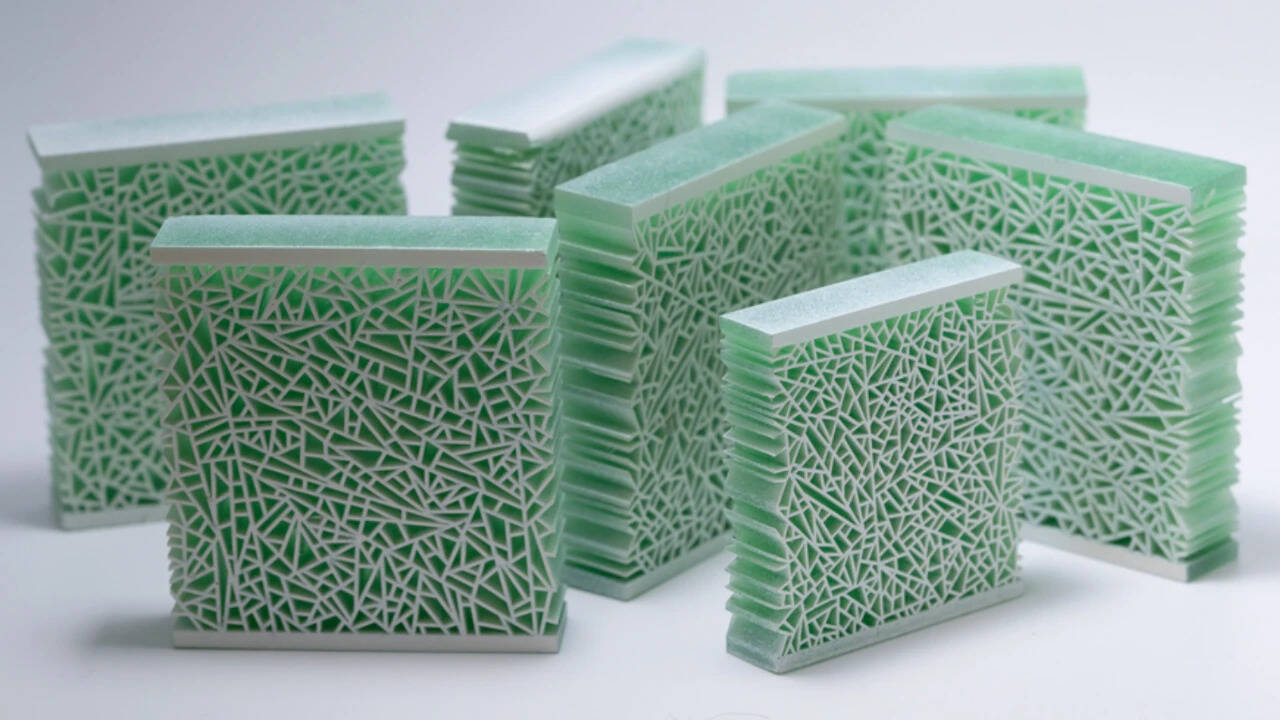
For decades, industrial manufacturing has suffered from a quiet, expensive obsession with straight lines, right angles, and uniform grids. Now, engineers at MIT have demonstrated a radically different path by copying the irregular, branching networks of leaves and dragonfly wings to 3D print stronger, lighter load-bearing structures. By translating biological vein patterns into digital CAD workflows and pairing them with bio-based resins, researchers proved that nature's messy geometry handles mechanical stress far better than traditional human-designed lattices.
It is an overdue correction. Walk onto almost any aerospace or automotive factory floor, and you will see parts filled with repetitive honeycombs or rigid, uniform trusses. Engineers love those shapes because they are easy to calculate on a spreadsheet and simple to machine. Nature hates them because uniform grids fail catastrophically when hit from an unexpected angle.
The Structural Flaw in Modern Engineering
Human engineers like predictability. When designing a bracket, an aircraft wing rib, or a building support, conventional software defaults to regular geometric patterns. A standard octet truss or a uniform honeycomb looks clean on a monitor, and under a single, predictable load vector, it performs well enough.
Real life rarely applies force along a single, tidy axis. A wind gust hits a drone wing from the side while gravity pulls it down. A runner's foot strikes pavement at an awkward slant, sending shockwaves twisting up through a shoe midsole. In a uniform grid, stress concentrates sharply at the identical corners where struts meet at fixed angles. Once one strut snaps, the neighboring struts inherit a sudden spike in load, triggering a zipper-like structural collapse.
Biomimicry in structural engineering is not new, of course. Designers have spent years admiring bone trabeculae and tree trunks. The bottleneck has always been translation. You cannot simply take a high-resolution photograph of a maple leaf, hit "extrude" in a modeling program, and send it to a factory floor. Biological forms are notoriously noisy, irregular, and computationally heavy to render in standard Computer-Aided Design (CAD) software.
What makes the MIT approach stand out is not just the aesthetic inspiration, but the creation of a practical pipeline that converts biological branching rules into manufacturable geometries. Instead of manually drawing thousands of tiny veins—a task that would break both the designer's patience and the software's memory—researchers used computational algorithms to extract the underlying structural logic of leaf venation and insect wings.
How Leaves and Dragonfly Wings Cheat Physics
To understand why these patterns work, look closely at a dried leaf or the wing of a dragonfly under a magnifying glass. You will not find a neat checkerboard. You will see a hierarchy of thick primary veins splitting into medium secondary veins, which then dissolve into a chaotic, polygonal web of microscopic tertiary veins.
This architecture solves two competing problems simultaneously. First, it distributes fluid or nutrients across a wide surface area. Second, and more importantly for structural engineers, it acts as a mechanical shock absorber and crack-arrester.
In a dragonfly wing, those irregular polygonal cells are surrounded by stiff veins made of chitin. When aerodynamic forces bend the wing during rapid flight maneuvers, the irregular network prevents stress from pooling in one spot. Force dissipates across dozens of varying angles. Even if a tiny tear begins in the membrane between veins, the crack hits a thicker structural rib and stops dead in its tracks. The wing keeps flying.
Leaves operate on a similar principle, known in botany as reticulate venation. A broad leaf acts like a sail in a storm, catching wind that tries to shred it apart. By arranging veins in closed, irregular loops rather than dead-end branches, a leaf ensures that if one pathway is severed or overloaded, mechanical tension instantly reroutes around the damaged zone.
Translating Biology Into Printable Code
Copying this geometry required more than an artistic eye. The MIT team focused on capturing the mathematical relationships governing how veins branch, taper, and intersect. In a natural wing or leaf, junctions rarely form harsh 90-degree corners. Instead, they meet at organic, variable angles—often closer to 120 degrees, similar to soap bubbles—which naturally smooth out stress concentrations.
By parameterizing these branching rules, engineers can feed specific boundary conditions into an algorithm. Suppose you need a rectangular support plate that takes heavy compression on the left side and twisting torque on the right. Rather than filling the plate with a generic grid, the algorithm grows a custom vein network tailored to those exact forces. Thick primary struts form along the heaviest load paths, while fine, web-like subdivisions fill the low-stress zones to save weight without sacrificing stability.
This process bridges a massive gap between topology optimization and generative design. Traditional topology optimization often spits out bizarre, bone-like blobs that look impressive in press releases but are a nightmare to inspect, certify, or modify. Biological venation offers a middle ground. The resulting structures retain a recognizable, hierarchical logic that engineers can tweak, scale, and verify before a single drop of material is cured.
The Quiet Revolution in Bio-Based Resins
Geometry is only half the battle. A brilliant structural design printed out of brittle, petroleum-heavy plastic still leaves industries tied to fossil fuels and vulnerable to shattering under cold temperatures.
Alongside the geometric breakthrough, researchers paired these branching designs with cellulose-derived resins—materials built from the most abundant organic polymer on Earth, the very stuff that gives plant cell walls their stiffness.
Standard stereolithography (SLA) and Digital Light Processing (DLP) 3D printers rely heavily on acrylate and epoxy resins derived from petrochemicals. They cure fast under ultraviolet light, producing crisp details, yet many formulations suffer from high brittleness or poor biodegradability. Once a prototype or jig reaches the end of its service life, it becomes permanent landfill waste.
Formulating a printable resin from cellulose nanocrystals or modified cellulose derivatives changes the material equation entirely. When cured inside a DLP or SLA printer, these bio-based photopolymers form dense networks that exhibit remarkable toughness relative to their weight. Combined with the crack-stopping geometry of leaf venation, the material and the shape reinforce each other. The cellulose chemistry resists microscopic brittle fracture, while the branching macro-structure redirects macroscopic impact energy.
It is a rare instance where the manufacturing process mirrors the biological specimen on both the microscopic and macroscopic scales. You are essentially printing a plant-inspired skeleton out of plant-derived chemistry.
Why Factory Floors Still Resist Nature
If leaf-inspired lattices are lighter, tougher, and potentially greener, why are commercial airplanes and consumer cars not already filled with them? Anyone who has spent time around aerospace certification boards or automotive supply chains knows the answer. Manufacturing culture moves at a glacial pace, and for good reason.
First, there is the inspection nightmare. Quality control engineers rely on ultrasonic testing, X-rays, and automated optical scanners to verify that a critical part has no hidden voids or internal cracks. When every part contains an identical uniform grid, automated inspection software knows precisely where every strut should sit. Introduce a complex, asymmetrical web modeled after a dragonfly wing, and traditional non-destructive testing algorithms struggle to distinguish a deliberate geometric quirk from a fatal manufacturing defect.
Second, additive manufacturing speeds still lag behind legacy methods for mass production. Injection molding can spit out thousands of identical plastic brackets per hour for pennies apiece. Vat photopolymerization—the family of resin 3D printing processes best suited for capturing fine, microscopic vein details—remains comparatively slow and expensive per unit. Post-processing adds another layer of friction. Every resin-printed part must be washed in solvents to remove uncured liquid polymer and then cured under secondary UV lamps.
Consider a hypothetical scenario in automotive manufacturing. Imagine a supplier wants to replace a stamped steel seat frame component with a 3D-printed, leaf-veined polymer structure to shave two kilograms off an electric vehicle. Even if the printed part passes crash tests in the lab, printing fifty thousand units a year would require a massive farm of industrial resin printers, automated washing stations, and continuous resin supply chains that do not yet exist at automotive scale.
The High-Value Niches Where It Actually Wins
Because of those economic realities, bio-inspired 3D printing will not replace stamped metal or injection-molded plastic in cheap, high-volume goods anytime soon. Instead, it will take over high-margin, low-volume sectors where weight savings translate directly into cash or survival.
- Aerospace and Defense: Every kilogram shaved off a satellite, rocket payload fairing, or long-endurance reconnaissance drone saves thousands of dollars in fuel or extends mission range. In these sectors, printing custom parts in small batches is already standard practice.
- Medical Implants and Prosthetics: Human bones do not grow in uniform grids, and standard titanium implants often fail because they are too rigid, causing a phenomenon called stress shielding where the surrounding natural bone weakens from lack of load. Printing cranial plates, spinal cages, or prosthetic sockets using biomimetic branching lets engineers tune the exact flexibility of the implant to match human tissue.
- Custom Robotics and End-of-Arm Tooling: Industrial robots swinging heavy grippers at high speeds waste massive amounts of energy fighting their own inertia. Lightweight, vein-structured grippers printed on demand allow robotic arms to move faster while using smaller, cheaper motors.
- High-Performance Sporting Goods: Cycling helmets, custom running shoe midsoles, and protective padding already rely on 3D-printed lattices to absorb rotational impacts. Branching architectures offer a clear upgrade over uniform elastomeric grids by tailoring stiffness zones across different regions of the skull or foot.
The Myth of "Free Complexity" in 3D Printing
For over fifteen years, additive manufacturing evangelists have repeated a popular slogan: "Complexity is free." The pitch was simple. Unlike a CNC milling machine, which charges you extra machine hours for every curved pocket or angled hole, a 3D printer builds layer by layer, so intricate geometry supposedly costs no more than a solid block.
Veteran engineers know that slogan is a half-truth. Complexity is never entirely free; you simply pay for it in different places.
When you generate a high-resolution model mimicking the intricate tertiary veins of a leaf, file sizes explode. A simple geometric bracket might take up two megabytes as a standard CAD file. A detailed biomimetic lattice can easily balloon into several gigabytes of dense triangle meshes. Standard slicing software—the programs that convert 3D models into machine instructions—frequently chokes, freezes, or crashes when trying to calculate toolpaths or light projections for millions of intersecting micro-struts.
Even after the file slices cleanly, trapped resin becomes a physical headache. In vat photopolymerization, tiny closed or semi-closed polygonal pockets can trap liquid resin inside the part during printing. If that liquid cannot drain properly before final curing, it either remains trapped as a weak, uncured pocket or partially cures into unwanted solid blobs that ruin the mechanical performance of the lattice. Engineers have to carefully balance biological realism with practical drainage pathways, ensuring the network stays open enough for viscous resin to flow out cleanly.
Software Is Finally Catching Up to Biology
The real turning point happening right now is not in printer hardware, which has matured steadily over the past decade, but in implicit modeling software.
Traditional CAD tools represent shapes using Boundary Representation (B-Rep), essentially stitching together mathematically defined surfaces and edges. That approach works wonderfully for engine blocks and smartphone casings, yet it collapses under the computational weight of organic, branching networks.
Modern implicit modeling engines, used in platforms like nTop and emerging research frameworks at institutions like MIT, abandon surface stitching altogether. Instead, they define geometry using mathematical fields and signed distance functions. Under this paradigm, a complex dragonfly wing pattern is not a heavy mesh of ten million triangles; it is a lightweight mathematical equation evaluated on the fly.
This shift changes how engineers work. You can adjust the thickness of primary veins, alter the branching density near a bolt hole, or blend a leaf pattern smoothly into a solid mounting flange in seconds rather than hours. The software handles the geometric heavy lifting automatically, spitting out clean slice data directly to the 3D printer without generating bloated mesh files.
What Comes Next for Structural Design
We are witnessing the slow death of the right angle in high-performance engineering. For centuries, human builders relied on cubes, cylinders, and straight beams because our tools—saws, lathes, mills, and slide rules—demanded geometric simplicity. Those constraints are evaporating.
By decoding how leaves survive windstorms and how dragonflies outmaneuver predators without snapping their paper-thin wings, researchers have handed industrial designers a blueprint honed over hundreds of millions of years of evolutionary trial and error. Pairing those algorithms with sustainable, cellulose-based polymers removes the last excuse for building wasteful, over-engineered structures out of brittle plastics.
The factories of the next decade will not abandon traditional manufacturing overnight, nor will every bracket under your car hood suddenly look like a botanical specimen. Yet wherever weight, impact resistance, and material efficiency truly matter, the rigid grids of twentieth-century engineering are already losing ground to the quiet, calculated chaos of nature.