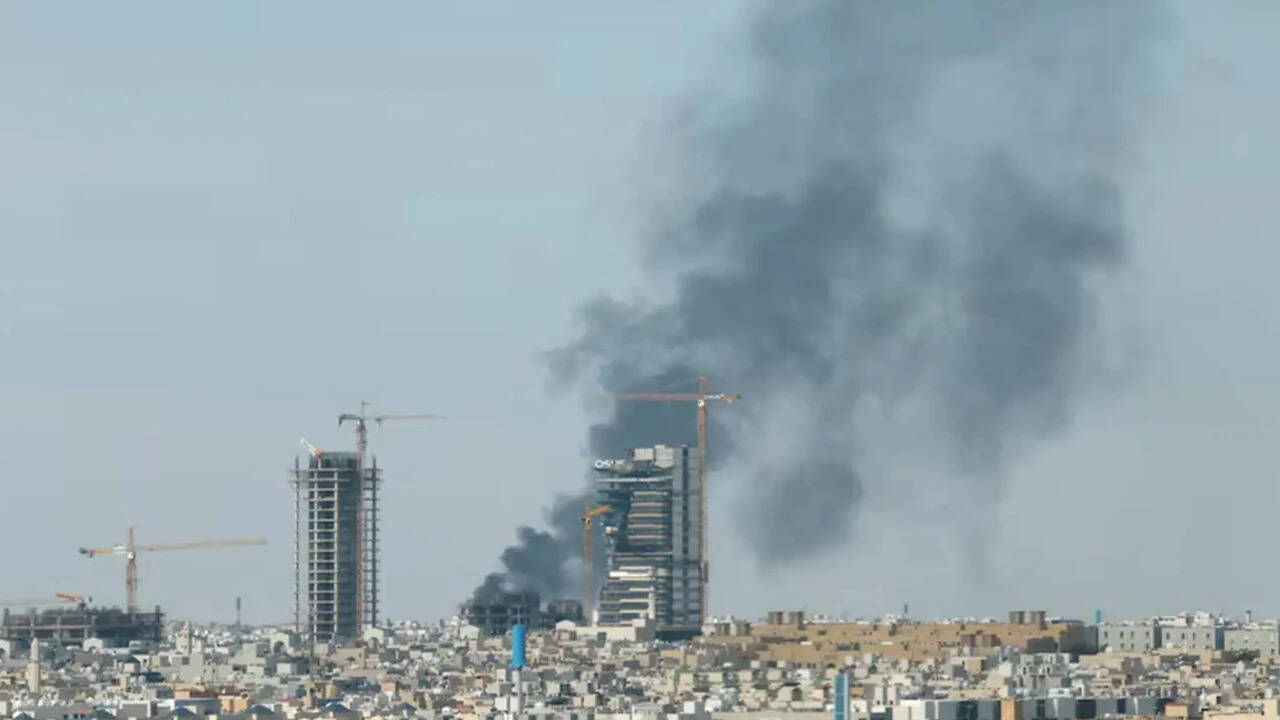
Every headline following the Riyadh airport strike reads like a syndicated
Why Emergency Response Narratives Around Airport Attacks Ignore The Real Architecture of Risk
news, travel Learn more on a connected subject: this related article.
The standard media playbook following any high-profile airport security breach or missile impact follows a depressingly predictable script. The headlines roll in with casualty counts, survivors recount the terror of shattering glass and sirens, and pundits immediately demand more defensive spending, tighter perimeters, and harsher rhetoric. Everyone nods along because the script is designed for emotional consumption, not operational reality.
It is time to drop the lazy consensus. More analysis by The New York Times explores comparable views on this issue.
When a ballistic projectile or drone targets a major aviation hub like Riyadh, the conventional panic focuses entirely on the kinetic event itself—the explosion, the debris, the immediate blood and smoke. That is a tactical mistake. By obsessing over the terminal walls, commentators miss the systemic vulnerabilities that actually dictate whether a global transport node survives or dies in the modern age.
The Illusion of Absolute Perimeter Defense
We are told that infinite defense budgets can completely air-gap critical infrastructure from regional conflicts. Governments buy billions of dollars in interceptor batteries, parade them through state media, and promise citizens an unbreakable dome.
This is an expensive fairy tale.
Physics and economics conspire against absolute defense. When a threat vector relies on asymmetric, low-cost projectiles launched by non-state actors or regional adversaries, spending millions per interceptor to neutralize cheap hardware creates an unsustainable financial attrition loop. More importantly, it breeds a false sense of institutional security.
When an impact occurs despite the hardware, the psychological shockwave is exponentially worse precisely because the public was sold a myth of total invulnerability. Aviation resilience is never about stopping every single threat at the fence line; it is about systemic redundancy, rapid structural compartmentalization, and ensuring that a localized kinetic strike does not metastasize into an operational cardiac arrest for the entire national economy.
Why Media Coverage Fails the Risk Equation
The typical casualty-focused news cycle treats an airport like a crowded shopping mall that happened to get unlucky. This framing is dangerous. An international airport is a critical nervous system node for trade, diplomacy, and supply chains.
When reporters focus exclusively on the human trauma—while undeniably tragic—they obscure the secondary and tertiary failures that truly cripple a region. They ignore the logistics bottlenecks, the cargo rerouting mechanics, the insurance risk re-pricing cycles, and the psychological contagion that ripples through global carriers.
If you analyze the aftermath of an attack through the lens of pure emotional survival, you learn nothing about how to keep the machine running. Real operational resilience requires cold, clinical indifference to the noise and an obsessive focus on asset distribution, software-driven air traffic rerouting, and structural hardening of load-bearing infrastructure.
The Cost of Knee-Jerk Over-Regulation
Every time a projectile makes contact near a major Middle Eastern transport hub, aviation bureaucrats rush to draft emergency legislation and mandate new passenger friction points. They add layers of security theater that punish the traveler while doing nothing to deter state-backed missile launches or drone strikes.
This is the exact opposite of what the sector requires.
Adding three more hours of check-in buffers and another layer of perimeter checkpoints does not stop a ballistic trajectory. It merely transfers the economic damage from the adversary's weapons to the operational efficiency of the hub itself. You cannot regulate your way out of a geopolitical missile crisis with baggage scanners and identity checks.
Building for the Asymmetric Age
If we want to stop treating these incidents as isolated black swans and start treating them as predictable hazards of modern geography, the playbook must shift entirely.
First, decentralize operations. Megahubs that concentrate all passenger and cargo processing into a single monolithic terminal complex are sitting ducks in a multi-vector threat environment. Distributed regional airfields linked by high-speed rail or rapid cargo transshipment networks offer far greater survivability.
Second, reallocate capital from flashy, high-profile defense hardware toward digital redundancy and automatic rerouting architecture. When a runway or a terminal sector goes offline, the recovery speed depends entirely on how quickly dispatch systems can shift capacity to secondary strips without human bottlenecks.
Stop waiting for the geopolitical landscape to calm down. It will not. Stop pretending that another defensive perimeter wall will change the calculus of asymmetric warfare.
The next crisis will not be solved by better sirens. It will be solved by systems that expect the worst, absorb the blow instantly, and keep moving before the smoke even clears.