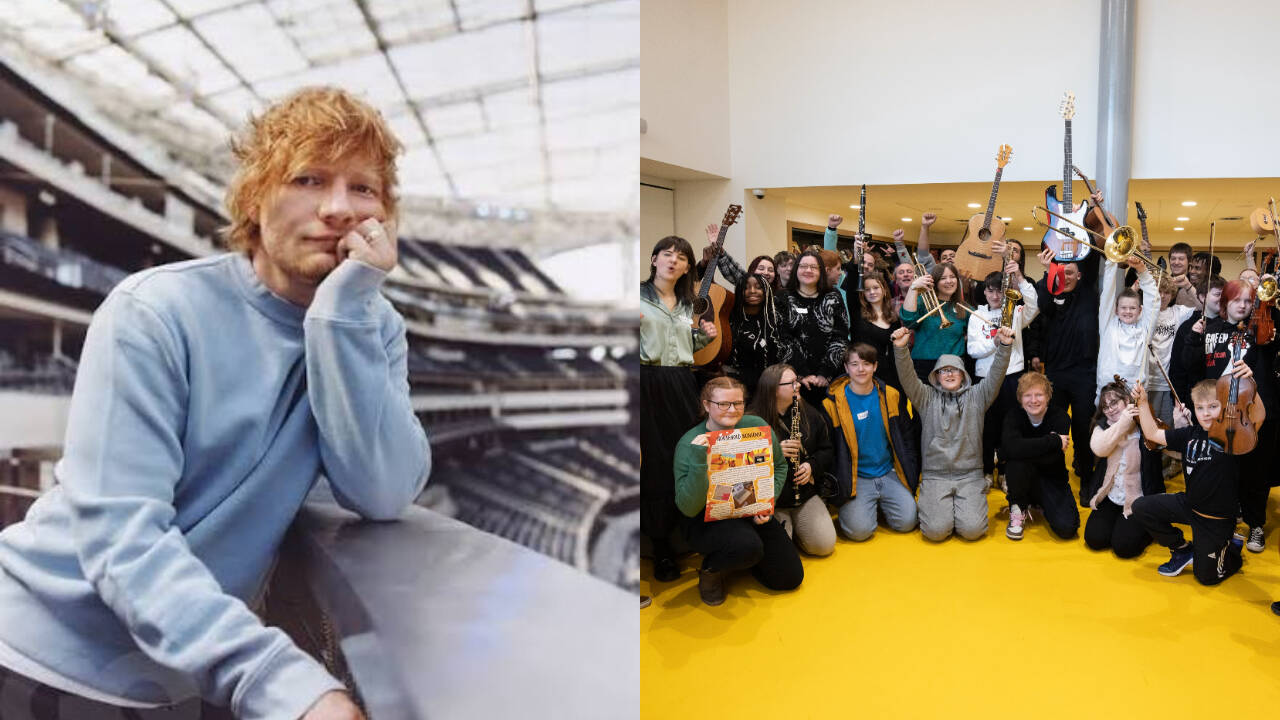
Twelve thousand young people across the United Kingdom now have access to instruments, mentorship, and recording spaces through Ed Sheeran’s charitable foundation, confronting a systemic vacuum left by decades of state school cuts. That milestone figure sounds like a standard corporate PR release until you examine the reality of modern British arts education. State secondary schools have watched their creative budgets evaporate for fifteen consecutive years. Drama studios have been converted into storage rooms. Guitar cupboards have gathered dust. Music education has quietly transformed into an exclusive luxury reserved for families who can afford private tuition.
Ed Sheeran’s foundation is stepping into that wreckage. But writing checks for charity is the easy part. The harder question is why a pop star has to subsidize basic cultural literacy in a G8 economy.
Let us look at the mechanics. Over the last decade, arts funding in UK state schools took a brutal beating. Department for Education statistics show a steady decline in secondary school arts teaching hours and a parallel drop in GCSE music uptake. When local authorities face bankruptcy, statutory obligations take priority. Creative subjects are the first on the chopping block.
Sheeran knows this terrain intimately. Long before stadium tours and multi-million-pound streaming royalties, he was an awkward teenager sleeping rough in London, playing small gigs for pocket change, and grinding through youth music projects that actually gave kids a room with a functioning PA system. His foundation targets the grassroots level. It does not fund elite conservatoires or glossy London academy theaters. It funnels money into community hubs, regional youth centers, and grassroots programs where kids are trying to figure out how to sequence a beat on a battered laptop or tune an acoustic guitar with rusted strings.
Why does this matter beyond the obvious feel-good narrative? Because the pipeline of British talent has always relied on accessibility. The British music industry punches far above its weight globally precisely because working-class artists could stumble into a council estate youth club, pick up a bass, and find a pathway. Think of the lineage. Grime, punk, Britpop, and trip-hop did not emerge from the practice rooms of expensive boarding schools. They crawled out of damp rehearsal spaces, community centers, and council estates where funding was cheap and ambition was high.
When you choke off those entry points, you homogenize the entire culture.
The industry gets risk-averse. Only artists with a financial safety net can afford to spend years touring for free or recording in expensive commercial spaces. Philanthropy like Sheeran's keeps the doors open, but it is also a glaring symptom of institutional failure. Relying on the personal charity of wealthy musicians to fund public education is an unsustainable economic model.
Charitable interventions create islands of excellence surrounded by a desert of neglect. A youth center in Suffolk gets a grant for new microphones, while a school twenty miles away in Norfolk has to cancel its choir because the music teacher retired and could not be replaced. The math does not scale.
Yet, we cannot discount the immediate impact. Twelve thousand young people is not an abstract statistic. It represents twelve thousand teenagers who learned how to express themselves, collaborate, and build technical competency in a world that increasingly tells them their creative impulses are economically worthless.