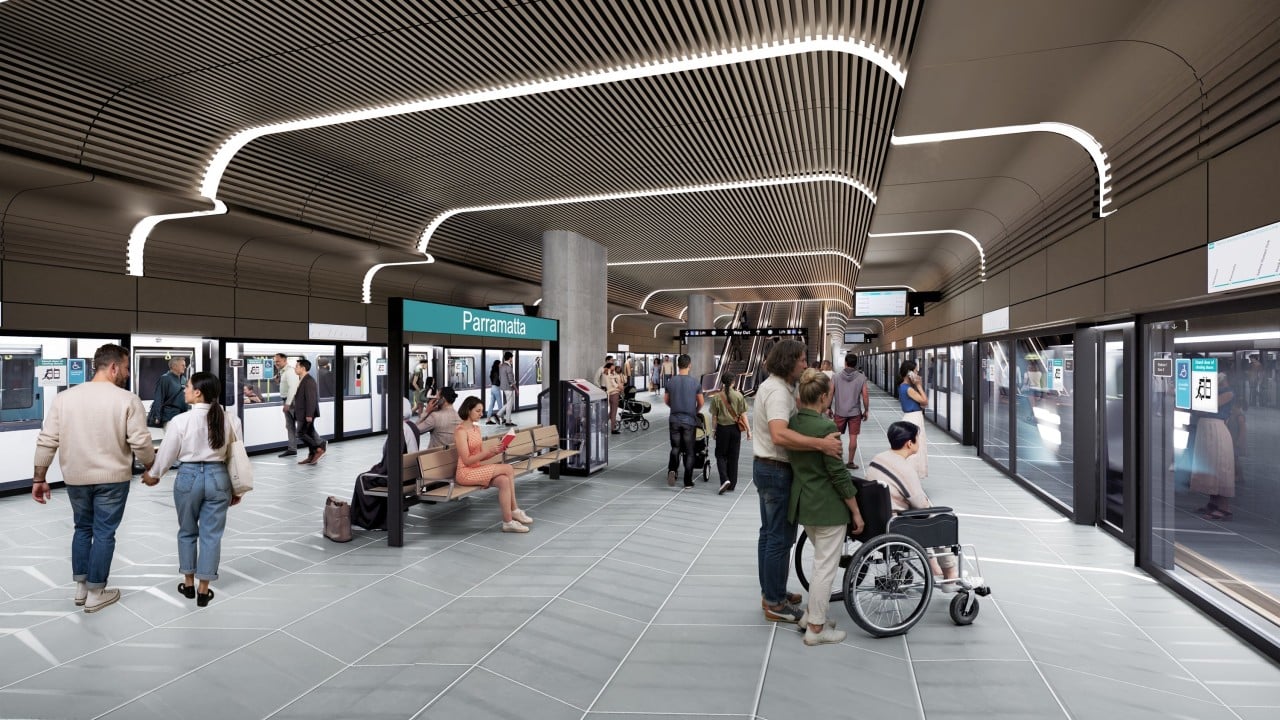
Urban rail infrastructure projects fail financially when treated strictly as civil engineering exercises rather than real estate catalysts. Traditional transit funding models rely on direct farebox recovery and government subsidies, both of which suffer from structural margin compression due to rising maintenance expenditures and inflationary labor pressures. The awarding of the Parramatta Integrated Station Development contract on the Sydney Metro West line to a joint venture between Gamuda Engineering and MTR Corporation (Australia) signals a structural shift toward the transit-oriented development model.
The mechanics of this contract require analyzing how capital expenditure, volumetric space optimization, and long-term asset monetization interact across a twenty-four-kilometer underground corridor scheduled for a 2032 operational launch. For another perspective, see: this related article.
The Dual-Asset Revenue Architecture
The financial viability of modern underground metro construction depends on exploiting the land value capture mechanism. Urban subterranean civil works carry immense initial capital outlays. The design and construction contract for the Parramatta station alone accounts for an $880 million capital expenditure. Relying solely on passenger ticket sales to amortize this expenditure introduces severe financial exposure, as operational cash flows remain constrained by regulated tariff structures and demand elasticity.
MTR Corporation and Gamuda circumvent this limitation through a dual-asset revenue architecture. The joint venture does not merely build a subterranean terminal; it secures explicit commercial development rights for the volumetric space above and adjacent to the station infrastructure. This model splits project execution into two distinct balance-sheet phases: Related coverage on this trend has been shared by MarketWatch.
- The Infrastructure Phase: A heavy civil engineering contract funded primarily through government capital allocations, executed to strict milestone specifications and engineering tolerances.
- The Real Estate Phase: A phased commercial build-out funded by private capital, capturing the land value increment generated by the introduction of rapid transit connectivity.
By integrating the station box design with four high-density towers—comprising a 43-storey build-to-rent residential asset, a 29-storey commercial office block, a 24-storey student accommodation facility, and an 8-storey hotel—the consortium alters the traditional municipal debt profile. The spatial proximity to a rapid transit node that reduces travel time to the Sydney Central Business District to approximately 20 minutes creates a localized pricing premium. This premium allows the private partners to offset construction inflation through long-term rental yields and strata asset sales.
The Cost Function of Subterranean Integration in Floodplains
Constructing high-capacity transit nodes within established urban centers involves severe geotechnical and logistical friction. The Parramatta station site presents specific structural cost drivers that dictate project economics:
- Geotechnical Constraints: Building within a known floodplain requires deep foundation engineering and continuous groundwater mitigation systems, raising baseline structural steel and concrete input costs.
- Urban Density Friction: Excavating a station box measuring nearly two hundred meters in length and twenty-five meters in width within a densely active commercial district requires phased utility relocation, traffic management overhead, and restricted working hours.
- Interface Risk: The physical interface between the subterranean rail systems—such as platform screen doors, signaling networks, and power supply—and the above-ground structural foundations introduces engineering coordination hazards.
The $880 million price tag for the Parramatta station reflects these compounding variables. When infrastructure costs outpace initial governmental estimates by margins approaching fifty percent over a multi-year planning lifecycle, project sponsors must scale up the yield potential of the accompanying real estate to preserve internal rates of return. Consequently, the project scope expanded from initial concept plans of 111 residential units to a targeted delivery of 970 dwellings and student rooms. Increasing density vertically absorbs the rising fixed costs of deep subterranean engineering.
Operational Risk Transfer and Asset Lifecycle Management
The involvement of MTR Corporation extends beyond civil construction into the long-term operational phase of the Sydney Metro West network. Under separate agreements tied to the broader program, the Metro Trains West consortium assumes responsibility for system integration, rolling stock provision, and fifteen years of post-opening operations and maintenance.
This procurement structure transfers operational performance risk from the public sector to the private operator. Driverless metro systems eliminate labor cost volatility associated with train drivers, optimizing the operating expenditure ratio per passenger-kilometer. However, this creates a dependency on high system availability. Reliability metrics directly impact the operational subsidy or penalty regimes enforced by the transit authority.
To mitigate downtime, the operator integrates predictive maintenance protocols driven by sensor arrays embedded within the track geometry and rolling stock bogies. Capitalizing on operational data from existing networks like the Sydney Metro Northwest allows the consortium to benchmark component degradation rates accurately, minimizing unplanned maintenance expenditure during the multi-decade lifecycle of the corridor.
Strategic Execution Roadmap
- Finalize Planning Approvals: Submit detailed design modifications for the four over-station towers to the New South Wales Department of Planning to lock in density parameters before foundation works reach grade.
- Execute Subterranean Civil Works: Complete structural slurry wall installation and internal excavation of the Parramatta station box while maintaining structural integrity for adjacent commercial properties.
- Sequence Above-Ground Phasing: Stage the vertical construction schedule to ensure commercial office and residential towers are completed sequentially following the structural sign-off of the station box, mitigating cash flow bottlenecks.
- Deploy Systems Integration: Align civil station completion dates with the installation milestones of the core railway systems, including signaling, communications, and platform screen doors, to ensure unhindered commissioning ahead of the 2032 network launch.