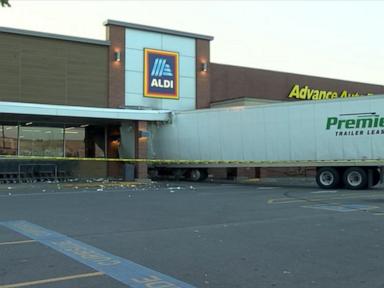
Commercial storefronts operating within high-density urban corridors face structural risk profiles defined entirely by architectural proximity to high-speed vehicular throughput. When a commercial vehicle breaches a retail perimeter, the resulting disruption propagates across three distinct axes: capital asset destruction, supply chain cold-chain failure, and business interruption liabilities.
The incident involving a tractor-trailer colliding with an Aldi retail location on Gallatin Avenue in Nashville highlights the operational vulnerabilities inherent to standard strip-center and urban-adjacent supermarket designs. Rather than evaluating such events through an isolated lens of criminal or accidental anomaly, risk management frameworks must assess the baseline vulnerabilities of commercial real estate parameters situated along designated high-injury traffic networks.
The Anatomy of Structural Perimeter Failure
Standard supermarket architecture prioritizes customer ingress and visual merchandising transparency. This requires expansive plate-glass storefronts, automated sliding doors, and minimal structural reinforcement along the primary pedestrian facade.
When a heavy commercial vehicle—such as a semi-truck weighing upwards of 30,000 pounds empty or 80,000 pounds fully loaded—impacts this low-resistance perimeter, the energy transfer equation heavily favors catastrophic failure. Steel-reinforced bollards or heavy-duty concrete planters serve as the primary kinetic energy mitigation barrier. Without these engineered defenses, the kinetic energy of a moving vehicle translates directly into structural collapse of the building envelope, compromising load-bearing columns, overhead utility lines, and interior shelving arrays.
Financial Loss Mechanics
The direct and indirect costs associated with a vehicular intrusion into a retail grocery facility follow a strict cascading function:
- Structural Remediation Costs: The replacement of compromised structural steel, electrical grids, data cabling, and shattered glass facades routinely exceeds hundreds of thousands of dollars before interior fit-outs begin.
- Cold-Chain Compromise: Grocery retail environments depend heavily on continuous refrigeration. A structural breach that impacts the building envelope or destroys auxiliary refrigeration units aboard the transport vehicle or within the store disrupts the temperature logs of perishable inventories. Regulatory standards mandate the complete write-off of perishable and frozen inventory exposed to temperature excursions, transforming a property damage event into a total inventory loss.
- Business Interruption Downtime: Every day a retail outlet remains closed due to structural rebuilding represents unrecoverable top-line revenue leakage. While property and casualty insurance mitigates direct repair expenses, margin loss during protracted permitting, demolition, and reconstruction phases places a heavy strain on district operational efficiency.
Traffic Flow and Spatial Risk Analysis
Urban thoroughfares designated as high-injury networks present compounded risks for roadside retail assets. Municipal planning data indicates that corridors featuring frequent turning movements, high traffic density, and complex intersections correlate with elevated statistical probabilities of vehicular loss of control.
Commercial operators selecting sites for high-volume retail distribution must incorporate quantitative traffic engineering assessments into their real estate underwriting. Proximity to arterial roads without adequate civil engineering buffer zones—such as deep setbacks, reinforced retaining walls, or heavy-duty crash-rated bollards—leaves retail real estate exposed to macroeconomic shocks driven by localized transit variables.
Strategic Mitigation Protocols
To systematically eliminate the financial and structural exposure demonstrated by perimeter vehicle intrusions, retail asset managers and corporate real estate developers must transition from reactive compliance to proactive fortification.
Property engineering teams should mandate the installation of Department of State or ASTM-rated crash barriers capable of stopping heavy commercial vehicles before kinetic energy reaches the building envelope. Furthermore, supply chain routing algorithms must restrict heavy delivery transport from navigating constrained urban corridors during peak vehicular congestion hours, reducing the operational window during which high-mass vehicles operate in close spatial proximity to vulnerable retail architecture.

