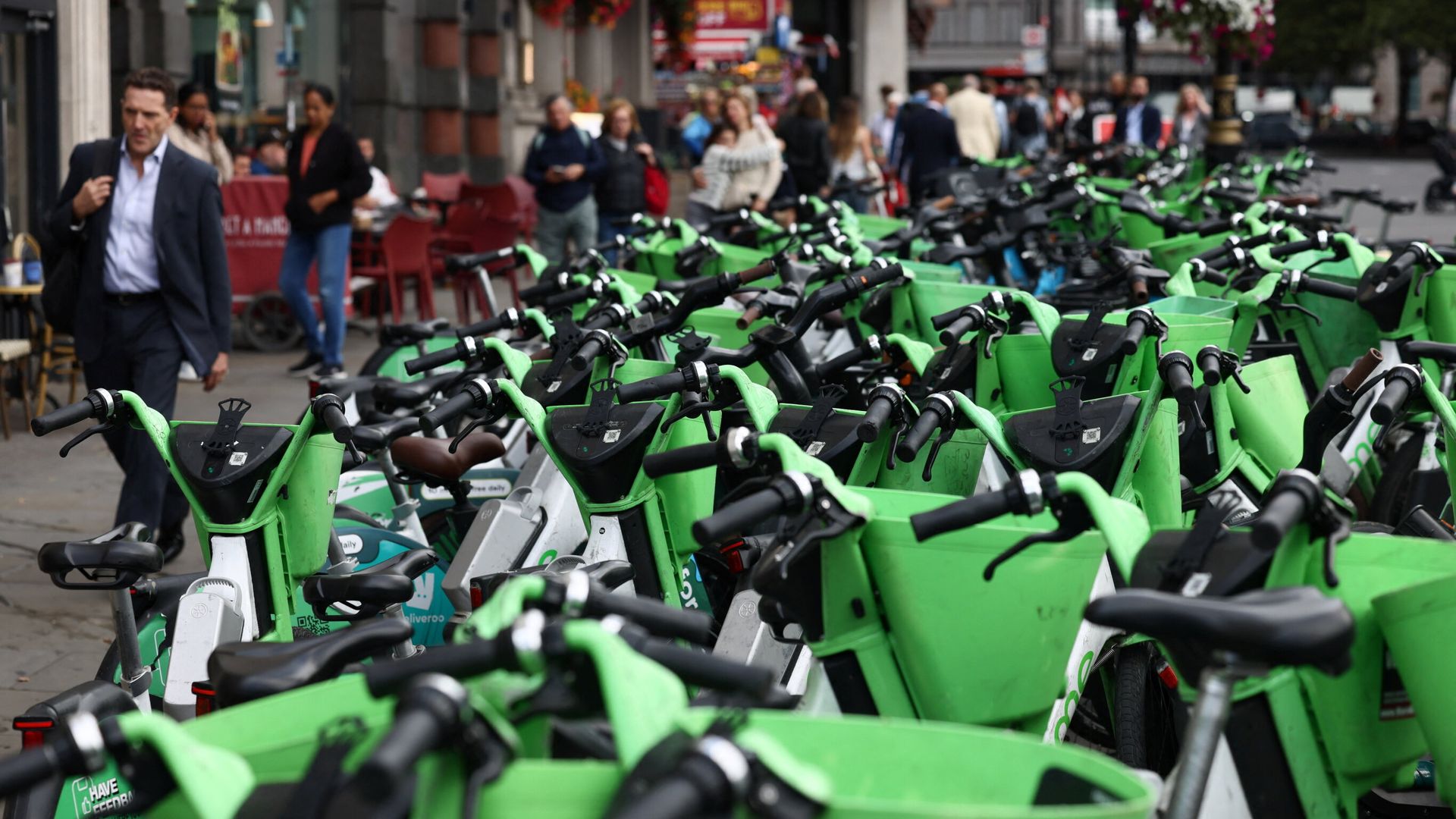
Unregulated dockless e-bike parking represents a classic tragedy of the commons, where private micromobility operators capture revenue while externalizing spatial storage costs onto public sidewalks. When municipalities introduce locally set parking fees and mandatory geofenced bays, they are not merely tidying up pedestrian walkways; they are fundamentally altering the unit economics of shared urban transit by forcing operators to internalize the opportunity cost of public curb space.
The proliferation of dockless electric bicycles—frequently characterized by municipal officials and local media as a "wild west" environment—stems from an asymmetric incentive structure. For a micromobility operator, fleet density directly correlates with rider conversion. The higher the probability that a pedestrian spots an available e-bike within a sixty-second walk, the higher the utilization rate per vehicle. Under a zero-cost parking regime, operators maximize revenue by saturating high-footfall areas, transit hubs, and narrow sidewalks with inventory. Because the marginal cost to the operator of leaving an idle vehicle on a public footpath is zero, the market naturally trends toward oversupply and spatial obstruction.
The Three Failure Modes of Unpriced Curb Space
When cities fail to price or strictly ration sidewalk real estate, three predictable operational failures emerge, degrading both urban accessibility and the long-term viability of the micromobility sector itself.
- Pedestrian Right-of-Way Erosion: Sidewalks are designed as linear throughput corridors for human movement, not static storage depots. When dockless vehicles are abandoned perpendicular to the curb, effective walkway width drops precipitously. This creates acute physical barriers for wheelchair users, parents with strollers, and individuals with visual impairments. The public bears the immediate cost in reduced mobility and heightened liability risks.
- Fleet Clustering and Spatial Asymmetry: Without financial penalties for over-concentration, vehicles naturally migrate along commuter desire lines—flowing from residential zones into central business districts during morning peaks and pooling at rail stations. Operators lack the financial urgency to rebalance fleets rapidly if the storage space at the destination is free. Conversely, outer neighborhoods suffer from chronic supply deficits because rebalancing trucks are not incentivized to retrieve clustered bikes until battery depletion forces a swap.
- Regulatory Backlash and Binary Bans: Historical precedent shows that when nuisance levels cross a political threshold, municipal governments rarely respond with nuanced pricing mechanisms on the first attempt. Instead, they default to blunt instruments: arbitrary fleet caps, abrupt permit revocations, or outright bans. These binary outcomes destroy capital invested in sustainable transit infrastructure and force commuters back into private automobiles or ride-hailing vehicles.
Deconstructing the Municipal Fee Mechanism
Transitioning from an unpriced commons to a regulated, fee-bearing model changes the operational calculus for every stakeholder. The introduction of locally set fees—whether structured as per-vehicle annual licensing, dynamic drop-off surcharges, or bay-rental tariffs—functions as a Pigouvian tax designed to correct negative externalities.
The Operator Cost Function
In a standard micromobility profit-and-loss statement, gross margin per ride is determined by ride revenue minus depreciation, battery swapping, maintenance, insurance, and payment processing. Locally set parking fees introduce a new, variable operating expense tied directly to spatial footprint and dwell time.
If a municipality charges operators for leaving vehicles outside designated parking bays, or levies tiered fees based on neighborhood congestion, the operator's algorithm must shift from pure availability maximization to spatial yield optimization. A bike sitting idle in a high-fee zone transitions from a passive asset into an active liability. To protect unit margins, operators must implement dynamic pricing models that pass these spatial costs—or corresponding discounts—directly to the end user.
Behavioral Nudges and Geofencing Execution
Technology bridges the gap between municipal policy and rider behavior through GPS geofencing and computer vision. However, standard civilian GPS suffers from signal multipath errors in dense urban canyons, often drifting by five to fifteen meters. A five-meter error is the difference between a bike parked neatly inside a painted bay and one blocking a tactile paving strip.
To enforce fee-based parking accurately without generating false-positive fines that alienate riders, operators must deploy a multi-layered verification stack:
- Sub-Meter Positioning: Utilizing Real-Time Kinematic (RTK) positioning or visual positioning systems (VPS) that cross-reference smartphone camera feeds against pre-mapped street-level imagery.
- Mandatory End-of-Trip Photography: Requiring riders to submit a photo of the parked vehicle before the billing clock stops, processed instantly via edge-AI models trained to detect upright kickstands and clear pedestrian pathways.
- In-App Incentive Loops: Offering immediate ride credits to users who terminate their trips in under-supplied zones or designated parking corrals, effectively crowdsourcing the fleet rebalancing process at a fraction of the cost of diesel van operations.
The Political Economy of Locally Set Fees
Granting local authorities the autonomy to set their own micromobility fees—rather than imposing a uniform national rate—aligns regulatory power with hyper-local spatial realities. A square meter of pavement outside a major metropolitan train terminal carries a vastly different opportunity cost than the same area in a low-density suburban high street.
Yet localized fee structures introduce significant friction and compliance overhead for regional operators. When a single metropolitan area is fractured into dozens of distinct boroughs or municipalities, each enforcing bespoke fee schedules, permit caps, and hardware mandates, economies of scale evaporate. A commuter crossing a municipal boundary on a five-minute ride may inadvertently trigger an out-of-zone parking penalty if the neighboring jurisdiction does not recognize the origin operator's permit.
This fragmentation creates a secondary market distortion: regulatory capture by incumbent operators with deep legal and compliance teams, while smaller, potentially more innovative competitors are locked out by administrative complexity. Furthermore, if local councils view micromobility fees primarily as a general revenue-generating mechanism rather than a ring-fenced fund for physical infrastructure, the policy fails. Charging operators fees without reinvesting those proceeds into physical parking corrals, painted bays, and protected cycle lanes merely taxes sustainable transport while leaving the physical streetscape unchanged.
Infrastructure Capacity and the Bay-to-Fleet Ratio
A critical operational bottleneck emerges when municipalities mandate designated parking bays and levy fines for non-compliance without providing sufficient physical capacity. In logistics and fleet management, parking infrastructure obeys strict queuing theory principles.
If a neighborhood supports an average daily demand of 500 dockless bikes, providing 500 physical parking spaces is mathematically insufficient. Because arrival and departure rates are stochastic rather than uniform, peak clustering requires a buffer capacity. In operational practice, maintaining a functional bay-to-fleet ratio requires roughly 1.3 to 1.5 physical spaces for every active vehicle in the local ecosystem.
When the bay-to-fleet ratio falls below 1.0, systemic failure occurs. Riders arrive at their destination, find the local parking bay completely full, and face an impossible choice: continue paying by the minute while searching for an open bay blocks away, or abandon the vehicle on the sidewalk and absorb a penalty fee. Both outcomes degrade the value proposition of micromobility—speed and door-to-door convenience—leading to rapid user churn.
Limitations of Fee-Based Regulation
While locally set fees and geofenced bays impose necessary order on public spaces, they are not a friction-free solution. Relying exclusively on financial penalties introduces three structural vulnerabilities:
- Modal Shift Regression: If parking fees and compliance friction push the total cost of a short e-bike trip close to that of a ride-hailing service or private car usage, price-sensitive commuters will abandon micromobility, increasing road congestion and carbon emissions.
- Equity Degradation: Flat-rate parking penalties disproportionately impact lower-income riders who rely on e-bikes for first-and-last-mile transit connections in areas poorly served by fixed-route buses or rail.
- Vandalism and Third-Party Displacement: Physical interference by non-riders—such as pedestrians moving a properly parked bike onto the roadway, or vandalism—can trigger automated fines against the last registered user or the operator, creating ongoing customer service disputes and evidentiary burdens.
Strategic Blueprint for Municipal Deployment
To transition away from chaotic sidewalk parking without suffocating urban micromobility, municipal planners and transport authorities must execute a sequenced, infrastructure-first rollout rather than leading with punitive tariffs.
First, authorities must convert existing on-street automobile parking spaces—not pedestrian sidewalk width—into high-capacity micromobility corrals. Replacing a single parallel car parking space yields room for eight to ten e-bikes, immediately expanding network capacity while preserving pedestrian walkways.
Second, municipalities should establish a unified, metropolitan-wide digital data standard—such as the Mobility Data Specification (MDS)—to ingest real-time telemetry from all licensed operators. Instead of static annual fees, authorities must implement dynamic, API-driven curb pricing: zero fees for parking inside designated corrals, moderate fees for compliant sidewalk parking in low-density zones, and steep, escalating penalties for vehicles left in high-congestion red zones or blocking accessibility ramps.
Finally, every dollar collected through operator licensing and parking penalties must be legally ring-fenced into a dedicated Active Travel Infrastructure Fund. By linking the financial penalties of improper parking directly to the capital expenditure required to build physical parking bays and protected bike lanes, cities align operator incentives, rider convenience, and public spatial order into a self-funding urban transit loop.