Silence.
That is the thing nobody tells you about the seconds immediately following gunfire, when the humid Florida air turns thick with the metallic tang of cordite and ozone, and every living thing within a three-block radius holds its breath at the exact same instant.
You have seen the headline already. Eleven sustain gunshot wounds in shooting near Florida university. Four lines of wire copy. A timestamp. A street intersection just outside the perimeter of campus property, where the neatly trimmed hedges of higher education give way to strip malls, late-night taco stands, and off-campus apartments rented by sophomores who still have their childhood posters rolled up in the backs of their closets.
Eleven.
It is a number small enough to fit on a single chalkboard, yet large enough to empty out three emergency room trauma bays before two in the morning. When we read a dispatch like that over morning coffee, our brains perform a quiet, practiced magic trick. We compress eleven separate universes of panic, surgical steel, shattered femurs, and frantic phone calls to mothers in distant area codes into a single, tidy statistic. We file it under the familiar, exhausting folder of American background noise, right between the weather forecast and the box scores.
I know how that filing system works because I used to operate it myself, right up until the night I stood on the sticky asphalt of a college town strip three miles from my own dorm, watching blue and red strobe lights wash over the faces of nineteen-year-olds who looked like they had just stepped out of a high school yearbook.
The Geography of Almost Safe
To understand what happened near that Florida campus, you first have to understand the invisible border that defines every major university town in America.
Consider a hypothetical student—let us call her Maya—who is twenty years old, majoring in marine biology, and working twenty hours a week at a coffee shop to cover the gap between her financial aid and her rent. Inside the campus gates, Maya lives in a curated ecosystem. There are blue-light emergency poles every hundred yards. There are campus police cruisers idling softly outside the library at midnight. Her parents, three hundred miles away in Tampa or Atlanta, look at the glossy university brochure and feel the warm, reassuring weight of institutional protection.
Now, walk Maya four hundred feet across the street.
The streetlamps grow dimmer. The jurisdiction shifts from university police to an understaffed municipal precinct juggling domestic calls across forty square miles. This is the twilight zone of college life—the off-campus corridor where students actually live, eat, gather after late-night study sessions, and celebrate the end of midterms.
When a shooting erupts "near" a Florida university, that preposition—near—does a massive amount of quiet political heavy lifting. To a university administrator, near means the incident will not appear on the federally mandated Clery Act campus crime statistics in the same red-alert column as an on-campus assault. To a local chamber of commerce, near creates just enough semantic distance to keep prospective families from canceling their spring campus tours.
To the eleven people lying on the pavement waiting for tourniquets, near means nothing at all.
Bullets do not read property deeds. Trauma does not check a student ID card at the curb before deciding whose life to rearrange.
The Anatomy of a Ten-Second Collapse
Let us look closely at the mechanics of what actually unfolds when eleven people are struck in a single burst of violence, stripping away the sterile language of police blotters.
In modern urban and suburban shootings, we are rarely dealing with the slow, cinematic standoffs of old television dramas. We are dealing with high-capacity magazines and semi-automatic platforms capable of discharging fifteen to thirty rounds in less than six seconds. Think of a deck of playing cards cascading off a table onto a hardwood floor. That is the acoustic signature of a modern mass shooting—not isolated bangs, but a continuous, tearing rip of sound that the human ear cannot initially distinguish from firecrackers or a backfiring exhaust pipe.
That auditory confusion is the first trap.
Behavioral psychologists who study mass casualty events call it normalcy bias. When something violently incompatible with our daily reality happens, the brain refuses to accept the data for the first two to three seconds. Students standing outside a late-night venue near a Florida university do not immediately dive for cover. They turn their heads toward the noise. They look at their friends to see if anyone else is laughing. They lose the very three seconds that separate a graze from a catastrophic torso wound.
Then comes the stampede.
When eleven people are hit in a crowded entertainment district or near an apartment complex, the injuries tell a brutal story of physics and panic. Surgeons at Level One trauma centers across Florida—places like UF Health Shands in Gainesville, Jackson Memorial in Miami, or Tampa General—know this pattern intimately. Rarely are all eleven victims targeted. Typically, two or three individuals are the intended focus of a dispute that escalated from a bruised ego, a social media slight, or a parking lot argument. The remaining eight or nine are simply human beings occupying the geometry of bad luck.
One victim catches a round in the lower leg while turning to run, the lead shattering the tibia like dry kindling. Another is struck in the shoulder while shielding a roommate. A third takes shrapnel from a bullet that ricocheted off a concrete curbstone.
And what of the twelfth, thirteenth, and twentieth people in that crowd? They are not on the hospital intake list. They are the ones kneeling in the oil-stained parking lot with their hands pressed hard into a stranger’s sweatshirt, trying to remember a thirty-second Stop the Bleed video they scrolled past on TikTok six months ago, feeling warm blood soak through the knees of their jeans while 911 dispatchers ask them to spell the name of the cross street.
Why Florida Keeps Becoming the Stage
If you feel a sense of weary deja vu reading about gunfire near a Florida college town, you are not imagining things. You are noticing a collision of demographics, geography, and policy that makes the Sunshine State a recurring pressure cooker.
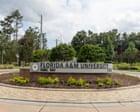
Florida is home to some of the largest public universities in the United States—institutions like the University of Florida, Florida State University, the University of Central Florida, and Florida A&M, each pouring tens of thousands of young adults into dense, walkable pockets of otherwise sprawling cities. Add to that a year-round climate that pushes social life outdoors onto sidewalks, balconies, and parking lots well past midnight, and you have constant high-density gatherings in open, unsecured spaces.
At the same time, look at the legal and cultural landscape surrounding firearms in the state. Since Florida enacted permitless concealed carry in July 2023—allowing anyone legally eligible to own a firearm to carry a concealed weapon without a state permit, background check for the carry license, or mandatory training—the sheer volume of firearms circulating in public spaces has shifted. While Florida law still prohibits carrying firearms directly onto college and university campuses, the moment a person steps off university property onto a public sidewalk or into a private parking lot across the street, those campus restrictions evaporate.
Here is the honest truth that partisans on both sides often obscure: law enforcement data consistently shows that the vast majority of violent street crimes are committed with illegally obtained or stolen firearms, not by law-abiding permit holders. Yet criminologists also point to a well-documented phenomenon known as the weapons effect and increased availability via vehicle thefts. In Florida, unlocked cars in apartment complexes surrounding college campuses have become the primary supply chain for illegal street guns. A firearm left in a glove box on a Tuesday night becomes the weapon used in a dispute outside a club three blocks away on a Saturday morning.
We have built an ecosystem where the boundary between a gun-free academic sanctuary and an unregulated street corridor is literally the width of a painted crosswalk.
The Lie of the "Non-Life-Threatening" Injury
Read the follow-up reports after almost any shooting of this scale, and you will encounter a phrase designed to sedate the public conscience: All eleven victims are expected to survive, with injuries ranging from minor to serious.
It is the most misleading reassurance in modern journalism.
Survival is not recovery. Walking out of a hospital discharge door in a wheelchair three days after a gunshot wound is not the end of the story; it is the prologue to a decade of quiet wreckage.
Let us return to our hypothetical marine biology student, Maya, and imagine she is one of the "lucky" ones—shot once through the upper thigh, missing the femoral artery by four millimeters. She survives. The local news moves on to the next story by Tuesday.
Here is what happens to Maya over the next eighteen months, grounded in the clinical reality of gunshot trauma survivors tracked by public health researchers at Johns Hopkins and the University of Pennsylvania:
First comes the financial ambush. Even with student health insurance, emergency trauma care, orthopedic surgery, anesthesia, and inpatient observation generate bills that routinely clear six figures. Deductibles are maxed out before breakfast. Physical therapy—three times a week for six months just to walk without a limp—requires co-pays that a barista’s wages cannot touch. Maya drops her spring semester classes because she cannot navigate a hilly campus on crutches, losing her scholarship eligibility in the process.
Then comes the invisible architecture of trauma.
A bullet traveling at over a thousand feet per second does not just punch a neat hole; it creates a temporary cavity inside human tissue, tearing nerve endings and leaving chronic, burning neuropathic pain that flares every time the barometric pressure drops before a Florida afternoon thunderstorm. Worse is what happens to the nervous system. Survivors of community gun violence exhibit rates of Post-Traumatic Stress Disorder comparable to combat veterans. A dropped textbook in a quiet lecture hall triggers an adrenaline dump so violent that Maya’s vision tunnels and her hands shake uncontrollably for an hour. She stops going to the library at night. She moves back home, trading her independence for a bedroom with blackout curtains.
Multiply that single trajectory by eleven. Then multiply it again by the forty friends, roommates, paramedics, and emergency room nurses who spent that night scrubbing dried blood from under their fingernails.
That is the true ledger of a shooting near a university. None of it fits inside a breaking-news push alert.
What We Refuse to Admit About Safety
When I stand back and look at how we talk about these events, what strikes me most is not our anger—we have plenty of anger, neatly packaged for social media algorithms—but our confusion. We seem genuinely baffled as to how a place dedicated to the future can repeatedly become a crime scene in the present.
Part of that confusion is deliberate. Universities are multi-billion-dollar enterprises competing fiercely for out-of-state tuition dollars. Municipal governments rely on student spending to keep local economies afloat. Neither institution has a financial incentive to advertise the vulnerability of the gray zones where campus meets city. So we rely on reactive theater. After eleven people are shot, the university sends out a late-night alert urging students to "avoid the area." The mayor holds a press conference promising "extra patrols for the next several weeks." A vigils is held on the campus green with battery-operated candles.
And then the patrol schedules quietly revert to normal, the candles go back into a storage closet in the student union, and the next incoming freshman class arrives in August without ever knowing which street corner used to be taped off with yellow plastic.
I do not pretend to have a magic legislative wand that erases decades of American gun culture or solves the complex socioeconomic friction between thriving universities and the neglected neighborhoods that often border them. Anyone who tells you this problem has a single, simple fix is selling you a slogan, not a solution.
Real progress in these campus-adjacent corridors is unglamorous, expensive, and stubbornly local. It looks like cities and universities pooling funds to install high-output LED lighting and monitored camera networks not just inside the campus gates, but six blocks beyond them. It looks like late-night safe-ride shuttles that actually run until three in the morning on weekends instead of shutting down at midnight. It looks like hospitals embedding violence-intervention specialists directly into emergency trauma bays—trained outreach workers who meet gunshot victims at their bedsides before revenge cycles can spin outward into the next weekend’s headline.
Most of all, it requires refusing the anesthesia of small numbers.
The Empty Chair in the Back Row
On the Monday morning following a shooting like this, classes at the university still meet. The coffee machines still hiss in the student union. Ducks still waddle across the retention ponds, indifferent to sirens and press conferences.
Somewhere in a second-floor lecture hall, a professor takes attendance, pausing for half a second over a name that does not answer, before moving down the roster. Three miles away, under fluorescent hospital lights that never turn off, a twenty-year-old stares at a plastic cup of ice chips, trying to figure out how to tell her mother over the phone that she is okay, even though both of them know she will never quite be the same person who walked out of her apartment door on Friday night.
Eleven names. Eleven sets of parents driving down Interstate 75 with white knuckles on the steering wheel. Eleven futures bent off course in the time it takes to draw a single breath.
We can call it a statistic if that helps us get through the morning, but the pavement remembers every drop.