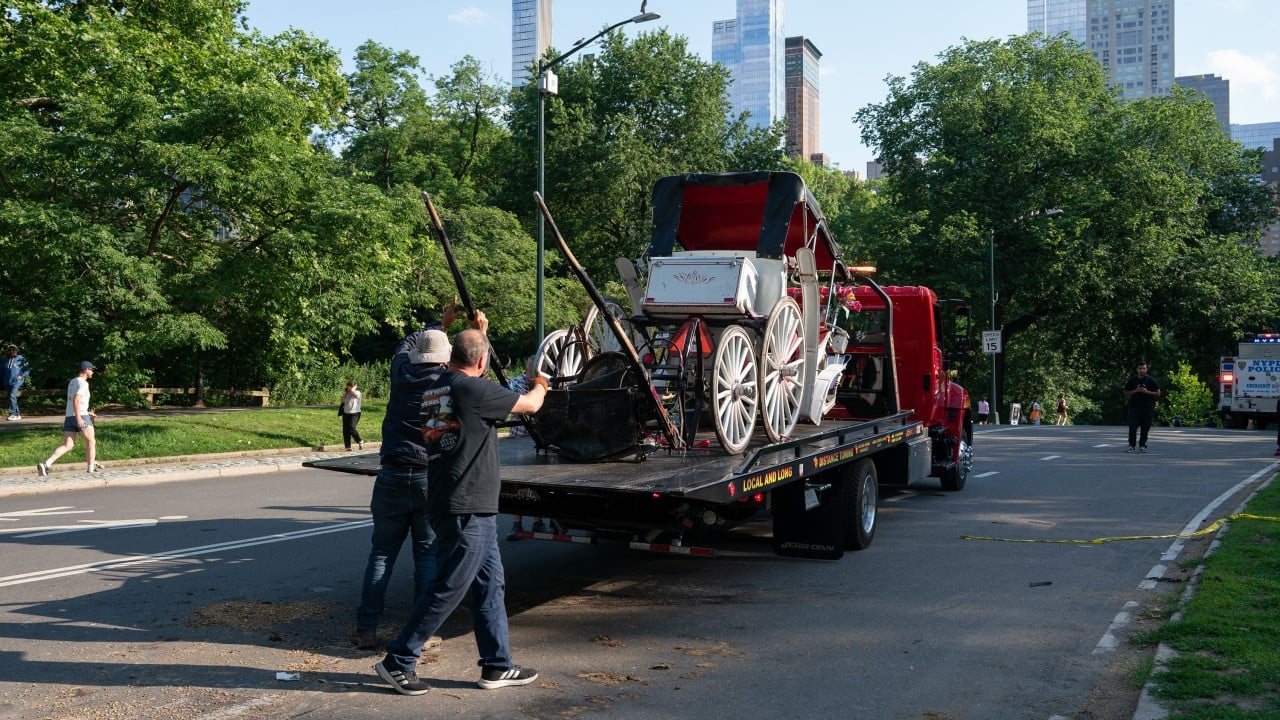
The clip-clop of hooves against modern asphalt is an anachronism we willingly buy into. To step into Central Park is to step into a carefully curated illusion of the nineteenth century, where the roar of yellow cabs fades beneath the canopy of ancient elms and the rhythmic, comforting sound of a horse-drawn carriage promises a slower, gentler world.
We look at the horses, their blinkers shielding them from the neon glow of Fifth Avenue, and we see romance. We see tradition. What we rarely see, until the illusion shatters, is the fragile thread holding that entire world together.
Central Park was designed in the 1850s by Frederick Law Olmsted and Calvert Vaux as a rural oasis for a rapidly industrializing city. It was built for carriages. But it was built for the carriages of a bygone era, sharing dirt paths with pedestrians in top hats, not five-ton tourist buses, electric bikes speeding at twenty miles per hour, and the unpredictable, high-decibel chaos of Manhattan. When these two worlds collide, the romantic veneer disappears instantly. Left behind is a stark, devastating reality.
Consider a crisp autumn afternoon. The air carries that sharp, classic New York chill, and the park is alive with the laughter of families, the flash of smartphone cameras, and the steady stream of traffic looping around the park's exterior drives. For a teenager visiting the city, this is the postcard come to life. The carriage ride isn't just transport; it is a rite of passage, a cinematic moment captured in real time.
Then, a sudden sound. A car horn. A low-flying drone. The sudden hiss of air brakes from a city bus.
To a human, it is background noise. To a prey animal weighing twelve hundred pounds, it is a mortal threat. The reaction is instantaneous, driven by millions of years of evolutionary survival instinct. The flight response kicks in. The horse bolts.
In that single, terrifying fraction of a second, the nineteenth century slams violently into the twenty-first. The heavy wooden carriage, designed for leisurely strolls, becomes an uncontrollable projectile. The structural integrity of a traditional carriage offers little protection against the sheer physics of a modern traffic accident. The aftermath is not just a statistic in a police report or a dry headline on a news site. It is a profound, irreversible tragedy that leaves a family broken and a city questioning the true cost of its nostalgia.
The debate surrounding the Central Park carriage industry is often framed in cold, binary terms. On one side stand the animal rights advocates, wielding data about asphalt temperatures, exhaust inhalation, and the psychological stress placed on working draft horses in urban environments. On the other side sit the carriage drivers and operators, many of whom belong to multi-generational families representing a deeply entrenched labor tradition, fighting to preserve their livelihoods and a piece of New York history.
But the real problem lies elsewhere, far beyond the talking points of political press conferences. The core issue is the fundamental incompatibility of infrastructure.
A draft horse requires a predictable environment. It relies on a delicate trust between handler and animal. Manhattan, by its very definition, is unpredictable. The city changes by the millisecond. A piece of construction equipment unrolling a tarp, a skateboarder performing a trick on the curb, or a sudden siren from an ambulance can trigger a catastrophic chain reaction. When a horse panics in a confined urban space bounded by stone walls, heavy traffic, and dense crowds, there is simply nowhere safe for it to go.
We must ask ourselves what we are asking these animals, and the people who ride in those carriages, to endure. Is the aesthetic of old New York worth the inherent risk of operating large, easily startled animals in the heart of the most densely populated city in the country?
The industry point out that safety regulations have been tightened significantly over the decades. Horses are restricted from working in extreme heat or bitter cold. They receive regular veterinary checks. Drivers must undergo licensing and training. Yet, no amount of regulation can legislate away the basic biology of a horse. Fear cannot be regulated. Instinct cannot be mandated out of existence.
When an incident occurs on the park's loop, the collective shock waves ripple through the city. For a few days, the conversations on the subway and in local coffee shops shift. People look at the carriages lined up along Central Park South with a different set of eyes. The charm feels a bit more fragile, the risks a bit more glaring. We feel a collective pang of grief for a young life cut short in a place meant for joy, a place meant for escape.
The vulnerability of the situation becomes impossible to ignore. We realize how thin the barrier is between a beautiful afternoon and an unimaginable disaster. It forces an uncomfortable vulnerability onto the city itself, exposing the friction between preserving a historical identity and ensuring public safety in a world that has outgrown its past.
Imagine the perspective of those left behind to pick up the pieces. A trip to New York is supposed to be about building memories that last a lifetime. It is about the lights of Broadway, the view from the Empire State Building, and the quiet beauty of Central Park. Instead, a family returns home with an empty space that can never be filled, their connection to the city permanently tethered to a moment of sudden, violent chaos.
The conversation eventually moves on, as it always does in a city that never stops moving. The headlines fade. The news cycle refreshes. The carriages continue to line up along the cobblestones, their brass fittings polished, their drivers calling out to passing tourists.
But the echo of that sudden, tragic moment remains for those who choose to listen. It lingers in the shadow of the trees, a quiet, persistent reminder that our desire to cling to the past sometimes comes at a price far higher than the fare listed on the side of a wooden carriage.