Wood. Glass. Silence.
The architecture of a German courtroom is designed to contain emotion. It is built to absorb anger and filter out the noise of the outside world, leaving only the sterile, necessary machinery of the law.
But some grief is too loud for soundproofing.
When the judge finally spoke the words—life sentence—the room did not erupt. There was no cinematic gasp. There was only a heavy, collective exhalation from the gallery. A sudden release of breath that had been held for months, perhaps years.
To understand the weight of that singular moment, you have to look backward. You have to leave the fluorescent lights of the courthouse and return to the sensory heart of a German winter.
A Weihnachtsmarkt—a Christmas market—is not just a collection of wooden stalls. It is a psychological defense against the longest, darkest nights of the year. It smells of roasted almonds, star anise, and damp wool. It sounds like clinking ceramic mugs of Glühwein and a low, steady hum of neighborhood gossip. It is a place of unguarded vulnerability. People are bundled up, their hands occupied with food and drink, their faces tilted upward toward strings of incandescent lights.
That was the scene before the violence arrived.
When the attack happened, it fractured more than just physical bodies. It shattered the quiet trust that binds a community together in public spaces. The perpetrator, a man who had crossed borders seeking refuge in the very country whose citizens he eventually targeted, turned a vehicle into a weapon of mass devastation.
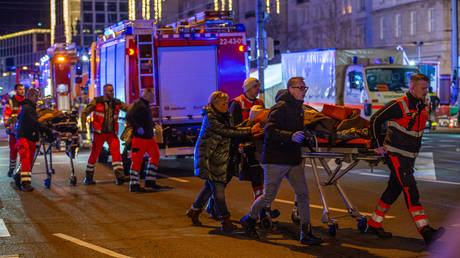
The political fallout was immediate. The fact of his immigration status poured gasoline on a simmering national debate about borders, integration, and security. Politicians shouted across aisles. Protests formed. But down on the cold cobblestones, beneath the flashing blue lights of the Notarzt ambulances, there was no politics. There was only the brutal, metallic reality of loss.
Consider a hypothetical survivor. We will call him Thomas, an amalgamation of the dozens of witnesses who later took the stand. Thomas went to the market to buy a wooden ornament. He remembers the cold bite of the wind. He remembers the sudden, deafening crack of splintering timber. He remembers the silence that followed, a vacuum of sound before the screaming began.
For Thomas, the trial wasn't about national immigration policy. It was about the empty chair at his dining table. It was about the sudden spike of adrenaline he now feels every time he hears a truck accelerate on a city street.
When the trial began, the German legal system faced a monumental task. The courts do not deal in vengeance. They deal in proportionality, evidence, and procedure. The defendant sat behind reinforced glass, listening to translations through a plastic earpiece. The banality of the legal process—the filing of motions, the cross-examinations, the procedural delays—can feel agonizing to families who are bleeding emotionally.
But this slow, methodical grinding of the gears is exactly how a civilized society responds to barbarism.
People often ask what a "life sentence" actually means in the German judicial system. It is a valid question. The system is fundamentally built on the principle of rehabilitation, the idea that the state must leave a path open for a prisoner to eventually rejoin society. Usually, a life sentence allows for the possibility of parole after fifteen years.
But the judge in this room understood the specific gravity of what had been stolen.
The court applied a specific, devastating legal mechanism: besondere Schwere der Schuld. The exceptional gravity of guilt.
This is not a phrase used lightly. It is the heaviest anchor the German court can drop. By legally establishing the exceptional severity of the crime, the court effectively locked the door and threw away the key. Parole after fifteen years is taken off the table. The sentence transforms from a severe penalty into a permanent removal from society.
The translation crackled through the defendant's earpiece. The exceptional gravity of guilt.
In the gallery, hands were held tightly. Some stared at the floor. Others looked directly at the glass box, watching the man who had authored their nightmares realize that he would grow old, and likely die, entirely within the confines of a concrete cell.
Justice cannot raise the dead. It cannot un-splinter the wood of the market stalls. It cannot erase the trauma etched into the nervous systems of the survivors. If you speak to anyone who has lived through the slow agonizing crawl of a murder trial, they will tell you that the verdict does not bring "closure." Closure is a myth invented by screenwriters.
What a verdict brings is a boundary.
It draws a thick, black line under the event. It is society standing up, speaking with one unified voice, and declaring: We see what you did. We measure its horror. And we cast you out.
The trial is over. The files will be placed into cardboard boxes and moved to a subterranean archive. The media satellite trucks will pull away from the courthouse steps.
December will come again. The days will grow short. The cold will set into the stone streets of the city.
And slowly, cautiously, the wooden stalls will be constructed once more. The lights will be strung across the squares. The smell of roasted almonds will return to the winter air. People will gather, standing shoulder to shoulder in the freezing cold, refusing to surrender the warmth of their traditions to the memory of terror.
They will hold their mugs of Glühwein. They will look at the lights. They will remember.