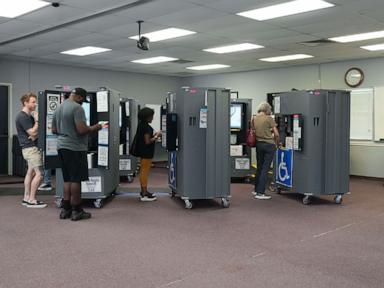
Two weeks before Election Day on November 3, 2026, a clerk in a Midwestern county courthouse stood behind a stack of ballot trays at 7:14 a.m. and heard the familiar scrape of a heavy glass door. Outside, the October air smelled like wet asphalt and crushed maple leaves. Inside, fluorescent tubes hummed over linoleum floors that had seen forty years of civic routine. She expected a trickle. Most midterms start with a trickle. Instead, six people were already waiting on the folding chairs—a retired machinist in a faded flannel shirt, a young mother balancing a car seat against her hip, and two college students holding crumpled notebooks.
Numbers on a dashboard make that moment look clinical. Turnout rates. Early-vote totals. Party registration splits. Analysts read those figures like cardiograms, searching for a spike or a dip that predicts who will hold the gavel next January. Yet a ballot cast two weeks before November 3 is rarely an act of pure statistical calculation. Most of the time, it is an act of relief, or worry, or quiet determination squeezed between a shift at work and a pediatrician appointment.
To understand what the early vote in the 2026 midterms actually meant two weeks out—with Election Day still fourteen days away and millions of ballots yet to be cast or mailed—you have to listen beneath the percentages. You have to look at why people were walking into community centers and town halls early in mid-to-late October, what was weighing on their kitchen tables, and why early numbers only tell half the story until the final tally settles.
The Kitchen Table Behind the Early Ballots
Polling from mid-October 2026—right around that two-week mark before the November 3 midterms—captured a country pulling at two different threads at once. In the NPR/PBS News/Marist survey conducted October 19–20, 2026, cost of living sat right at the top among likely voters at 34%, with preserving democracy right behind it at 33%. Nearly four in ten registered voters—40%, up from 34% in September—said their family finances had deteriorated.
Those numbers sound abstract until you attach a pulse to them. (Note: The following two characters are hypothetical composites created to illustrate real economic and civic pressures documented in October 2026 polling; they are not real individuals.)
Consider Hannah, a hypothetical dental hygienist in Ohio who voted early on her lunch break in late October. Nothing catastrophic happened to Hannah's household this year. She still has her job, her car still starts, and her kids still play soccer on Saturdays. What changed was the slow, grinding math of staying afloat. Groceries cost a little more every trip. Auto insurance crept up again. When Hannah stepped into the voting booth two weeks before Election Day, she wasn't thinking about cable news panels. She was thinking about whether her paycheck was stretching thinner than it did two years ago, and whether anyone in Washington was actually looking at the price tag on her receipt.
Now place David, a hypothetical retired postal worker in North Carolina, across the aisle in spirit. David voted early too, driven less by a single line item on his utility bill and more by a nagging unease about how rules get bent and who guards the guardrails. In that same October Marist poll, 84% of likely voters said they were enthusiastic or very enthusiastic to vote, and 55% said it mattered more to elect candidates who would bring about change rather than rely on a proven track record.
Two voters. Two weeks out. Both urgent. One carrying a grocery list in her head, the other carrying a question about the durability of democratic norms. Early voting doesn't flatten those differences into a single mood; it brings them forward ahead of schedule.
Why Two Weeks Out Is a Flashlight, Not a Floodlight
There is a temptation every midterm cycle to treat the two-week-out early vote mark like a finished painting. It isn't. Two weeks before November 3, 2026, early in-person voting had opened across dozens of states—many in mid-to-late October, following earlier mail-in and September openings in places like Minnesota and South Dakota—while millions of voters were still waiting for their final week, their weekend, or Election Day itself.
Think of early voting like a flashlight beam sweeping through a dark room. The beam illuminates whatever it hits with sharp clarity—long lines at a county clerk's office, surges in registration checks, enthusiastic early waves—while leaving the corners of the room in shadow until the lights come fully on.
Historically, early-vote patterns shift as habits evolve. Some voters always bank their ballots the moment doors open so life can't get in the way: a flu bug, a double shift, a sudden family trip. Others wait until the final days when local races sharpen, mailers pile up, or a close family conversation tips the scale. Even platform activity from Vote.org across the 2026 cycle showed how much energy clustered right at the finish line—with 1.94 million polling place lookups from October 22 through November 3, including over 1.1 million on Election Day alone.
Wait.
That distinction matters more than pundits usually admit. High early turnout in week two can signal genuine hunger among eager voters, or it can simply mean voters who were going to vote anyway are showing up earlier than they used to. You cannot read a final margin off a partial ledger.
The Quiet Machinery Behind Every Early Ballot
When headlines talk about early voting, the spotlight usually lands on candidates, cable pundits, or partisan advantage. Rarely does it land on the people keeping the machines calibrated and the paper trails intact two weeks before the election.
Around that two-week mark in late October—coinciding with the League of Women Voters' "Election Hero Day" on October 20—election administrators across the country were working through the most delicate stretch of the calendar. Early ballots were being accepted, logged, verified, and stored under strict bipartisan or nonpartisan chain-of-custody rules. Mail ballots were arriving in envelopes that had to be checked for signatures, postmarks, and state-specific rules.
Here is something that confuses many people every election cycle: an early ballot is cast early, not necessarily counted and reported early.
In many states, processing and tabulating early or mail ballots follows strict statutory timelines. Some jurisdictions begin scanning ahead of Election Day; others wait until polls close on November 3. And when races are razor-thin—as several 2026 congressional and Senate contests proved to be once November arrived—final tallies can stretch days or even two weeks past Election Day as mail, provisional, and affidavit ballots are verified and counted.
Two weeks out from Election Day, that entire counting architecture is humming quietly in the background. If you've ever felt a knot of skepticism when results take time, remember what is actually happening inside those rooms: clerks checking lists, bipartisan teams observing, security seals intact, slow human care taking the place of rushed guesswork. Speed is entertaining on television. Accuracy is what keeps a republic standing.
What Surges in Registration and Youth Energy Signal
One of the clearest clues in the 2026 cycle wasn't just who walked into an early-voting site two weeks out, but who was getting ready to show up at all. Vote.org reported more than 1.2 million voter registrations across the 2024–2026 cycle—nearly 75% higher than the 2022 midterm cycle—with 77% of registrants under age 35 and nearly three in ten (29%) aged 18.
Younger voters have a reputation in political commentary for being loud online and quiet at the ballot box. Sometimes that reputation has teeth. Midterms historically draw fewer young people than presidential years. Yet when registration and voter-readiness tools spike heading into the final stretch of a midterm, it points to something real beneath the surface: frustration over affordability, anger over stalled promises, or a sense that local and federal decisions on housing, jobs, and rights aren't theoretical anymore.
A twenty-year-old checking her registration in late October isn't doing it for a political science thesis. Maybe her rent went up. Maybe a friend told her her name wasn't on the rolls at the last election. Maybe she just decided she was tired of sitting on the sidelines while other people chose who speaks for her neighborhood.
Whether a first-time voter casts a ballot two weeks early or two hours before polls close, the political weight is identical once it's counted. Early voting simply gives anxious, busy, or newly energized citizens more room on the calendar to make good on that decision.
Reading the Signals Without Fooling Yourself
If you are trying to make sense of early-voting snapshots two weeks before a midterm election, a few grounded habits keep you from getting whiplash.
First, separate enthusiasm from inevitability. High energy two weeks out tells you people care enough to act ahead of schedule. It does not tell you whether the remaining undecided or late-deciding voters will break the same way in the final ten days.
Second, watch the issues, not just the team jerseys. In October 2026, affordability and democracy dominated the conversation, alongside local concerns that varied from county to county—from healthcare and immigration to community debates over infrastructure like data centers. A voter's core worry shapes how durable their choice is.
Third, give the process breathing room. Elections in a nation of over 330 million people—where preliminary estimates for the 2026 midterms pointed to roughly 124.3 million total ballots cast, up from about 112 million in 2022—are massive logistical operations, not instant lottery drawings. A slow count after Election Day isn't a malfunction; it's often the sound of rules being followed carefully.
I'll admit it: watching early-vote coverage can feel exhausting. Every day brings another chart, another breathless comparison to four years ago, another claim that the whole story is already written. You don't have to memorize every county percentage to be an informed citizen. You just have to ask a simpler question: Who is showing up, what are they carrying with them, and are we looking at the whole picture or only the part the light hits first?
Out in that county courthouse two weeks before November 3, the six early voters had already stepped back into the October breeze. The machinist headed toward his morning coffee; the young mother buckled her child into the back seat; the students walked toward campus with cold hands and lighter minds. None of them knew yet how the final numbers would read two weeks later. Each of them knew why they had walked through the glass door that morning.