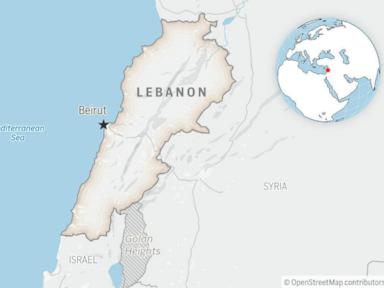
The dust in southern Lebanon is different now. It isn't the light, sun-baked silt that rises behind a tractor or the gentle haze of a summer afternoon in the Galilee panhandle. It is heavy. It smells of pulverized concrete, ancient limestone, and the ghost of incense. When a home that has stood for three generations vanishes in a cloud of grey smoke, the sound isn't just an explosion; it is the snapping of a spine.
In the synod halls and the quiet chancelleries of the Melkite Greek Catholic Church, the air is thick with a different kind of weight. The bishops have gathered. They aren't just reading casualty reports or tracking troop movements. They are counting the holes in the map where their people used to be.
The Geography of Disappearance
Consider a man named Elias. He is a hypothetical composite of the thousands currently watching the horizon from the cramped safety of a Beirut apartment or a mountain schoolhouse. For Elias, the border wasn't a political abstraction. It was the ridge where the olive trees transitioned from his family’s grove into the haze of the south. It was the bell tower of the village church, a landmark that told him he was home long before he reached his front door.
Now, that bell tower is gone.
The Melkite Catholic bishops, led by Patriarch Youssef Absi, recently voiced a visceral concern that goes beyond the immediate horror of war. They are witnessing the systematic demolition of entire villages. This isn't just "collateral damage," a phrase that sanitizes the destruction of a kitchen table or a child's bedroom. It is the erasure of a specific, delicate social fabric.
Southern Lebanon is a mosaic. It is a place where Shia Muslims, Maronites, Melkites, and Druze have lived in a state of precarious, beautiful balance for centuries. When the bulldozers and the missiles level a village, they aren't just hitting Hezbollah targets. They are hitting the shared history of a multi-confessional society. The bishops see the smoke and realize that even if the guns fall silent tomorrow, there may be nothing left for the people to return to.
The Invisible Stakes of the Rubble
War often focuses on the "what"—what bridge was hit, what commander was targeted. The bishops are focused on the "who" and the "where."
They are pointing to a terrifying reality: the creation of a "no-man's land." In military strategy, a buffer zone is a line on a map. In human terms, a buffer zone is a graveyard of memories. When the Israeli military clears a path of destruction through border towns, they are doing more than securing a perimeter. They are making the land uninhabitable.
If you destroy the school, the bakery, the church, and the water station, you haven't just won a battle. You have ended a civilization.
The bishops’ statement was uncharacteristically blunt. They spoke of "unprecedented" destruction. They described the targeting of civilians and the systematic flattening of neighborhoods. They are terrified that the Christian presence in the south—a presence that predates the modern borders by a thousand years—is being permanently extinguished. This isn't about theology. It is about the right to exist in the place where your ancestors are buried.
A Language Beyond Words
Why does a bishop’s concern matter in a world of drone strikes and geopolitical maneuvering?
Because they are the keepers of the long memory.
Political leaders think in election cycles or four-year military budgets. The Church thinks in centuries. They know that once a village is emptied and its structures are ground into the dirt, the "return" becomes a myth. Young families who flee to the north or to Europe don't come back to a pile of rocks. They build new lives elsewhere. The unique cultural identity of southern Lebanon—a place where the call to prayer and the ringing of church bells have echoed off the same hillsides—is being dismantled brick by brick.
The bishops are shouting into a storm. They are calling on the international community to recognize that this is not a standard military operation. It is the physical deconstruction of a region's heritage.
The Sound of the Void
The real tragedy is the silence that follows the demolition.
It is the silence of a village square where no one will ever drink coffee again. It is the silence of a parish register that stops abruptly in the autumn of 2024. The Melkite leadership is warning us that we are losing something we can never get back.
We often talk about the "middle ground" in the Middle East as if it were a political compromise. In southern Lebanon, the middle ground was a physical space. It was the shared marketplace. It was the neighbor helping a neighbor harvest tobacco or olives regardless of how they prayed.
When those houses are demolished, the middle ground vanishes. Only the extremes remain.
The bishops are not just mourning buildings. They are mourning the possibility of peace. They know that a landscape of ruins is the most fertile soil for future hatred. You cannot expect a man to look at the crater where his life used to be and see a path to reconciliation.
The Weight of the Morning
Every morning, the sun rises over the scorched hills of the south. The smoke clears just enough to reveal the new gaps in the skyline.
The Melkite Catholic bishops are asking a question that the world seems intent on ignoring: What happens when the buffer zone is cleared of everything but the wind?
They aren't just protecting their flock. They are trying to save the soul of a country that is being torn apart by the cold logic of security and the hot fire of revenge. They are standing in the rubble, holding onto the names of villages that are disappearing from the map, praying that the world will look at the dust and see the people who are buried beneath it.
The stones are silent, but the absence of them is a scream.
The world watches the maps. The bishops watch the people. And in the south, the dust continues to fall, covering the ground where a home once stood, turning the vibrant green of the Galilee into a grey, unrecognizable wasteland.
The bell tower is gone. The house is gone. The only thing left is the prayer that someone, somewhere, will decide that enough has been broken.