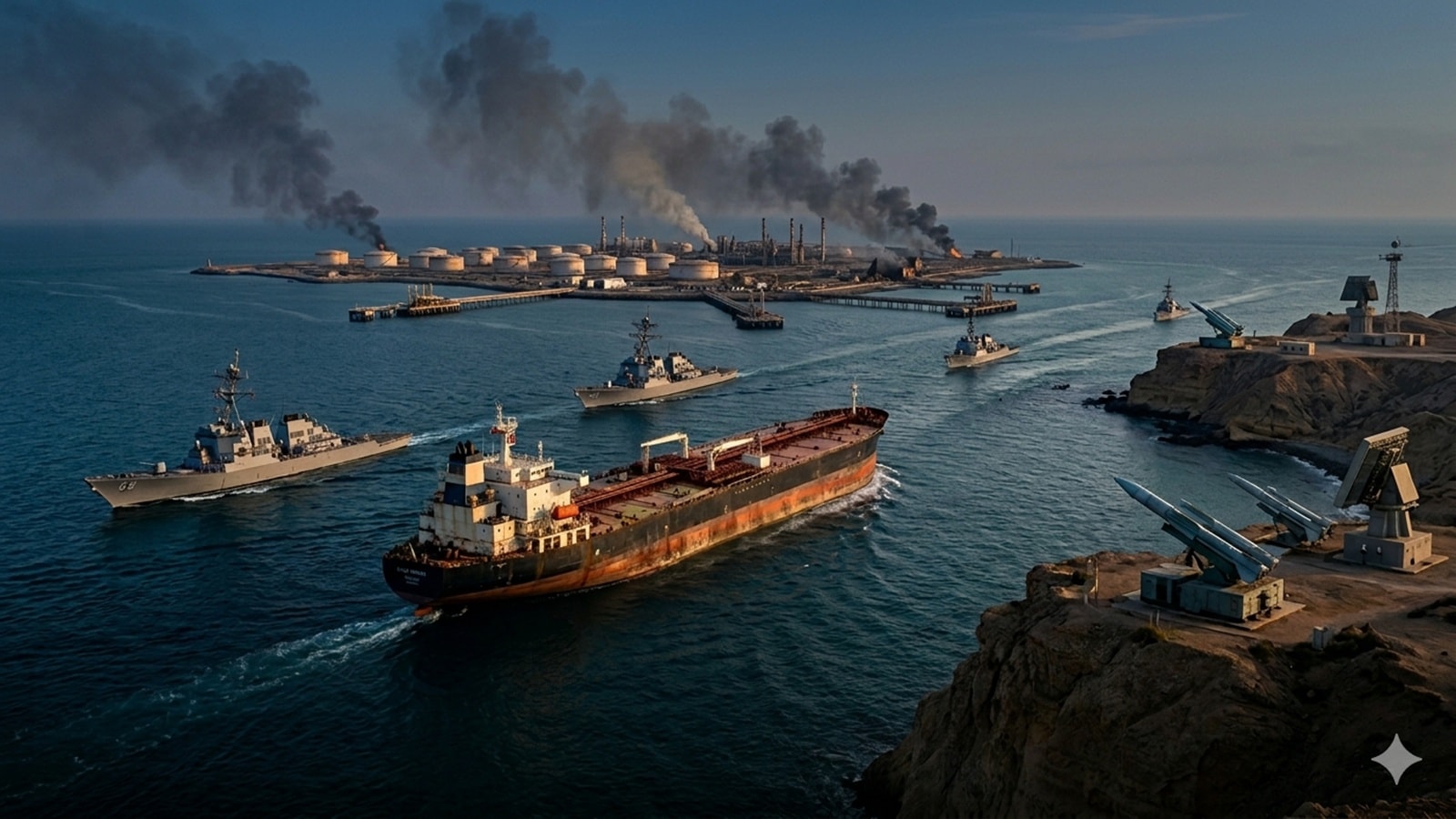
The horizon at the Strait of Hormuz is not supposed to be quiet. It is the jugular vein of the world, a narrow passage where massive tankers, laden with the oil that keeps the lights on in London and the factories humming in Seoul, usually crowd the shipping lanes. But lately, the water has gone still. The rhythm of commerce, that relentless, mechanical heartbeat of global trade, has faltered.
Across the water, the blockade has turned the sea into a graveyard for schedules. Captains sit in their wheelhouses, watching fuel burn while they drift in holding patterns, wondering if today is the day a maritime insurance premium triples or a hull becomes a target.
Far from the saltwater, however, a different kind of movement is beginning.
Consider a hypothetical truck driver named Malik. He sits in the cab of an aging, heavy-duty prime mover on the edge of the Taftan border crossing. The air here is thick, yellow with dust, and tastes of diesel and history. For years, this route has been a secondary thought, a rugged path for smugglers and local traders, a dusty bypass for those who didn't want the scrutiny of the major ports. But today, Malik’s manifest is different. He is hauling cargo that was meant to be on a container ship.
When the sea lanes choke, the land remembers how to breathe.
Pakistan has made a calculated, desperate, and necessary pivot. Faced with the strangulation of maritime routes that threaten to spike energy costs and paralyze local manufacturing, Islamabad has thrown open its emergency land borders with Iran. They are turning the map upside down, swapping the vast, volatile ocean for thousands of miles of arid, unforgiving road.
This is not a simple logistical fix. It is an act of geopolitical survival.
The economics of this are brutal. Shipping by sea is inherently cheap because water supports weight; you can move an enormous volume of goods for pennies per mile. Moving those same goods by truck across the Balochistan desert is expensive. It is slow. It is subject to the whims of weather, the state of crumbling asphalt, and the complexities of regional security. Yet, when the cost of waiting at sea exceeds the cost of fuel for a cross-country drive, the arithmetic changes.
We often think of trade as a digital flow, a series of clicks and lightning-fast transactions in the cloud. We forget the friction. We forget the physical reality of a tire blowing out on a mountain pass in the middle of the night, or the sweating hands of a customs agent looking at a pile of paperwork that hasn't been updated for a crisis of this magnitude.
When I stood on these roads years ago, reporting on the quiet trade that moves through these regions, I learned that borders are rarely lines on a map to the people who live on them. They are economic membranes. They swell and contract based on the pressure from the outside world. Right now, the pressure is immense.
The Iranian government, often isolated by sanctions, finds itself in an unexpected position. They are not just a point of origin for oil or manufactured goods; they have become a relief valve. By facilitating this land bridge, they are signaling to the region that there is an alternative to the Western-dominated maritime order. It is a slow, grinding alternative, but it is one that keeps the engines running.
There is a profound irony here. The world spent decades building the most efficient maritime supply chains in history, creating a system so optimized that the slightest hiccup causes a cascade of failures. We built for efficiency, not for resilience. Now, we are paying the price for that optimization. The "just-in-time" delivery model is shattering, and in its place, we are returning to the ancient, messy, and physical reality of the caravan.
Look at the statistics—if you can find them, as the data in these border regions is often guarded like state secrets. The surge in border crossings at Taftan is not just about a few extra trucks. It is a massive, structural shift. We are talking about hundreds of thousands of tons of cargo being diverted from the safety of the ocean to the vulnerability of the road.
Every truck Malik drives carries a piece of a global economy that is frantically trying to avoid a total shutdown. If he makes it, a factory stays open. If he gets delayed by a landslide or a security bottleneck, a production line somewhere thousands of miles away loses its supply of raw materials. The invisible stakes are staggering.
The uncertainty is what keeps the policy makers up at night. Is this a permanent shift? Will the infrastructure hold? Pakistan’s government is scrambling to pave roads that were never meant for heavy transit. They are hiring, building, and negotiating under the glare of international scrutiny. They know that if they fail to facilitate this flow, the impact on domestic inflation will be catastrophic.
Yet, there is a certain grim beauty in it. As the modern world panics about blocked ships and digital supply chain disruptions, a driver in a dusty truck pulls onto a road, shifts gears, and begins the long haul.
He doesn't care about maritime blockades or the complexities of international trade law. He cares about the road ahead, the next checkpoint, and the hope that his cargo arrives before the market price collapses or the shortage hits the shelves. He is the physical manifestation of resilience, the human element that keeps the global machine from grinding to a complete halt.
We are watching a transition that few anticipated. We are moving away from a world of fluid, effortless commerce toward one where geography matters again. Where the path you take determines whether you survive the day. Where the silence at sea is answered by the steady, rhythmic roar of engines on the desert floor.
The dust settles on the windshield as Malik reaches the next border post. He turns off the ignition. The engine ticks as it cools, a mechanical sigh in the vast, empty landscape. He checks his watch. He has miles to go, and the world is waiting for the goods in his trailer. He restarts the engine, and the heavy vibration travels through his seat, through the frame of the truck, and into the earth itself. The journey is not over. It is only beginning.